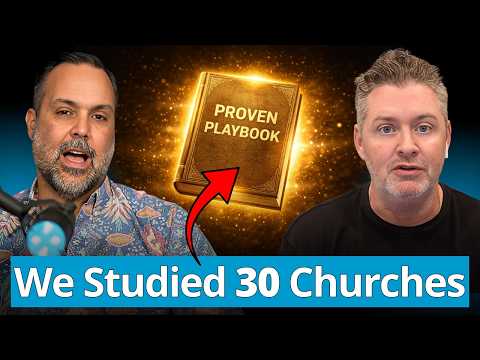
This is not your typical episode. And it is not your typical guest lineup.
Ed Stetzer has probably studied more churches than anybody in America. He’s the Dean of Talbot School of Theology at Biola University, Editor-in-Chief of Outreach Magazine, and a teaching pastor at Mariners Church. Corey Alderin is the CEO and Co-Founder of Sermon Shots — an INC 5000 company now serving over 9,000 churches worldwide.
We brought them both into one conversation to tackle the AI question the church cannot afford to get wrong. Where’s the line with AI and sermons? What does the data actually say about church decline? Why are most churches wasting their best content every Sunday? And what’s it going to take to reach the next generation?
Here’s what came out of it.
Ed Stetzer’s Heart for Small Churches
Before we got into AI, something came up that’s worth mentioning. Ed does something that most leaders at his level don’t do. About 8 to 10 times a year, he tweets an open invitation to any church under 100 people: he’ll come fill in for you this weekend.
He’s preached at Foursquare churches, missionary Baptist churches, Lutheran churches. No requirements. No theological filter. He just shows up.
And on long drives, he’ll tweet his phone number and say, “If you’re a pastor and you need someone to talk to or pray with, drop me a DM and I’ll call you.”
Why does this matter? Because Ed leads a large organization. Talbot is the third largest multi-denominational seminary in the world. He could easily stay in that lane. But he intentionally stays connected to small churches — because, as he put it, small churches are “like yeast getting in the dough, changing the world.”
That posture is actually a big part of why he partnered with Sermon Shots in the first place. More on that in a minute.
The Origin of Sermon Shots
Corey started Sermon Shots out of a different software platform — a design tool. While talking to pastors about how to serve churches, it became clear that smaller and mid-sized congregations were watching large churches crush it with sermon clips and reels and thinking, “I want to do that, but I don’t have the ability.”
The platform was nearly built already. In a couple of months, they pivoted it to focus specifically on sermon content repurposing, handed it to a handful of churches for feedback, and the response was immediate.
Full disclosure from Thomas: “My church is a paying customer. We use Sermon Shots. My social media team loves it.”
What makes it work is the combination of AI-powered moment detection and a design editor that lets you customize everything. The AI finds the best clips from your sermon. You make them yours. And when it started — this is the wild part — it was before ChatGPT even launched. They were using early AI transcription tools before “AI” was even a widely used term.
The Line With AI and Sermons
This is the part that matters most. And Ed didn’t mince words.
He’s a heavy AI adopter. He uses it in sermon prep. He had Christianity Today link to his work with Corey with a mildly critical framing. He’s fine with that. But here’s the line he draws — and it’s a bright one.
“If I have AI do that and then basically I just sort of mouth the words that AI created, I’m not really a teacher or preacher of the word of God. I’m kind of an actor reciting lines.”
Ed uses AI to accelerate the processes he already does in sermon preparation. He’ll ask for four or five ways to think about a passage. He’ll look at illustrations. He’ll check for ways to communicate with more clarity. But the Bible work? The wrestling with the text? The Holy Spirit work? That has to come from the pastor.
Here’s why this matters theologically, not just practically. Ed’s voice is easily replicable by AI. He has about a thousand articles online. His own daughter has typed “in the voice of Ed Stetzer” into ChatGPT just to mess with him. The AI version sounds like him. But sounding like someone and being someone who wrestled with Scripture under the guidance of the Holy Spirit — those are two completely different things.
Your people expect you to have done that work. And if you haven’t, something breaks. Maybe not immediately. But it erodes the trust that preaching depends on.
Where Thomas Has Landed
Thomas was candid about his own evolution. He famously said on this podcast — more than once — “never use AI to write sermons.” His editors even pulled the clip back up a few episodes ago.
He’s softened on that. Not because the principle was wrong, but because the application was too broad.
Here’s what he actually does now:
- Uses AI as a research assistant throughout sermon prep
- Dictated a rough version of his message after doing the observation and Spirit-led work, then had AI help organize his thoughts
- Used AI to help with alliteration on sermon points (Ed’s response: “That’s a Foursquare thing — Baptists would already know how to do that”)
The key: AI never leads the process. It comes in after the hard work is already done.
Why the Pushback on Sermon Shots Is Misplaced
Corey made an important point about the pushback they get. When people push back on Sermon Shots, it’s almost always because they misunderstand what it does. They hear “AI” and “sermons” and immediately jump to “I would never use AI to write my sermon.”
Nobody’s asking you to.
Sermon Shots is all backend. Post-delivery content. It takes the sermon you already preached and helps you repurpose it — clips, reels, social posts. That’s a fundamentally different thing than having AI write your message on the front end.
Ed put it plainly: “The way Sermon Shots is doing things is kind of not particularly controversial.”
Short-Form Video: Why It’s Harder Now (and What to Do About It)
Thomas brought up something we’ve been noticing across the board: short-form vertical video is harder to stand out on than it was a couple of years ago. The heyday was probably 2023. You could post almost anything and get views.
Now? There’s 10 to 20 times more content on these platforms than there was then. Because it worked so well early on, everybody piled in.
Corey’s answer was counterintuitive but backed by how the platforms actually work.
Post more. Not less.
Here’s the logic: the platforms are incredibly good now at knowing who wants to see your content. When you post 10 videos instead of one, you’re not bombarding your followers with all 10. The algorithm sends each one to the people most likely to engage with that specific topic. Different topics hit different people. And the more you post, the more chances you have to hit the one that breaks through broadly.
Thomas made a point worth highlighting about YouTube Shorts specifically: the connection to long-form video on YouTube is massively valuable. You can minister to someone in 45 seconds — but 45 minutes is where you actually unpack Scripture and do the deeper work. Shorts are the on-ramp to that.
Has AI Changed Church Staffing?
This was one of the more honest conversations we’ve had on this topic. The answer across all three: no one has been let go because of AI. But the picture is more nuanced than that.
Ed’s take at Biola/Talbot: With about 200 full and part-time employees, they haven’t made any staffing decisions based on AI yet. They’ve asked staff to look for ways to increase efficiency, but the work is too student-centric and relational to automate in any meaningful way.
Corey’s approach at Sermon Shots: He’s been direct with his team — use AI, don’t be afraid it’ll cost you your job. His actual words: “If you make your job more efficient, I’ll find more work for you.” But he acknowledged the harder question: would he have hired an additional person if AI hadn’t made existing processes faster? Probably not, in some cases. But he believes that efficiency opens doors to entirely new roles that don’t exist yet.
Thomas’s experience at ReachRight: No one was let go. People were pivoted. Blogging used to be a huge part of the business — five or six posts a week with paid writers. That’s shifted. Not because AI replaced the writers, but because the value of that kind of technical content diminished as AI-generated writing saturated the space. Those team members now work on live content and other things.
The line that kept coming up: AI won’t replace you. But someone who uses AI will.
What’s Next: Biola’s Expansion and the Future of Theological Education
Ed shared something exciting. Talbot — which is currently the fastest-growing seminary in the country by organic FTE growth — is launching regional education sites across the country. Classes are already running in Seattle and San Diego, with Las Vegas, Honolulu, and Phoenix coming soon.
The model is what they call “modular cohort hybrid.” You don’t leave your place of ministry. World-class faculty fly in for Thursday-Friday-Saturday intensives. You do online prep work before and follow-up work after. Some sessions include synchronous hybrid participation from other locations.
Why does this matter? Because Ed has seen the pattern: when a pastor from Boise moves to LA for seminary, they often don’t go back to Boise. When someone from Honolulu comes to the mainland to study, they get connected and stay. This model keeps pastors rooted in the communities they’re called to serve.
Technology is driving all of it. And Ed made the connection explicit: the seminaries that are growing are the ones engaging technological tools well.
The AI Tools Worth Your Time
We asked both guests what tools pastors should be paying attention to.
Ed’s daily stack: Sermon Shots (through his team), Logos Bible Software with its AI research tools, and ChatGPT. Simple. Focused. He doesn’t chase 10 tools — he goes deep on the ones that match his actual workflow, which is primarily writing and video-driven.
Corey’s recommendation surprised people: Claude. Not because ChatGPT isn’t good, but because Claude tends to be more creative in its writing output. And Claude Code — while it sounds intimidating — is where Corey sees a real frontier for administrative tasks. He encouraged churches to just watch a video or two and try applying it to one admin task. It opens your eyes to what’s coming.
Both agreed on the bigger point: if you tried AI tools when ChatGPT first launched and walked away unimpressed, you need to come back. The technology 6 months ago is radically different from what it is today. And it will be radically different again in two months.
The Next Frontier for Churches
The conversation kept circling back to one idea: the biggest untapped opportunity for churches with AI isn’t content. It’s operations.
Most pastors are using AI for sermons and social media. That makes sense — it’s the most visible use case. But Ed believes the real frontier is administrative: course planning, resource stewardship, workflow efficiency, organizational systems. He’s putting together a group of denomination and church leaders specifically to share ideas on this.
The churches that figure out how to use AI to be better stewards of their time, money, and people — not just better content creators — are the ones that will pull ahead.
Your Next Step
If you’re a church leader trying to figure out where AI fits in your ministry — or you’re realizing your tech stack needs a serious look — we can help.
We offer a free church marketing and outreach review that covers your website, social media, SEO, and digital strategy. No sales pitch. Just honest, specific recommendations on what’s working and what needs attention.
More Resources
- Churches Are Using AI All Wrong — Here’s What Actually Works
- 5 AI Tools Every Church Should Be Using Right Now
- AI Can Make You a Better Preacher
- The Ethics of AI in Ministry: What Every Pastor Needs to Know
- The Church Tech Trends Worth Your Attention (And the Ones That Aren’t)
- How Smart Churches Are Using AI Prompts to Save Hours