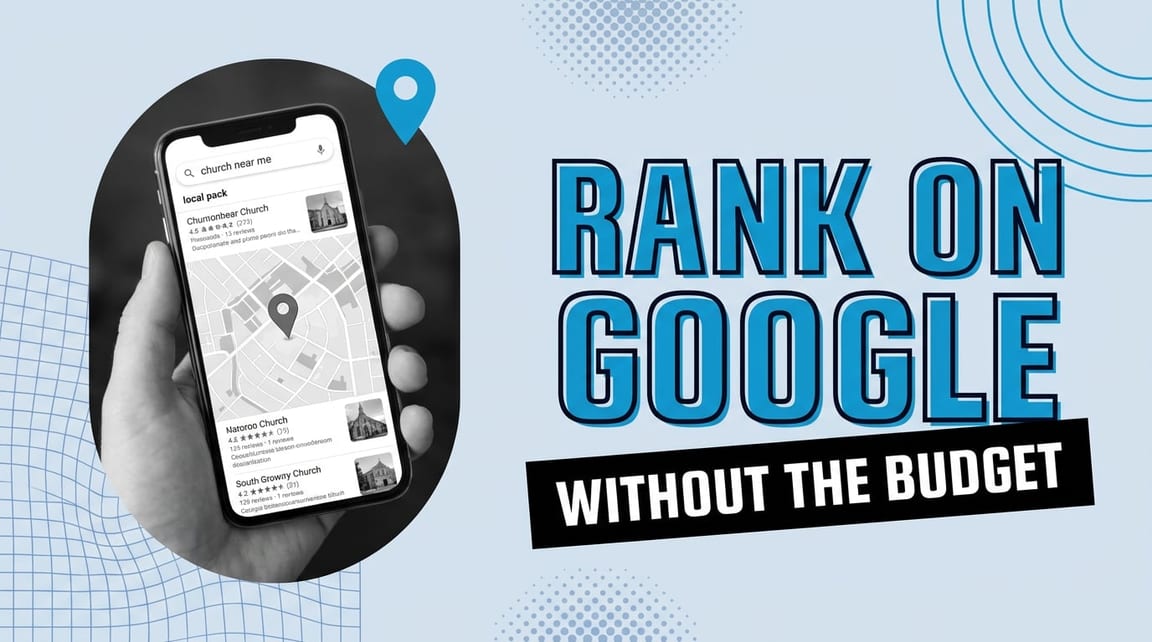
A small church can rank on Google without spending a dollar, because Google’s local rankings don’t care how big your church is or what your budget is. They reward the church that claims its Google Business Profile, collects reviews, and keeps its information consistent. After a decade helping churches get found online at REACHRIGHT, I’ve watched 60-person churches outrank churches ten times their size for exactly this reason. The work is free. The advantage goes to whoever actually does it.
I pastored for 18+ years before this work consumed my weeks, so I know the constraint most of you are under. You’re bivocational, or you’ve got one volunteer running communications between their day job and bedtime, and “do SEO” sounds like one more thing you can’t afford. So let me take the budget excuse off the table right now, then give you the exact order to do the free work in.
Can a small church really outrank a bigger church on Google?
Yes, and it happens constantly. Google’s local rankings have nothing to do with attendance, square footage, or marketing spend. The map results you see when you search “churches near me” are ranked on three things: how relevant your listing is to the search, how close you are to the person searching, and how prominent — how trusted and established — your church looks online.
Notice what’s not on that list. Budget isn’t a ranking factor. Neither is staff size. A 60-person church with a fully completed Google profile and 40 recent reviews beats a 2,000-person church that never claimed its listing. The megachurch has more money and more people, and none of it helps, because they never showed up to do the free work.
Budget isn't your problem. Focus is.
I help my brother Paul run marketing for his pool service in Hawaii Kai on the side. One guy, one truck, no ad budget. He outranks bigger pool companies on Google for our neighborhood because his profile is complete and his customers leave reviews. Same playbook works for a church. The platform doesn’t know or care that you’re small. It only knows whether you did the things it rewards.
What does Google actually look at? (In plain English)
You don’t need to understand algorithms. You need to understand three words, because Google’s own documentation says local rankings come down to them: relevance, distance, and prominence. Nearly half of all Google searches have local intent, according to 2026 local search data, so these three words decide whether your church shows up for a huge share of what people type.
- Relevance is how well your listing matches what someone typed. If a person searches “non-denominational church near me” and your profile clearly says you’re a non-denominational church, you’re relevant. If your profile is half-empty, Google can’t tell.
- Distance is how close your building is to the searcher. You can’t move your church, so this one’s mostly out of your hands. But it’s also why small churches can win — you’re competing for the people right around you, not the whole city.
- Prominence is how established and trusted your church looks online. Reviews drive this. So do consistent listings across the web and a website that actually works. This is where most of your free wins live.
Two of the three are entirely in your control. That’s the whole game. For the deep version of how these factors play out in the map results, our complete local SEO playbook for churches walks through every lever in detail. This post is the triage order — what to do first when you’ve got an hour and no money.
The free-first priority stack: 5 moves in order
Here’s how small churches rank on Google without a budget: five free moves, done in this order. Order matters. I’ve seen churches waste months tinkering with website keywords while their Google Business Profile sat unclaimed, which is like repainting the sanctuary while the front door is locked. Do these in sequence. Each one is free.
- Claim and complete your Google Business Profile. It's free, it's the single biggest ranking factor, and a fully optimized profile can land you in the map results in 30–60 days. Fill out every field: category, description, hours, service times, phone, and 10+ real photos. Time: 1–2 hours up front.
- Start collecting Google reviews. Reviews are one of the heaviest prominence signals you can influence directly. Ask members in person, by text, and with a QR code in the bulletin. Time: 15 minutes to set up, then ongoing.
- Make your name, address, and phone identical everywhere. Google cross-checks your info across the web. "123 Main Street" on Google and "123 Main St." on Facebook sends a mixed signal that drags you down. Time: an afternoon to audit and fix.
- Put your location and service times on your website. Say your city, your neighborhood, and when you meet — in plain text, on your homepage and contact page. If you don't say it, Google can't know it. Time: 30 minutes.
- Make sure your site loads fast on a phone. Most "churches near me" searches happen on a phone, and a slow mobile site quietly costs you visitors and ranking. Time: 30 minutes to test and flag fixes.
Step 1 is non-negotiable: your Google Business Profile
If you do one thing, do this. Your Google Business Profile is the free listing that puts your church in the map results, on Google Maps, and in the little info panel on the right side of search. A fully optimized profile can produce map-pack rankings within 30–60 days, and it costs nothing to create or maintain, according to small-business SEO data for 2026.
Go to business.google.com, search your church, and either claim the existing listing or create one. Then fill out everything — a claimed-but-empty profile barely helps. Our Google Business Profile guide for churches has the field-by-field walkthrough if you want it.
Step 2: reviews are your great equalizer
After the profile itself, reviews move the needle more than anything else a small church can control. They also do double duty: they help you rank and they help you convert. When someone sees your church has 40 reviews at 4.8 stars next to a bigger church with 6 reviews, guess who they’re visiting Sunday.
You don’t need a campaign. You need to ask. A personal text from a pastor — “So glad you’ve been part of the family. Would you take 30 seconds to leave us a Google review? It helps other families in town find us” — works better than anything fancy. Our guide on how to get more Google reviews for your church has the exact scripts.
Steps 3–5: the foundation under everything
Fix your name, address, and phone so they match everywhere online — Google, Facebook, Yelp, your denomination’s directory, your own website. Then make sure your website plainly states where you are and when you meet. Then test your site on a phone and flag anything slow or broken. None of this is glamorous. All of it tells Google you’re a real, active church at a real address, which is exactly what prominence is built on.
How a busy church does this in about an hour a week
The reason most churches don’t rank isn’t that the work is hard. It’s that it dies after week one when the volunteer who started it gets pulled into forty other things. So here’s the realistic cadence. Treat it like a standing appointment.
| When | What to do | Time |
|---|---|---|
| Week 1 (one-time setup) | Claim and fully complete your Google Business Profile, fix your NAP everywhere, add location and service times to your site | 3–4 hours total |
| Every week | Ask 1–2 people for a Google review, reply to any new reviews, post one update on your profile (sermon topic, event, encouragement) | ~30 minutes |
| Monthly | Add a few fresh photos, check your profile insights, scan for any new directory listings that need fixing | ~30 minutes |
That’s it. About an hour a week after the initial setup. I grew The Journey in Madison from 30 people to 150 over six years, and the unglamorous truth is that the things that compound — showing up, staying consistent — beat the things that feel exciting. Local SEO is the same. Consistency is the strategy.
What NOT to spend money on yet
Here’s where small churches with a little bit of budget get it backwards. The moment they decide to “invest in marketing,” they go buy ads — while their free Google profile sits unclaimed. That’s spending money to rent visibility you could own for free.
Until the five free moves above are done, skip the paid Google Ads, skip the $200–$3,000/month SEO retainer, and skip the paid “get listed in 500 directories” tools. The free tools do the job — we keep a list of the best free SEO tools for churches if you want them. Spend your money on ministry until the free work is maxed out.
When is it worth paying for help?
The free playbook has a ceiling, and you’ll know when you hit it. It’s usually one of three things: you’re running multiple campuses and the listings get complicated, you genuinely don’t have the hour a week and it keeps falling through the cracks, or you’ve done everything right and plateaued behind tougher competition in a big city.
That’s the point where hiring out makes sense, and the math holds up — local SEO for churches typically runs $200–$500/month, and the traffic is high-intent because these are people actively looking for a church to attend. But notice the order: you pay for help to break through a ceiling you’ve already reached on your own, not to skip the free work. The churches that get the most out of paid help are the ones who did the fundamentals first.
You hire help to break a ceiling — not to skip the free work that gets you there.
Why this matters for a small church
The stakes here are higher than rankings. When someone in your town goes looking for a church, they’re often in a season when they actually need one. They just moved. They’re grieving. A friend finally invited them. And 76% of people who run a local search visit within 24 hours, so this isn’t a slow trickle of traffic. It’s someone deciding where to show up this Sunday. If your church isn’t in those top three map results, you’re invisible to the person God may have moved into your neighborhood last week. Not ranking lower. Invisible.
The good news is the one I started with. None of this requires a budget. It requires an hour a week and the discipline to do the free things in order. A small church can absolutely win this. Most just never start.
Frequently Asked Questions
Done the free work and still feel stuck?
My team will take a free look at where your church stands in local search and tell you exactly what's holding you back — no budget required, no hard sell.
Thomas Costello is the Founder & CEO of REACHRIGHT (since 2016) and Executive Pastor at New Hope Hawaii Kai. He’s pastored for 18+ years — including growing The Journey in Madison, WI from 30 to 150 — and his team has helped hundreds of churches get found in local search.
More Resources for Small Churches
- Local SEO for Churches: The Complete Guide — the full playbook when you’re ready to go deeper
- Google Business Profile for Churches — the field-by-field setup walkthrough
- How to Get More Google Reviews for Your Church — scripts and tactics that don’t feel awkward
- NAP Consistency for Churches — fix your contact info across the web
- Best Free SEO Tools for Churches — the free stack that does the job
- How Much Does Local SEO Cost for Churches? — what to expect when you’re ready to pay for help