

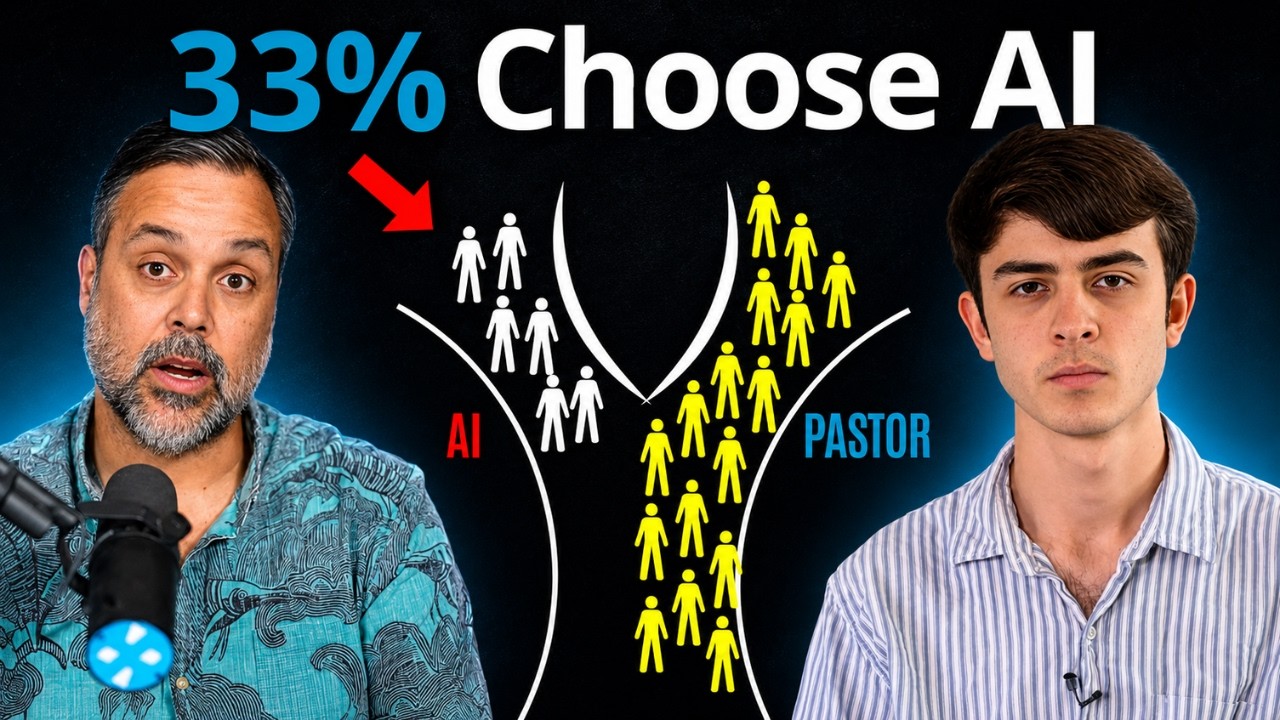
A third of practicing Christians say they trust spiritual advice from AI as much as advice from their pastor.
Read that again. Not “have used ChatGPT for a Bible question once.” Not “think AI is interesting.” Trust it as much as their pastor. For Gen Z and millennials in the pews, that number climbs to roughly 40%. This isn’t a future problem to think about at a leadership offsite next year. The people sitting in your sanctuary on Sunday are already doing this, on their phones, on Tuesday night, with the lights off.
That’s the Barna number that should be on every pastor’s desk this month. And the honest response isn’t outrage — it’s curiosity. Why is this happening? What gap did the church leave open that a chatbot quietly filled? And what can you do about it before the number is 50%?
This episode is the unflinching version of that conversation.
The Numbers, Briefly
You don’t need a long stats dump, but a few are worth naming:
- 34% of practicing Christians say they trust AI’s spiritual advice as much as their pastor’s. (Barna/Gloo, Nov 2025)
- 39–40% among Gen Z and millennial practicing Christians.
- 4 in 10 Christians say AI has already helped them with prayer, Bible study, or spiritual growth.
- 31% of practicing Christians say they want their pastor to teach on AI.
- 12% of pastors say they feel comfortable doing so.
- 65% of pastors worry AI could displace their guidance — and almost none are addressing it from the pulpit.
That last pair is the one we keep coming back to. Pastors know this is happening. Pastors are worried about it. And pastors are mostly silent on it. Silence is its own message: if the pulpit doesn’t engage with the most disruptive consumer technology of our lifetime, the people in the pews assume the church has nothing to say. They don’t go without an answer — they go somewhere else for one.
Why People Choose a Chatbot Over Their Pastor
If you’re a pastor reading this, the temptation is to make this about discipleship failure or theological drift. Sometimes it is. But more often, the reason is much more practical, and much more uncomfortable.
People are choosing AI because it does four things the church often doesn’t.
1. It’s available at 11:47 PM on a Tuesday
The hardest moments — a fight with a spouse, an intrusive thought, a question about a verse, a fear about a kid — almost never happen between 9 and 5. They happen late. They happen in the car. They happen the night before a hard conversation. The church’s pastoral access model is, with rare exceptions, built around appointments, office hours, and “let’s grab coffee next week.” ChatGPT responds in eight seconds, every time, at any hour, with no apology for the timing.
2. It’s anonymous
A lot of what people actually need help with carries shame. Pornography. A faltering marriage. Doubt. Same-sex attraction. A drinking problem. A child who’s deconstructing. The math for the person in your pew is brutally simple: if I ask my pastor, somebody at this church will know. If I ask the chatbot, nobody will.
That’s not a theological failure on their part. That’s a human one we should expect.
3. There’s no perceived judgment
Whether or not pastors are actually judgmental is almost beside the point. The perception that bringing a hard question to a pastor will result in a follow-up call, a recommended small group, an invitation to a recovery ministry, or a look — that perception is the friction. AI doesn’t react. It doesn’t recommend you talk to so-and-so. It just answers.
4. The answer is instant
Even when a pastor does respond well, the response time is measured in days. Sometimes weeks. By the time the conversation happens, the moment is gone. AI is real-time. For a generation raised on real-time everything, “I’ll get back to you next week” is functionally the same as “no.”
The uncomfortable truth in those four points: the church didn’t lose to AI on theology. It lost to AI on access, anonymity, and speed. AI didn’t take ground. It walked into ground the church had already left empty.
What AI Actually Gets Wrong (And Your People Don’t Realize)
None of the above means a chatbot is a good substitute for a pastor. It isn’t. But the failure modes are specific, and naming them precisely is what gives your sermon, your small group, your one-on-one its leverage. Vague “AI is dangerous” warnings bounce off. Specific ones land.
The four real problems:
AI is a yes-machine
Large language models are trained, very intentionally, to be agreeable. They mirror the user’s framing, soften disagreement, and produce a response designed to feel helpful. That’s a fine quality for drafting an email. It is the opposite of what discipleship requires.
Discipleship requires somebody who’ll tell you the marriage you described isn’t a personality-conflict problem, it’s a sin problem. Somebody who’ll push back when you’re rationalizing. Somebody who can say “what you’re describing is a pattern, and you need to repent of it, not strategize around it.” A chatbot designed to maximize user satisfaction will not, on its own, do that. Ever.
It blends traditions without flagging the seams
Roughly 22% of users in the Barna research reported doctrinal errors when they checked AI’s spiritual answers. The errors weren’t usually wild — they were subtle. A Reformed framing of grace stitched onto a Wesleyan view of sanctification, or a Catholic view of communion served up next to a Baptist one, with no acknowledgment that those are different theological homes. The user has no idea. They get a smooth, confident answer that quietly papers over centuries of careful disagreement.
People raised in a single tradition don’t notice. They walk away thinking they got “the Christian answer” when they got an averaged-out compromise.
It can’t be present in the room
A chatbot cannot sit in a hospital. It cannot lay hands on the sick. It cannot show up at a funeral. It cannot bring a casserole. It cannot baptize. It cannot serve communion. The ministry of presence — which is most of the actual job — is something AI structurally cannot do. The danger isn’t that people will replace pastoring with a chatbot in those moments. The danger is that they’ll get so much of the verbal, advice-shaped portion of pastoring from the bot that they stop noticing when the embodied portion is missing entirely.
It pulls toward isolation, not community
This is the quiet one. Every spiritual question someone answers with a chatbot at 11 PM is a question they didn’t bring to a small group, didn’t text a friend about, didn’t carry into Sunday. Multiply that across years. The person ends up with a personal, private, “answered” spiritual life and a slowly thinning thread of actual relationships in the body of Christ. The more answered they feel, the less they think they need the church. That’s not a tech problem. That’s a discipleship trajectory.
The Guidance Gap
Here’s the part that should sit with leadership the longest:
31% of practicing Christians want their pastor to teach on AI. Only 12% of pastors say they feel comfortable doing so.
That’s a roughly three-to-one demand-to-supply mismatch on the most consequential consumer technology in a generation, within the church. The people in your pews are asking — sometimes explicitly, more often through their behavior — for the church to weigh in. The pulpit is mostly silent.
And silence reads as permission. If pastors say nothing about AI for two years, the average Christian listening rationally concludes one of two things: either there’s nothing to say, or my pastor doesn’t have a view. Both conclusions push them further toward the chatbot, not less.
This isn’t a tech problem. You don’t need to understand transformer architectures to preach on this. You need to be willing to name reality from the pulpit and offer biblical guidance on how to think about a tool your people are already using.
That’s a leadership opportunity, not an IT one.
What Your Church Can Do This Week
Vague advice like “be more present” or “engage with AI” is part of how we got here. Below is the specific version. Pick two and do them. Not all of them at once.
1. Lower the barrier to pastoral access
The “schedule a meeting” model is broken for the late-night questions that drive people to chatbots in the first place. Try one of these instead, this month:
- An anonymous question form on your website. One question per week answered from the pulpit, in a five-minute “Pastor Q&A” segment.
- A text-a-pastor line. Real number, real human, 24-hour response window. (You don’t have to answer at 2 AM. You have to respond within a day.)
- Open-door hours — one weekday morning where the pastor is at a coffee shop, no appointment needed, anyone can drop in.
2. Preach on AI directly — at least once this quarter
You don’t have to be a tech expert. You have to be willing to name what’s happening. A sermon doesn’t have to be “AI is good” or “AI is bad” — it can be “here’s what we use AI for as a church, here’s where we’d warn against it, and here’s why a chatbot can’t replace what God designed pastoring to be.” Your people will exhale just hearing you address it.
3. Build genuinely anonymous pathways
A community where people can’t say the hard true thing without social cost is a community where chatbots will keep winning. What does an anonymous prayer request actually look like at your church? What does a small group designed around honesty (not just curriculum) look like? Are there any spaces where someone can ask “is what I did last weekend disqualifying?” without it becoming everyone’s business by Wednesday?
This isn’t soft. This is foundational.
4. Don’t demonize AI — redirect the impulse
Someone googling “what does the Bible say about anxiety” at midnight is still searching for something true. That instinct is a gift. The wrong response is to scold them for going to ChatGPT. The right one is to make sure your church is in their answer when they search: a great church website with real content, AI-discoverable information, a sermon archive that actually answers the questions people are typing in.
In other words: get into the room where the search is happening.
5. Audit your pastoral response time
This is the unglamorous one. How long does it currently take, on average, between a church member reaching out for a real conversation and that conversation happening? If the answer is “a couple weeks,” you’ve already located the problem. The fix isn’t to work the pastor harder. It’s to build a layer between the front door and the pastor’s calendar — trained lay leaders, a care team, deacons — who can have the first conversation within 24 hours.
The goal isn’t to make the chatbot wait. The goal is to be visibly faster than zero.
The Real Question
Step back from the tactics for a minute.
Barna’s broader data — the trust survey that doesn’t even mention AI — says only about a third of U.S. adults consider pastors a trustworthy source of wisdom. A third. That number isn’t about AI at all. It’s a pre-existing condition.
Which means the honest framing of this whole conversation might be: AI didn’t create the church’s trust gap. AI just made it visible. The chatbot is a thermometer, not a thermometer-breaker. It surfaced something that was already true about the relationship between the average person and the average pastor in America — and it gave that person a working alternative at the exact moment they needed one.
That’s a hard read. It’s also a useful one. Because if the gap is older than ChatGPT, then closing it isn’t a technology project. It’s a leadership project. And it isn’t accomplished by banning, lamenting, or out-engineering the AI. It’s accomplished by becoming the kind of pastor — and the kind of church — that people would rather talk to.
The question for every leader reading this:
In five years, will your church have responded to this honestly — and become more available, more present, more trustworthy as a result — or will it still be pretending it’s not happening?
The answer to that is already being decided. Quietly. On phones. At 11:47 PM. Every week.
Your Next Step
Not sure where your church stands on any of this — your AI search visibility, your pastoral response time, your digital front door? We offer a free church marketing and website review. Our team will look at how findable, fast, and substantive your church is online, and send back honest, specific recommendations you can actually use. No sales pitch. Real feedback.
Turnaround is about 48 hours. It’s free for any church that asks.


