Most churches have a social media presence. Very few have a social media strategy.
That gap is the whole story. It’s the line between the churches that are quietly winning online and the churches that are pouring hours into posts that go nowhere. And the good news is that the difference isn’t talent, budget, or a viral personality. It’s a plan — a repeatable playbook you execute week in and week out.
So that’s what this is: what the winning churches are actually doing differently, and the specific moves you can steal starting this week.
First, a Confession About “The Stat”
For two decades now, we’ve all been quoting the same line: 70% of people engage with your church online before they ever walk through the doors. We’ve heard it for 20 years, and honestly? We can’t tell you where it comes from. If anybody has a real source for that number — something more than “a guy said it once at a conference” — we’d genuinely love to see it.
We don’t doubt it’s roughly true. What’s changed is where that first engagement happens. In the beginning, it meant your website — someone stumbling onto your site before visiting. That still happens. But today, people are far more likely to be introduced to your church on social media than to trip over your website on their own. Social is now the front porch, and often the second step too: someone hears your church’s name, then goes to Instagram to size up your community before they commit a Sunday.
That’s why we keep coming back to this topic. It’s not that social media is trendy. It’s that it’s become one of the primary ways people discover — and vet — a church.
How to Spot a Church That Has a Plan
Here’s the tell. You can walk up to any church’s social account and know within about five seconds whether there’s a strategy behind it. A few dead giveaways:
The posts are current. We once pulled up a church’s Instagram in April, and the most recent post was a Christmas announcement. Seasonal posts are the worst offenders when they go stale like that. It gives the page this abandoned, Wild-West-ghost-town feel — tumbleweed rolling across an empty street, and you’re standing there wondering, is this church even still around? Flip it around: if the last post was two days ago, that communicates something completely different. This church is alive. Things are happening here.
The posting is consistent. This is the biggest one. Churches with a plan can execute the same thing every single week, so you can basically read the strategy off the posting frequency. And here’s what a lot of churches miss — we don’t even care that much what the plan is. One good post a week, every week, beats five posts one week, then three weeks of silence, then two posts, then seven weeks off. Training yourself to do the same thing on the same schedule is the whole game.
There’s a story up. This one is subtle but real, especially on Instagram. When you’ve posted a story in the last 24 hours, your profile picture gets that red ring around it. Even if nobody taps it, that ring is a vital sign. For anyone raised on Instagram, it’s an instant, subconscious signal that a church is alive and doing things throughout the week — not just showing up on Sundays.
Stories Are Internal. Posts Are External.
That last point deserves a nuance we’ve been chewing on. Stories and feed posts do two different jobs.
Stories lean internal. They’re delivered primarily to your existing followers — the people already connected to you. That makes stories the perfect place for the occasional in-house announcement. We had this exact conversation about a worship night at our church: how do we promote it? A worship night is a smaller, more internal service — most of the town doesn’t care about it, and that’s fine. Stories are where that kind of invitation belongs, because your followers are the ones most likely to see it.
Feed posts lean external. They get pushed out to people beyond your followers, which means they’re your real reach engine to the community.
And here’s the philosophy underneath all of it: we’d rather see social media used to do ministry online than to constantly invite people to the place where the real ministry happens. Don’t get us wrong — people should be in the room on Sunday morning. But use your feed to actually impact people where they are, not just as an invitation system. If you need to sneak in a promotion, stories are the place to do it.
The Playbook
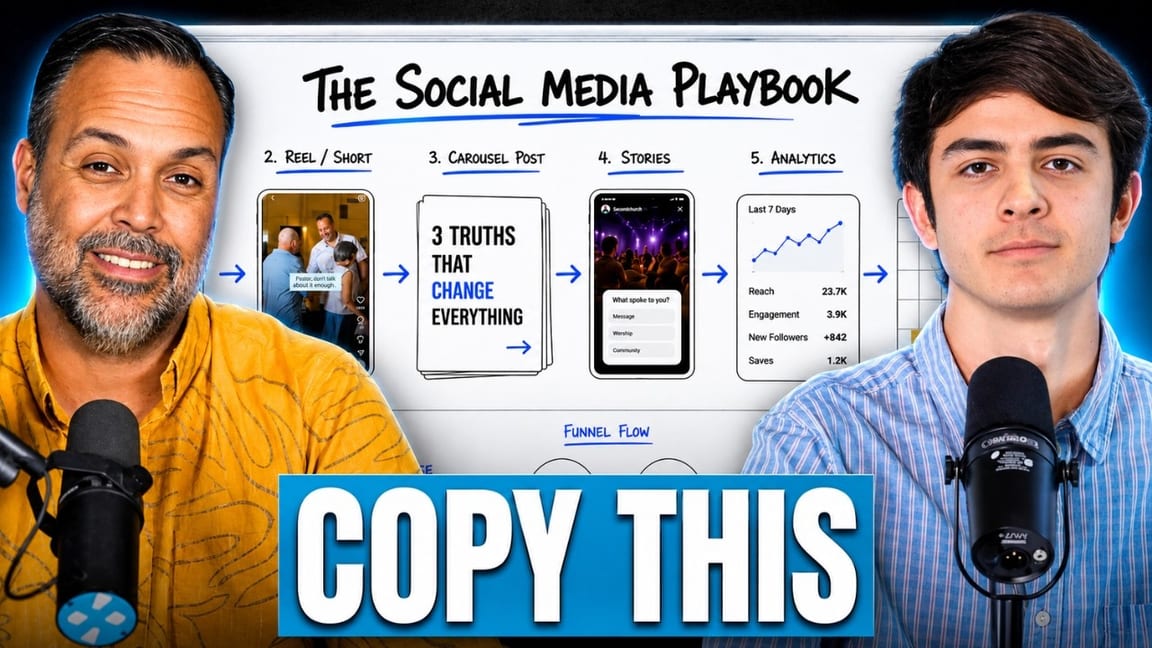
Okay — here’s the actual playbook. Six plays.
1. Get consistent (this is the whole foundation)
Instagram, TikTok, all of these platforms heavily reward consistency over the one perfect post you sank ten hours into. The reason is simple: these are businesses, and they like accounts that show up on their platform a lot. Consistent posting signals “I’m here often,” and they reward that by pushing your content to more people.
Is there a perfect number? Probably. Daily is the theoretical ideal — there’s even some evidence your results dip if you post more than once a day. But daily isn’t realistic for most churches, and we never want that to be the reason you do nothing. So here’s the practical target: if you’re at zero or total inconsistency, get to three posts a week. If you’ve got the team to do more, work toward daily — and once you’re there, pour the extra energy into making that one daily post better rather than cranking out two.
Then get specific. Don’t just say “three times a week.” Say: “We post Mondays, Wednesdays, and Saturdays at 3:00 PM.” Nail down the exact days and times so you’re never tempted to cram three posts into Friday-Saturday-Sunday. The time itself barely matters — post when your people are active if you can, but these posts have a long enough shelf life now that anytime works. The one window we’d avoid is around 9:00 PM local, when your first viewers are asleep.
2. Post for the 95%, not the 5%
This might be the number one trap churches fall into: posting exclusively for the people already in the pews, with zero thought for everyone who’s never heard of you. Think about it — the vast majority of people in your town do not attend your church. Only a small percentage do. So if you want to get noticed and get people in the door, post primarily with that audience in mind — the people who don’t know your church, your people, or your inside language yet.
Here’s the mechanical reason this matters so much, and it comes down to how the algorithm works. When you publish a post, the platform doesn’t show it to everyone at once. It sends it to a small sample first — say 20 people, a mix of your followers and random people from your area — and watches. Did they stop scrolling? How long did they look? Did they swipe through the whole carousel? Did they like, comment, share? Remember, the platform has exactly one goal: keep people on the app looking at ads. It does not care about delivering good church content.
So when you post something purely internal — an announcement that means nothing to the 95% who aren’t part of your church — it flops with that test audience, and the algorithm reads that as “bad post” and shows it to fewer people. The fix is to lean hard into content that’s valuable to anyone in your area who might see it. This is exactly why skits, Bible quizzes, and other location-neutral content tend to pop up on your feed — that stuff is universal. It travels.
Think of every post as a test: you’ll get more views both inside and outside your church when you aim at the broader audience instead of the narrow one. And this isn’t Instagram-only. Try posting insider language to TikTok from your church account — trust us, it will go absolutely nowhere. Content anyone could watch does far better.
If you’re realizing you only ever post for your followers — that’s normal. It’s how it used to work. This is just the adjustment to how things run now.
3. Make the sermon your primary content engine
If you’re posting three times a week, the obvious question is: what are those posts? Our answer: the sermon can fuel almost all of it. Clips, quotes, questions, carousels, stories — nearly everything can come from the message that was preached last Sunday.
This goes beyond social, honestly. The churches reaching the most people are great at keeping their messaging tight — the Sunday sermon shows up in small group discussion questions during the week, in follow-up emails, in the calls to action they keep reinforcing. Social media is just one more channel for that same unified message. A few ways to pull it off:
- Sermon clips. Take the highlights and whittle them down to 25–45 seconds for Instagram Reels, TikTok, and YouTube Shorts.
- Carousels. Build out the problem the sermon addressed and walk toward the answer (more on carousels below).
- Text-on-screen videos. Take the central verse or a key quote and lay it over footage — ideally a local landmark. We just made one with waves crashing at a lookout over the water near where we live, with a verse from Matthew we’d recently preached on. Familiar imagery like that pulls people in.
One hill we will die on: the most valuable content is still real people from your church. Wherever possible, combine the two. Say you preached on Acts 2 — the disciples meeting in each other’s homes, sharing meals, everything in common. Instead of a generic graphic, make a video of B-roll from your own church: people hugging, greeting, doing life together, with that verse over the top. That’s the combination that works — your message plus authentic imagery of your actual people.
How to build a carousel from a sermon
Quick clarification in case it’s new: a carousel is one of those Instagram posts that’s really a little slideshow — people see the first slide and swipe left to right through the rest. Here’s the structure we use for the carousels we write at REACHRIGHT:
- A hook so strong it stops the scroll. The text on your first slide has to grab attention and make people want to keep swiping. The best shortcut here is to study what successful accounts do — their wording, their pacing, how many slides they run.
- A transition slide. Clarify what the hook was about and move people into the body.
- The body. If it’s takeaway questions from Sunday’s sermon, that’s question one, question two, question three, and so on.
- A call to action. Usually we want a comment — “Which of these is the one you most need to sit with this week?” Comments tell the algorithm the post is worth pushing.
We’ve found the sweet spot is about eight to nine slides per carousel. And here’s something not to sleep on: right now, we’re seeing carousels outperform reels for churches on average. Everyone piled onto reels hard, and they’re still great — but carousels are pulling more consistent engagement, and we rarely see a dud. Occasionally a reel blows everything out of the water, but you don’t get that consistency. There’s something about a person actively reading and swiping that’s just more valuable.
Best of both worlds? Photos of your people with the text burned in on top. And you can make all of this in Canva — it’s not hard, and if your church qualifies for Canva for Nonprofits, you unlock a ton of it for free.
4. Choose authentic over polished
We’ve said this before, so we’ll keep it short: right now, in 2026, “authentic” content is outperforming “polished” content — especially on Instagram and TikTok. By authentic we mean the video clearly shot on an iPhone of someone just talking to camera and sharing their heart. By polished we mean the highly produced, color-corrected, shot-on-a-DSLR piece. Counterintuitive, we know. But that heavily produced look increasingly reads as ad — a business or corporation running a campaign — and people scroll right past it.
This whole podcast is our example of unpolished, by the way. One take, no cuts, the ums left in, off the cuff with a few notes. And here’s what we’ve found: unpolished is better at building trust. It’s why people are so faithful to podcasts — they feel like they actually know the hosts. You don’t get that from a glossy promo video.
For a church, your polished content is probably already happening on Sunday — the sermon, the clip you cut and color and make look great. Your unpolished content is the conversational, off-the-cuff stuff that builds real relationship. Both have a place. But for churches with limited time and resources, lean into the authentic side and just grip it and rip it. The paralysis of “it’s not good enough to post” is the real enemy. The worst thing that happens is a post doesn’t get shown to many people. Get over the fear, get out there, and make content.
5. Make Instagram your hub (but don’t sleep on YouTube)
By now it’s probably obvious: Instagram is the hub. Somewhere around 80–88% of Facebook, TikTok, and X users are also on Instagram, and plenty of people use Instagram and none of the others. So make it your main platform, then cross-post from there to TikTok and Facebook.
In a perfect world you’d make unique content for every channel — different cuts for different demographics. Nobody in a typical church has time for that. So make one video, write unique captions per platform, and cross-post the same content everywhere. If you assigned a generation to each platform, it’d look roughly like this:
- Facebook → Boomers and Gen X
- Instagram → Millennials
- TikTok → Gen Z
- YouTube → Gen Alpha
Instagram sits right in the middle of that age range, which is exactly why it’s the smart default target.
Now the caveat we can’t let go: we’ve been talking as if YouTube isn’t social media — but it absolutely is, and for churches it might be the most valuable platform of all. Most of you are already using it. You’re already uploading your showpiece content — the full sermon — every single week, which means you likely already have an audience there. YouTube Shorts in particular is a great place to build right now; there are more people watching Shorts than you’d expect, and brand-new accounts are pulling real views fast.
The deeper value for churches: someone who engages with your Shorts is far more likely to click into your long-form content — and watching a full 30- or 40-minute sermon because a Short pulled them in is enormously valuable. The other platforms just don’t do long-form well. Long horizontal videos on Facebook get very minimal results, because nobody goes there to watch them. YouTube is the opposite.
One practical exercise: build an avatar for your social posts. Picture one specific person — probably someone who doesn’t know your church yet, probably a little younger than your current crowd, and probably meeting you on Instagram first. Make your content for them.
6. Measure reach, not followers
Follower count is a metric, and it matters. But in this algorithm-driven era, reach, watch time, and engagement matter far more than how many people are subscribed to you.
We spent this whole playbook talking about targeting the 95%, not the 5% — and your follower count is your 5%. It’s a measure of how big your in-house audience is. There’s real value there; bigger channels do get bigger reach, that’s just how it works. But the number to actually watch is engagement and reach on your posts, not follower count — which is a bummer, because followers are the one number everyone can see and compare.
So build a social media scorecard. Ours lists followers, sure, but it spends far more time tracking engagement and reach. How many comments? How many shares? How many views per post? And then — the part that matters most — do something with that information. When you notice a certain kind of content pulls big reach and church announcements pull almost none, make the course correction. That’s what social media really is: a giant A/B test, engineered to reward you for repeating what works and quietly punish you for what doesn’t.
Which raises the obvious tension: we’re not going to compromise the gospel just because a certain post underperforms. If the gospel isn’t landing in one format, we don’t shy away from it — we find new ways to tell the story. New wineskins for the same unchanging message, so it reaches the widest audience we can carry it to.
The One Thing to Do This Week
If you do nothing else after reading this, do this: get out a piece of paper or your phone, pick the days you’re going to post, and commit. Not someday — today. Write it down like a promise: “We will post three times a week, on these days, at this time, for the next 52 weeks.” Consistency is the thing that never happens by accident, and it’s the single biggest difference between the churches that are winning and the ones that aren’t.
And a word to pastors: if you’re reading this thinking I cannot do this myself — you’re right, and that’s normal. For most pastors, this is too big a burden to carry alone. You need a champion — someone at your church who owns this and executes it week after week. Done well, it takes real hours every week, so find the person who can give it that time. (We’ll go deep on exactly how to build that role in an upcoming episode.)
If you genuinely can’t find that person in-house, that’s the one thing we can take off your plate entirely — see below.
Your Next Step
Not sure how your church’s social media actually stacks up? We offer a free church marketing and website review. Our team will look at your social presence, your website, and your overall digital strategy, then send back honest, specific recommendations you can actually use. No sales pitch. Real feedback.
Turnaround is about 48 hours. It’s free for any church that asks.
And if the real problem is capacity — no champion, no hours — we also run social media management for churches, handling the posting, the clips, and the carousels so your team doesn’t have to lift a finger. It’s often cheaper than hiring in-house. Just mention it when you reach out.