Gen Z churchgoers now average 1.9 weekends a month. That beats Gen X at 1.6 and boomers at 1.4. The generation everybody assumes is checked out is, in fact, the most committed once it shows up.
So why is your church spending money on fog machines and TikTok trends to reach them?
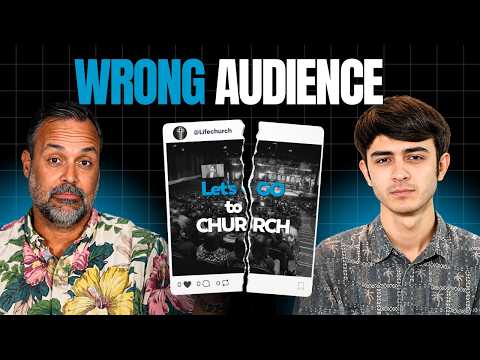
This episode is a conversation with Shiloh — one of the most visible Gen Zers on the ReachRight team — about why the way most churches chase young people is backwards. Not malicious. Not even wrong-hearted. Just ineffective. And in a lot of cases, the harder a church tries to look young, the faster the young people walk the other way.
Read That First Stat Carefully
Before anyone runs a victory lap, the 1.9-weekends number needs an honest asterisk. It does not mean most of the people in your building are Gen Z. It doesn’t even mean Gen Z is the most likely generation to attend church at all — they’re actually the least likely to walk in the door in the first place.
What the stat measures is frequency among the ones who do come. Gen Z attenders are the most committed attenders. The people in that generation who’ve decided church is for them are all in. That’s a genuinely good sign — but it’s a different sentence than “Gen Z is going to church the most,” which is how the stat usually gets repeated.
A few others worth sitting with:
- 45% of Gen Z men attended church in the past week. Among Gen Z, men are showing up more than women — a reversal from a decade ago, when youth groups skewed female. Shiloh helps serve in youth ministry and sees nights with more guys than girls now.
- 13% of Gen Z identify as atheist, versus 25% of Gen X. Young people are less atheist than their parents. That doesn’t mean they’re more Christian — they’re more likely to land on “agnostic” or simply not think about it. The new-atheism, Richard-Dawkins moment peaked about 20 years ago, when most of Gen Z were babies.
- Two in five senior pastors report higher Gen Z engagement than a few years ago.
All of that is encouraging. And all of it is why churches are leaning hard into reaching young people. That instinct is good. Wanting to evangelize a group you’re not currently reaching — whether it’s young adults, men, or a different income bracket — is part of the job. The problem isn’t the goal. It’s the method.
The Fakeness Detector
Here’s the thing about Gen Z that older leaders consistently underestimate: this generation has a finely tuned radar for fake. They grew up online, where so much of what you see is staged, sponsored, or both. The result is a reflex — any whiff of inauthenticity and they’re gone.
Look at what happened to advertising. The glossy, high-production TV-style ad stopped working on platforms full of young people. Gen Z brains register that polish as “ad” and scroll right past. So brands shifted to ads shot on an iPhone, dropped into the middle of an influencer’s normal video, barely distinguishable from regular content.
The irony Thomas can’t get past: it’s just as fake. The influencer is still getting paid. It’s still a company selling a product. In some ways it’s sleazier than an honest, labeled ad. But the packaging reads as authentic to the Gen Z brain, so it works.
Now apply that to church. When a pastor does a TikTok dance, or the website screams “Hey young people, look — this is your thing, right?”, a lot of young people read it as try-hard. And try-hard is exactly what this generation is trained to distrust. Gen Z prizes being nonchalant, being chill, not reaching too obviously. The harder you visibly chase, the more the chase itself becomes the turnoff.
Stop Sorting Everyone by Age
One of the quieter ways churches chase young people is by slicing the church into age silos. Middle school youth group, high school, college, young adults, then the “seasoned saints” at the other end. None of those are bad on their own — a youth group is great, and you should absolutely have one.
But the more a church separates people out and broadcasts “this is the Gen Z thing, this is the young adult thing,” the more it misses the part young people are actually starving for: multigenerational community. Shiloh’s blunt about it. His generation is craving solid older adults who’ll mentor and disciple them — and a lot of young people don’t have those figures anywhere else in their lives. They also want younger people they can pour into. Age silos quietly cut off both directions.
There’s a useful way to think about this, borrowed from cross-cultural ministry: the more boundaries you have to cross to reach someone, the harder it is. Age is one boundary. Nationality, language, race, income are others. The more of them stack up, the more effort connection takes.
That cuts two ways:
- Age-based groups are great for the first step. They lower the boundary. When a teenager gets invited to youth group and walks in to a room full of teenagers, that’s not a hard sell. When a young couple visits and finds other young couples, they relax. Evangelism and initial connection happen more easily among people who feel similar.
- Cross-generational groups are where the deeper growth happens. Discipleship, maturing, being shaped by people older and younger than you — that’s the richer soil. It’s also harder, which is exactly why churches default to the easier silos.
So the answer isn’t to gut your youth group. It’s to build a path. A young couple finds the church through its young-adult community, makes friends there, and then gets invited into a multigenerational life group where the real discipleship happens. The age group is the front door. The mixed-generation small group is the living room.
This is the same argument people have about children’s ministry, by the way — some say kids should be in worship with their parents, not pulled out. Same principle underneath: multigenerational is better for discipleship, age-grouping is easier for reaching people in the first place. Hold both.
Shiloh grew up in a home church — six or eight families in a living room. They worshiped together, all ages in the room. When they broke into small groups, it was always adults paired with kids who weren’t their own, different families mixing. That culture was the whole point, and people who came just slid into it. (He also married into one of those families — so the model clearly works.) Most churches aren’t home churches. But the culture a church builds, set by its core people and staff, is what newcomers absorb. Build a multigenerational culture and the silos matter less.
Hiring a Young Pastor Isn’t “Chasing” — Usually
One example Shiloh originally filed under “chasing” was hiring a 27-year-old young-adults pastor who becomes the face of every event. Thomas pushed back on that one, and the back-and-forth is worth keeping.
Being intentional about staffing across cultural lines is just wisdom. There’s solid data that in the average American church, the bulk of the congregation falls within about five years of the lead pastor’s age. A monoethnic church often stays that way partly because its leadership is monoethnic — people struggle to cross boundaries they don’t see represented up front. So if all your staff are Gen X or older and you’re not reaching young people, bringing a younger leader onto the team is a reasonable, even smart move.
The line isn’t whether you hire young. It’s the motive. “Look at the cool young guy we hired, just for you” is a method masquerading as a relationship. “We want to see young people come to faith and get discipled, and a younger leader has access to them we don’t” is a motive — and honestly, that’s what almost every pastor actually has. Very few are running the cynical caricature. Their heart is “we’ll do anything short of sin to see this generation meet Jesus.” The caution is just about how it comes across, not the intent behind it.
What Young People Actually Want: Lean Into the Old Stuff
Here’s where it gets counterintuitive for a lot of leaders. When Shiloh describes what genuinely draws him and his peers — especially Gen Z men — it’s not the trendy stuff. It’s the opposite.
Trends, celebrities, music, the whole culture churns constantly. Here today, gone tomorrow. You love a celebrity one week and cancel them the next because something came out. Nothing is stable. The church is one of the few things that has roots — tradition, history, wise people who’ve been around, a truth that’s 2,000 years old and hasn’t moved. That stability is the draw, not a liability to hide.
Take communion. Shiloh went to ministry school with a room full of young adults, and communion was a huge deal to them — they peppered the teachers with questions about it. Why? Because it’s ancient. It’s a ritual rooted in the gospel, something the church has done for two millennia. In a world that’s evolving by the hour, that permanence is magnetic.
The data backs the instinct. There’s renewed interest among young people in Orthodoxy, Catholicism, liturgy, ancient-future worship, practices like lectio divina. At Thomas’s own (lower-church evangelical) congregation, they’ve seen a clear uptick in hunger for communion and baptism — baptisms tripled in 2025 versus 2024, and 2026 is on the same pace. Baptism is the best single indicator of church health, because anybody can raise a hand in a service, but standing up in front of everyone to be dunked costs something.
So the temptation to lead with the flashy stuff and quietly tuck the “churchy” traditions away until newcomers are comfortable? Backwards. Move that stuff to the front. It’s not what scares young people off. It’s part of what they came looking for.
Don’t Soften the Truth
The same principle applies to the message itself. Authenticity, depth, and truth draw young people. Softening and dumbing down repels them. There’s a reason a lot of the Gen Z resurgence — especially among men — is happening at churches that simply preach the gospel without sanding off the edges.
Thomas preached through the parable of the weeds recently — the one about wheat and weeds, where one goes to heaven and the other to hell. There’s no soft version of that text. He told the church he’d been tempted to find a way to make it more palatable, and as he prayed about it, he felt the Lord say: Thomas, you are not more kind than I am. Then he asked his 14-year-old son for feedback on the message. His son’s response: “Dad, why would you feel like you need to soften it? Just let the Lord speak for himself.”
Will that approach turn some people off? Yes. There’s a kind of person who will be repelled by a message like that. And that’s okay — it isn’t the pastor’s job to be more kind than God in order to make more people like Him. A 14-year-old and a 23-year-old landed in the same place: don’t dumb it down. We can tell when you do, and we’d rather have the truth.
The Hard One: Mental Health and Hard Topics
Barna data: Gen Z names mental health (42%), anxiety (35%), and job loss (29%) as reasons they’re turning to faith. They want answers to the things actually wrecking them — the breakup, the lost job, the depression, the addiction. If every sermon and every small group floats above all that, young people will go find answers somewhere else. You want that somewhere to be your church.
But there’s a real generational divide here, and Thomas named it honestly. If a lead pastor stood up and authentically shared that he was in the grip of depression right now, a subset of Gen Z would respect the courage. But a subset of boomers and Gen X would quietly discount him — “who is he to tell me how to live if he hasn’t figured this out either?” That’s a genuine tension a preaching pastor has to navigate.
Shiloh drew a distinction that resolves a lot of it. There’s a difference between a pastor saying “when I was a teenager, I struggled badly with depression” — sharing a past battle as testimony, which costs him no credibility — and a pastor preaching from inside an active crisis. Gen Z doesn’t actually need the pastor to be in the pit with them. Ideally he’s already out, holding the rope. And a pastor who’s never struggled with anxiety at all can still say, “here’s what the Bible says about anxiety.” Not addressing it is the problem. Addressing it from a place of honest victory is the goal.
Thomas’s counsel for leaders: the pulpit may not be the right venue for a pastor’s own current struggle — that belongs with the church council, fellow pastors, or a counselor. (We’ve done several episodes on pastor burnout and loneliness; this is real, and pastors need somewhere to take it.) Be careful what you put in front of the whole congregation. Give people the account from the point of victory — honestly, never pretending to be over something you’re not.
The Even Harder One: Politics and Current Events
Young people want the church to engage with what’s actually happening in the world — wars, current events, the things they’re hearing a hundred takes on all week long. If they show up Sunday and the church says nothing, they’ll form their views from every other voice in their feed. Silence has a cost.
And yet. Pastors are under constant pressure from both sides to take public stands on issues where sincere Christians land differently. The Iran war was happening when this episode was recorded — and faithful believers can disagree on it. Take a side and you alienate half your church. The “third way” of carefully threading every needle to please everyone often turns into a fool’s errand too.
A couple of things help. One, Gen Z Christians may be the most politically diverse group of believers in recent memory — a single church can hold wildly different viewpoints. So a pastor doesn’t always need to come down with one verdict. With something like war, “what does the Bible actually say about this? Let’s get into it” — and then leaving people to wrestle — signals that the church is a safe place to ask the hard questions. The acknowledgment alone matters. Without it, young people quietly wonder whether they’re even allowed to bring it up here.
The deeper challenge Thomas named: a lot of people, across the spectrum, have made politics their actual religion. Gen Z is both the most diverse and among the most polarized. When politics is your god, you go looking for a church that matches it — and you shut off the gospel the second the church disagrees with you. Someone who walks in with “love is love” may stop listening the moment they sense a traditional view of marriage, and the gospel conversation is over before it started. The aim is to lead with the gospel and let it inform politics downstream — God on the throne first, politics descending from that. But that only works if people keep listening, and many won’t past the first disagreement.
There’s no tidy bow on this one. They didn’t pretend to solve it in an episode, and neither will we. Lead with the gospel, make room for the questions, and accept that it’s genuinely hard.
The Thing That Works Best: Activation
If there’s one move that reliably brings young people in and keeps them, it’s activation. Get them involved. Give them real things to do — volunteer, serve, lead worship, help run the youth night. At Thomas’s church, a group of students leads worship on youth nights under an adult worship leader. That kind of ownership is healthy and it’s magnetic.
This generation is desperate to be part of something — you can see it in how young people throw themselves into movements and causes online. Channel that into the church. Use discernment; don’t bury an 18-year-old in pressure or hand a random teenager the Sunday sermon. But most churches err too far the other way and could lean in a lot more.
Both hosts have the same origin story. At 18, fresh out of a one-year ministry school, Shiloh’s youth pastor didn’t just allow him to help lead a group at youth camp — he actively encouraged it, walked with him through it, told him it mattered. That invitation changed the trajectory of his life, and he’s still serving in youth ministry years later. Thomas was invited to preach at a 200-person church at 19 (he declined, didn’t feel qualified), preached at 22, and planted a church at 27. People took real risks on him when he was barely more than a kid, and it made him who he is.
His generation, he admits, hasn’t carried that forward as well. Senior pastors are aging — roughly 10 years older on average than in the ’90s — which is evidence the church has gotten more protective, more reluctant to release young people into real responsibility. His conviction now: I’d rather err on the side of releasing too early than too late, and let God sort it out. Still with discretion. But on the close calls, hand them the opportunity.
The Bottom Line
Chasing young people with campy, look-how-cool-we-are tactics is the surest way to repel the generation with the sharpest radar for fake. What actually draws them is almost the inverse of chasing: real community across generations, the old traditions you were tempted to hide, a gospel you didn’t water down, honest answers to the hard things, and a genuine invitation to get their hands dirty.
Or, in Shiloh’s framing: don’t treat a young person as a demographic to acquire. Treat them as a soul to disciple. They can tell the difference instantly — and that difference is the whole ballgame.
Your Next Step
Want outside eyes on how your church is actually coming across to the young people you’re hoping to reach — your website, your digital front door, the first impression you’re making online? We offer a free church marketing and website review. Our team will look at how findable, current, and welcoming your church looks, and send back honest, specific recommendations you can actually use. No sales pitch. Real feedback.
Turnaround is about 48 hours. It’s free for any church that asks.