Every year there’s a new social media trend your church absolutely has to be doing. Most of them aren’t worth your Sunday afternoon.
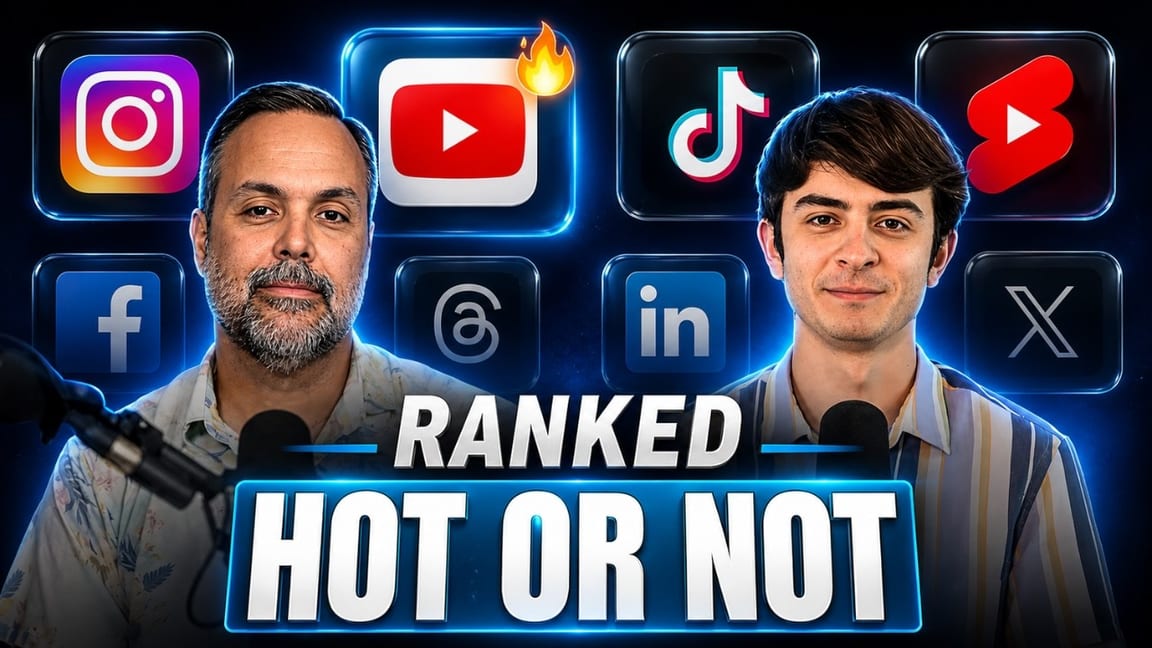
So we sat down and ranked them. Not the hyper-specific “here’s the audio that’s trending this week” stuff that’ll be dead by the time you read this — but the actual forms of content churches keep getting told to chase. Short-form video, long-form YouTube, AI-generated posts, behind-the-scenes content, personal branding, cross-posting. We graded each one on what it’ll actually do for a normal church with a normal budget, and we tried to be ruthless about it.
Here’s where each one lands, and why.
Why Social Media Is Even Worth the Headache
Before the rankings, the honest part: the deck is stacked against churches on social media, especially small and mid-sized ones.
It’s a hotbed of comparison — that’s literally what the platforms are built on. And the accounts you see winning are almost always the largest churches in the country, the ones with a content team of 20 to 30 people. You’ve got somewhere between zero and half of one employee on this. If you measure yourself against the top ten churches in America, you’re destined to feel like a failure. Don’t play that game. It’s rigged.
But here’s why it still matters enormously: social media might not be the first place someone hears about your church, but it’s almost always a stop before they visit for the first time. It’s the gut check. Somebody hears about you, and before they ever walk through your doors, they pull up your accounts to see what they’d be getting themselves into.
And the way we think about it has shifted. The old model was: ministry happens on Sunday in the building, and social media is just an advertising tool to get people in the door. There’s still truth there — we can preach the gospel better to someone sitting in the room on a Sunday morning than in a 30-second clip. We believe in getting people in the room. But social media isn’t only a funnel anymore. It’s also a place where ministry actually happens, where the gospel gets preached to people directly.
We saw this last night, in fact. At our church we run a “growth track” — the first step for people newer to the church or newer to faith — and during the testimony time, several people said the thing that made them curious wasn’t a sermon or a flyer. It was watching people they already knew interact with our church online. Social media was an early step in their evaluation of the church, and by extension, the gospel.
Yes, young people really do search this way
Here’s the Gen Z reality, from someone living it: a lot of us use social media as a search bar before Google or Maps. Looking for a coffee shop or a restaurant? Type it into the TikTok search bar and watch a few videos. The same instinct applies to churches. For a lot of young people, your social media is the first impression — or at least a very close second after the website.
We go back and forth on how far to push that. The data still says Google is far and away the number one way people find a church, with YouTube second. And there’s a fair critique of social search: a TikTok search surfaces curated content, which can feel more like an ad than an honest signal — the way Google reviews or Yelp feel more trustworthy for a restaurant. So social search probably ranks third or fourth overall today. But it’s a rising tide, right alongside people using AI like Claude or ChatGPT as a search engine. The trend is real, and it’s pointed up.
So the question stops being should we be on social media and becomes how do we not waste our time on it. That’s the ranking.
How We’re Ranking These
Three tiers:
- Hot — almost every church should be doing this, full stop.
- Worth trying — there’s real evidence it works, but it may not be the best use of limited time.
- Skip it — it won’t move the needle enough to justify the effort.
(One trend broke the system and earned a fourth tier. You’ll see.)
Short-Form Video — Worth Trying (Not the Slam Dunk It Used to Be)
Short-form vertical video — TikTok, Reels, YouTube Shorts — has been the dominant trend for a few years now. And it’s genuinely hard to give it a glowing review in 2026, not because it stopped working, but because it was so much better a couple years ago.
It peaked around 2023 or 2024. Back then any church that just got vertical video out the door was going to clean up. You could repurpose sermons, post pretty rough stuff, and the algorithms pushed it so hard you’d rack up views and comments either way. Whether it actually moved the needle for the church is a separate question — but the reach was there for almost no effort.
That’s not the game anymore. Saturation is brutal — the average TikTok video gets watched for about six seconds, which works out to roughly ten videos a minute, a hundred in a ten-minute scroll. (Do the math yourself and correct us in the comments.) Stack AI slop on top of that flood and it’s harder than ever to break through. The platforms still push the format, so the opportunity hasn’t vanished — it just takes a lot more work to get results than it did. We’ve watched it firsthand: a couple years ago our editors could get a church real traction in about a quarter of the time it takes now.
So it lands in worth trying. If your church hasn’t touched short-form video yet, absolutely give it a real shot — nobody should be skipping it. But it’s no longer the automatic, “you must come back to this because it’ll work for you” trend it once was. It’s somewhere in the middle, and honestly it might be the single most labor-intensive thing on this whole list.
Long-Form YouTube — Hot, and the Best 30 Minutes You’ll Spend
This is the one we’d put our chips on first.
And to be clear, the trend isn’t “put your sermons on YouTube.” Everybody’s been doing that for a decade. The trend is optimizing your videos for YouTube — and almost no church is doing it.
Think about what already goes into a single sermon. Study time, writing, practice, preaching it, recording it, editing, uploading — you’re easily 20 to 30 hours in. Then the video goes up titled “Sunday Service – June 12, 2026,” with whatever auto-thumbnail YouTube grabbed, and it gets nothing. Your channel becomes a video repository where old sermons go to die.
Spend 30 more minutes — that’s maxing it out — and the math flips. Design a genuinely good thumbnail (call it 20 minutes). Write a real title, different from what you called the sermon on Sunday (five minutes). Feed your transcript to AI and have it draft a description that’s actually compelling. We’ve seen churches five-to-ten-x their views on a sermon just by doing those three things. You can preach a phenomenal message, but if the title and thumbnail don’t earn the click, nobody ever hears it.
A 30-minute ask for five times the reach on content you already made? That’s a no-brainer. Hot.
Behind-the-Scenes Content — Where We Split
Behind-the-scenes or “day in the life” content — setup before service, the worship team in rehearsal, the staff prepping — can run as a short-form clip or an Instagram story. And this is one we genuinely land in different places on, so we’ll give you both reads.
The case for it: it’s endearing. It makes your staff and leaders approachable and your church feel authentic and human. It’s the kind of thing that’s pleasant to watch, and there’s real value there. Worth a try.
The case against it, being harsh: most viewers don’t care about your church yet. In those first six seconds before someone scrolls past, a behind-the-scenes clip has to be genuinely charming to survive — and unless you do it really well, there are better things to spend your time on.
Where we’d both probably agree: don’t make it the bedrock of your strategy, and don’t do it so often it gets stale — a couple times a month, not multiple times a week. We’d honestly love to see a church where this turns out to be the content that performs best. If that’s you, tell us. But going in, treat it as a worth-trying experiment at most, not a sure thing.
AI-Created Content — Hot, With a Seatbelt
Using AI to help create content covers a huge spectrum — from “write the caption for this carousel” all the way to “generate the entire image or video.” That makes it hard to grade with one verdict, but the headline is: hot — lean in, with a seatbelt firmly buckled.
Your church should already have decided, today, what it will and won’t do with AI. Some lines should move as the tools change. Others we hold firm as followers of Jesus and shouldn’t hand over to a machine.
Where AI is an easy yes: writing descriptions. If you’ve got a great sermon clip, feeding the transcript to a top-tier model and asking for the description most likely to land is fantastic — just don’t blindly post whatever it spits out. Edit it, curate it, make it yours. Same with design and graphics. Just today, one of us generated 18 graphics for some ReachRight ad projects: had Claude write a JSON prompt, dropped that into Nano Banana 2, and got images for social ads. That’s a firm yes.
Where we’d draw a line: making fake people with image generators. Same reason we don’t use stock photography of people — we want the people on our accounts to actually be from our church, not synthetic stand-ins or lookalikes. People see through it fast. “I’ve never seen that person in my life” is not the impression you want.
And the slop. The slop comes from one move: typing a single lazy sentence — “make me a viral church post” — and posting whatever comes back without checking it, shaping it, or making sure it sounds like your church. The tool should save you time and lift your quality. It shouldn’t replace the human entirely.
Now, the honest caveat. We’re filming this the day after Claude Fable 5 dropped, and it’s startling — we’re no longer sure the statement “AI can’t make something good enough to post” holds. You can probably one-shot a genuinely solid church post right now. Which means the real question isn’t could AI do it. It’s should we. Two years from now, “obviously it can do it better than we can” will be a foregone conclusion — and the should question will be the only one left. (If you’re watching this in 2028, leave a comment.)
”Authentic” vs. Polished Content — Worth a Try
There’s been a real shift away from the super-commercialized, highly-produced look toward “authentic” content — a regular person filming themselves on an iPhone, talking straight to camera. It comes largely from a Gen Z instinct to distrust anything polished (“you’re just trying to sell me something”) and to trust the plain, personal version instead.
The quotation marks around “authentic” are doing work, though, because a ton of so-called authentic content is performative — it just pretends to be unscripted. There’s a TikTok that made the rounds recently of a husband filming himself praying over his wife while she was on her period, and it’s held up as raw and authentic — but anyone who makes content knows it took real production. Lighting, camera placement, the baby positioned just so. It’s staged authenticity, which is a whole separate conversation.
For churches: most lean toward polished, and a little more genuine, unscripted content would probably serve them well. If “authentic” means the pastor grabbing a phone and sharing a 30-second encouragement, we’re all for it. If it means manufacturing fake spontaneity, give it a try but don’t put much weight on it. Worth a try.
Micro-Dramas and Scripted Series — Skip It
This one’s fascinating and we still think churches should pass.
Scripted serialized content — basically modern soap operas in 60-second chunks, where following the account lets you stitch the story together episode by episode — is enormous overseas right now, especially across Asia. We’ve also seen the lighter version domestically, like the creator who turned her coffee shop into a “sitcom” for a week.
It’s interesting. We’re just not sure how a church pulls it off well, and it looks like a massive lift to make it actually valuable. So we’d skip micro-dramas specifically. If there’s some other kind of produced content worth the effort, it’s probably skits or quizzes — Bible trivia, or pitting two of your pastors or resident Bible scholars against each other. That’s got legs. But if you’ve seen a church genuinely nail the micro-drama format, show us — we’d love to change our minds.
Pastors Building a Personal Brand — Use Discernment
Time for the fourth tier, because this one didn’t fit cleanly anywhere.
Investing in a lead pastor’s personal accounts — not just the church account — and putting your social media person on building that brand: does it get results? Unequivocally, yes. It’s probably the single most effective method on this entire list for views, watch time, and engagement. Every celebrity pastor you can think of has a team running their personal brand alongside the church account; the idea that they’re casually posting from their phone isn’t reality.
And it’s not inherently wrong. A personal account preaching the gospel, sharing encouragement, discipling people — that’s good fruit. Some platforms basically only work this way: trying to grow a church account on X is a lost cause, but as a personal brand, written-content platforms like LinkedIn and Twitter can be great.
The hesitation is the old personality-driven-versus-community-driven church tension. Is the goal building the pastor’s name, or the church’s? We do a version of this ourselves — part of our ReachRight team helps with a personal brand — so this isn’t a condemnation. But using church staff and church accounts mainly to pump up a pastor’s personal Instagram gives us pause.
So: hot if the goal is genuinely reaching more people, pass if it’s really just building one person’s name. Call it use discernment.
Cross-Posting the Same Content Everywhere — Hot
Take one video and post it across TikTok, Instagram and Facebook Reels, YouTube Shorts — maybe even LinkedIn and Twitter. Good idea? Yes. This is the rare case where less work became best practice.
Could you cut a version tailor-made for TikTok that outperforms the one you put on Facebook, given the different audiences? Sure. Is it worth doing a completely separate edit of the same sermon clip for every platform? For a typical church running around a hundred people on a Sunday, no — the differences aren’t big enough to justify the time. What works on one platform usually works similarly on the others.
The one caveat: change the description on each platform. It’s an easy edit and it matters. Lean on the YouTube description for search; use TikTok and Facebook captions more for engagement. Vary the pinned comment too. But the video itself? Cross-post it everywhere. Then monitor it — if one platform consistently does nothing with your content, stop feeding it. Hot.
If You Could Only Pick One Platform — YouTube
If we had to send you off with a single platform to pour effort into, it’s YouTube — and specifically the long-form side.
The reason is leverage. You’re almost certainly already posting sermons there; you’re just not doing it the way the algorithm rewards. So this isn’t a new initiative you have to staff from scratch — it’s 30 minutes of a volunteer’s time bolted onto something you already do, for outsized results.
And it comes down to two things: the title and the thumbnail. They’re the subject line of your video. You can write the best email in the world, but if the subject line doesn’t earn the open, nobody reads it — and a title and thumbnail work exactly the same way. They’re the only two chances you get to grab someone before they scroll on. Thumbnail, maybe 20 minutes. Title, five — AI can help. Nail those two and you’ll see a real jump from that one small change.
Your Next Step
Doing social media well takes a stack of different skills — video editing, graphics, copywriting — and most churches don’t have all of that on staff. That’s exactly the gap our team fills, and it’s also why we offer a free church marketing and website review. We’ll look at your website, your Google presence, and your social media, then send back honest, specific recommendations you can actually use. No sales pitch. Real feedback.
Turnaround is about 48 hours. It’s free for any church that asks.