Every Sunday, churches work incredibly hard to give first-time visitors a great experience. Then Monday comes — and most of those visitors never hear from that church again.
We’ve worked with literally hundreds of churches, and the vast majority of us have a broken visitor follow-up system. Not a bad one. A broken one. And unless you’re deliberately intentional about it, it will tend to stay that way, because things drift toward disorder, not order.
This might sound like a small, unglamorous topic. It isn’t. It’s the single highest-leverage thing most churches could fix this month.
The Stats Worth Sitting With
- Only 10–20% of first-time guests return without intentional follow-up.
- Churches that follow up within 24–48 hours see three times higher return rates than those who wait a week or more.
- 29% of church dropouts say they left because they never felt connected.
- Close to 60% of people become part of a church after their third visit.
Read that second one again, because it reframes everything else your church is doing. Websites, social media, ads, outreach events — all of it exists to get people to walk through your doors. If your follow-up system is broken, you are throwing away two-thirds of the return on every dollar and every hour you spend on any of it.
There’s genuinely no sense in investing a penny in marketing if the follow-up isn’t nailed down. Get this one area right and you make everything else you’re doing three times more effective.
The Math Nobody Runs
Here’s the version of this that convinced us.
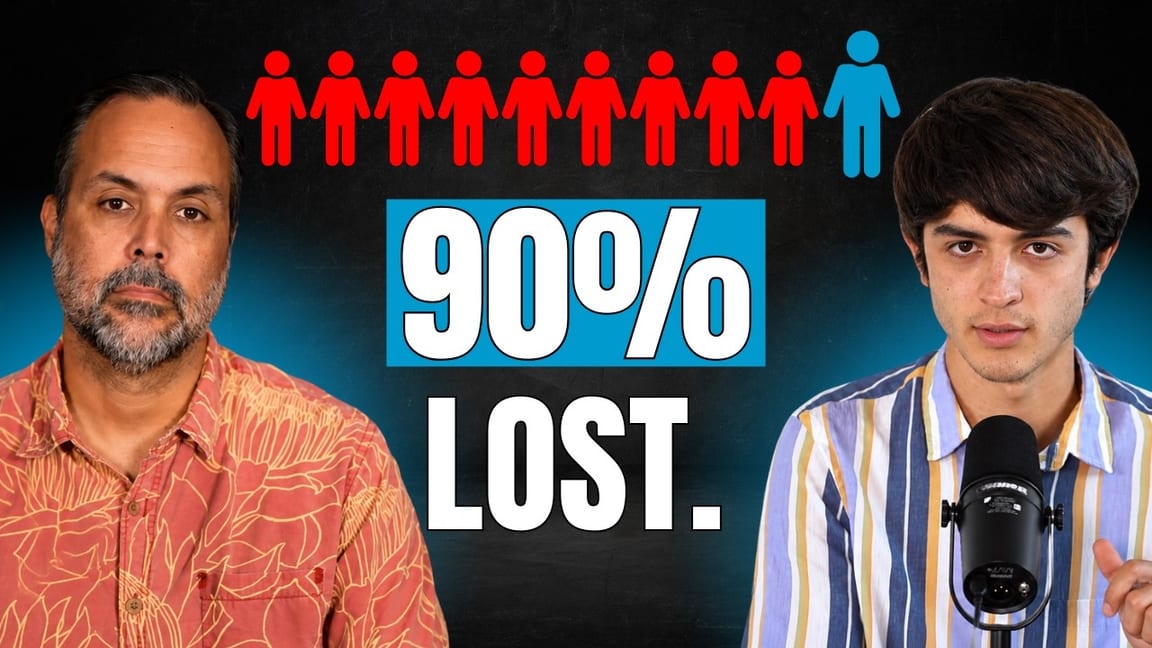
The baseline we operate from is that a church with a bad follow-up system converts about 10% of visitors — one in ten comes back for a second visit and eventually gets plugged in. The very best churches we’ve studied push about 25%.
Now, 25% might still sound low. As pastors, we tend to assume that when a visitor shows up there’s a 90% chance they’re going to become part of our church and we’re all going to be best friends from this day forward. In reality, even the most effective churches in the country don’t see anything close to that.
But the gap between 10% and 25% is an enormous chasm. Watch what it does to your growth math.
The average church loses about 10% of its members every single year to completely natural attrition. People pass away. People move. People decide they’d rather be somewhere else. Ten percent is a healthy drop-out rate.
So if you’re a church of 100 people and you want to still be a church of 100 people next year, you need 10 new people to join. Which means:
- At a 10% conversion rate, you need roughly 100 first-time visitors walking through your doors this year — just to stay flat.
- At a 25% conversion rate, you need about 30.
Same church. Same year. Same goal. One number is attainable and the other is a full-blown marketing crisis. Fixing follow-up doesn’t just improve your growth — it completely re-skews the math and makes growth possible at a visitor volume you can actually generate.
That’s why, as marketers, this is the most important secret sauce in any recipe we have for helping a church get to the next level.
The Real Problem Isn’t the Plan
When we ask churches about their visitor follow-up process on a strategy call, most of them can describe one. “Oh yeah, we make a call, we send a card, we do this thing.” Great. We’re fairly strategy-agnostic — we’ll give you a recommended approach below, but almost any plan works if you actually work it.
Here’s what we hear far more often than “we have no plan”: we hear churches with a plan that nobody is accountable to.
Because here’s the secret nobody says out loud: nobody likes sending these messages. Not cold ones, not even warm ones. It feels awkward. If your plan involves phone calls, you’re effectively asking a volunteer or a staff member to make cold calls and start a conversation on a phone — something a lot of people, especially younger ones, are already deeply uncomfortable doing.
So it quietly falls to the wayside. Unless someone is actually inspecting it — verifying that the texts went out, the emails sent, the calls got made — the odds are very good that this week’s visitors slipped through the cracks. That’s not an accusation. We’ve just watched it happen over and over and over.
What a Broken Follow-Up System Actually Looks Like
1. There’s no system at all
The most broken a follow-up process can be is that it never existed. Someone shows up, fills out a card, and nothing happens — or one of the pastors has to remember to reach out and maybe texts them if he happens to have the number. That’s not a system. That’s a coin flip.
Sometimes this gets spiritualized: we don’t want a rigid system, we want to let the Holy Spirit lead us — if we feel like we’re supposed to follow up with someone, we will. We understand the instinct. But that’s one extreme end of the spectrum, and it consistently produces the 10% number.
2. Everything is a form letter
The other extreme is just as bad. Messages so formulaic and generic that they read like a newsletter blast instead of a person. “Hey [FIRST NAME], here’s what’s coming up, we hope to see you next week.” It’s the same kind of marketing email we all glaze over in our inboxes — the one you won’t take ten seconds to unsubscribe from, so instead you scroll past it for years.
Both extremes are equally serious infractions. One has no structure at all; the other has structure and no humanity.
3. One and done
This one is extremely common: the entire follow-up process is a single email that goes out when the church administrator enters the cards into the system on Monday morning. That’s better than nothing — something going out is genuinely good. But a single touch will never carry someone to a third visit. What you want is a consistent, dripped-out sequence with messages landing on set days at set intervals.
4. Waiting too long
You might have four well-written follow-up messages. If the first one goes out a week later, it’s way too late. They’ve already moved on. They’ve already forgotten the specifics of the Sunday you’re referencing.
And when these messages depend on a human remembering to click send, human error is guaranteed. That person will forget. That person will realize on Thursday it was supposed to go out Monday. That’s not their fault — it’s just what happens to manual processes.
We’ve tested this. Sunday afternoon wins. It’s not the end of the world to send something Wednesday — but you’re leaving real conversion on the table for no reason.
Before You Can Follow Up, You Have to Get the Information
This is the part of the conversation that gets skipped, so it’s worth naming: none of the above matters if visitors aren’t giving you their contact info in the first place.
The appeal of “we’d love to connect with you, so please fill out this card” just doesn’t work anymore. Sometimes peer pressure carries it — a card physically in front of someone while the people around them are filling theirs out. But if you leave it purely to their own judgment, it isn’t good enough. Asking for someone’s phone number and email in 2026 is a genuinely big ask, and people have gotten far less willing to hand that over.
So: incentivize, incentivize, incentivize.
At my church right now, that’s a free scoop of ice cream from a shop nearby we’re friends with — mentioned in the morning announcements, with a QR code and a paper card in the bulletin that can go in the offering bucket. It’s a small, cute, low-pressure reason to act.
Other versions that work:
- Coffee. Simple, cheap, universally appreciated.
- A donation in their name. One church we know makes a $10 donation to a local nonprofit — and lets the visitor choose which one. The thinking is that it starts a generosity wheel turning on day one.
- Something absurdly generous and small. At another church we handed out giant half-pound Hershey’s bars. Almost nobody says no to that.
One caution from experience: here in Hawaii we used to give a lei to every first-time visitor, and we moved away from it. It singled people out — wearing the lei effectively announced I’m new here, everybody look at me. Whatever incentive you pick, make sure it doesn’t spotlight the person you’re trying to make comfortable.
The Three Ps of a Working System
Everything a good follow-up message needs comes down to three words: Prompt, Personal, Pleasant.
Prompt
Covered above, but to be blunt about it: same day. Sunday afternoon. Not Monday if you can help it, and definitely not next week.
Personal — and this is the hot take
I’m the executive pastor at a church of about 300 people. We see roughly 10 first-time visitors a week, and we get contact info back from about 7 of them. (Which tells you incentives work — and that they still don’t work 100% of the time.)
Even at that size, our lead pastor is personally involved in follow-up every single week. Here’s our actual rule: whoever preached that Sunday sends a same-day text, Sunday afternoon, to every first-time visitor whose information we got. Our lead pastor is on sabbatical right now, so lately that’s been me.
That might sound burdensome. It’s fifteen minutes. And there are very few things at our size that move the needle harder than that initial personal connection.
We have a new members lunch — our aloha lunch — happening this weekend. I can tell you that roughly half the people coming are people I personally texted, got a response from, started praying for, and had an actual back-and-forth with.
The texts themselves are simple. I’ll have met about half the visitors on a given Sunday and missed the other half:
- If I met them: reference something real. “It was so great to meet you and Jane — loved hearing about your two kids and so glad they’re settling into school.”
- If I didn’t: lead with the apology. “Hi, this is Thomas. I was the guy who did most of the speaking on Sunday. I’m so sorry I didn’t get a chance to meet you, but I want you to know I’m praying for you, and I hope I get to meet you next Sunday.”
Response rates on the second version are almost as good as the first.
So here’s the hill I’ll fight for: yes, systematize this — but build real human interaction into the system. If your church is under 500 people, or you’re seeing fewer than 10–15 visitors a week, the preacher personally texting is worth every minute it costs.
And don’t underestimate why it works. We forget, as pastors, the weight the role still carries. You stood up and spoke for thirty minutes to a room that was hanging on your words. Somebody who just spent their Sunday morning investing in you feels, at least a little, like they know you. A text from that person almost always gets a reply. Almost nobody else in your church has that.
Pleasant
The other pieces: an email within 24 hours, and then multiple touch points across that first week and first month that actually add value rather than just asking.
This is where the business comparison is useful, even though your church isn’t a business and the goal isn’t money. In marketing, you get someone’s email by giving them something genuinely valuable, and then every message in the sequence keeps giving — free resources, free information, free help — instead of only pitching. It works because generosity earns attention.
Your follow-up sequence should feel the same way. Not four increasingly desperate variations of please come back. Something useful in each one.
We’ll be transparent about how this works, since we do exactly the same thing: we put together a free download of the actual templates we use at my church to follow up with first-time visitors, and the link is in the video description. You put in your email, we send you the templates, and we’ll send a couple of follow-up emails showing more of how our process works. Unsubscribe any time — genuinely, no hard feelings. The bet we’re making is that if we load you up with real value, then when it’s time for a new website or help with social media, we’re the first name that comes to mind. That’s how the cheese gets made. Now you know.
Every Message Has Exactly One Job: Get Them to Visit #3
Remember the 60% number — most people commit to a church after their third visit. So your entire follow-up system exists to get someone to visit number three. That means it needs to run for at least two weeks, because visit three is two Sundays out.
And it needs to be laser-focused on that, which means resisting the urge to take a big swing.
When someone visits for the first time, the goal of Sunday’s text is not to get them into Wednesday’s life group. It’s not to sign them up for the nine-week course you’re launching. Those are great opportunities and they can absolutely take them — but that’s not what this message is for.
The next step you offer needs the lowest possible barrier to entry. For most churches, that means: come back next week. Then: come back the week after. That’s it. Those are your only two goals.
Then you up the ante. After the third visit, that’s when a pastor’s lunch or a new members conversation makes sense — because that’s someone who’s been there three times and now genuinely has questions about what your church believes and how to get more involved.
Can Follow-Up Ever Go Too Far?
Yes, but almost certainly not for you.
There was a time when churches did house visits as a standard part of the protocol — you put your address on a card, someone showed up at your door that week. That’s still the fear some older visitors carry when they’re asked for an address. Today that’s too far. It’s going in for a kiss on the first date. Work up to it.
Following visitors on Instagram immediately is also too far, and this one’s more subtle than it looks. When the pastor follows someone who may not be a believer yet, it can land as pressure — now religious people are watching my account, I have to change how I show up here. Make it a third-visit move at the earliest, and ideally wait until they follow you first. Following someone back is completely normal social behavior; initiating isn’t, yet.
And obviously: if you don’t want to look like a stalker, don’t behave like one. If someone gives you a name and an email and gets back “we saw on your Instagram that you’re training for a marathon and we’ll all be there Saturday cheering you on” — that’s too far.
One more piece of restraint worth building in: after two weeks, release them. If they came once and didn’t come back after your sequence ran, stop. Don’t keep pestering. They’ve made their decision, and that’s completely fine.
But let’s be honest about the odds here. For 99% of churches, the failure mode is not going far enough. We don’t know a single church still doing house visits. What’s actually going wrong is that you aren’t doing enough — and you’re so far from the creepy line that you’d need to take several more steps just to get near it. Swing for the fences.
Should You Still Call People?
This is the one place we genuinely land in different spots, so here’s the honest version.
The case against: as a Gen Z-er, I can’t imagine a phone call being effective. People in my generation don’t just dislike phone calls — some of us can’t order food over the phone without real anxiety. An unknown number showing up as “First Baptist Church” is not getting picked up. Ever.
The case for: there’s a real difference between what people like and what actually works. Something making someone mildly uncomfortable doesn’t automatically rule it out. And when we push on the question — would a call actually turn you off the church? — the honest answer is no. It would have to be genuinely weird to become a negative. It might even land as a positive.
Which points at the actual answer: segment. Call the Gen X and boomer visitors. Text the millennials and Gen Z. That’s what we do at my church, and it’s a judgment call you can make from the card.
And don’t discount the voicemail. Nobody answers the phone anymore, so a call is functionally a voicemail — and that’s fine. “Hey, just calling from Life Church. It was so awesome having you on Sunday, and I wanted to see if there’s anything we could pray for you about.” Even for someone who would never call back, that lands as they were thinking about me. That’s a win.
When I first visited the church I now serve at, the entire visitor follow-up process was one woman in her eighties who picked up the phone and called every guest. I still remember that call. She was the system, and she was faithful at it for years.
For the record, the person who had to make those calls at another church hated it. Tuesdays in the office, working down the list of everyone who’d visited. So here’s a trick of the trade: slide dial. Let it ring through to voicemail on purpose, leave a warm, genuine message — and if they call back, the conversation is somehow far easier for everyone.
The Point Isn’t Closing a Deal
It’s worth stepping back from the tactics, because we’ve talked a lot about sequences and conversion rates and business analogies.
We don’t hold church services because we want people to show up one time. Church is about community — about people getting connected and plugged in and actually having each other. That’s the whole thing.
So the goal of follow-up was never to close a deal. It’s to make someone feel noticed, for real. To make them feel seen. That’s all it is. It just looks different now than it used to, because now it’s texts and emails and automated sequences instead of a phone call from a woman in her eighties. But the message underneath is identical: we remember you. We see you.
And people who feel genuinely seen want to come back to a place like that.
We know your church is a great community with real people who would love the family in your town that’s quietly looking for one. This is how they find out.
You don’t need a complicated system. You need a consistent one. Sit down this week and map the fourteen days between someone’s first Sunday and their third. Write down every touch point. Automate everything that can be automated, keep the pastor’s text human, and give one person the job of checking that it all actually happened.
If you can’t draw that map right now, that’s your next project.
Your Next Step
Want outside eyes on how your church is turning visitors into members? We offer a free church marketing and website review. Our team will look at your website, your Google presence, your social media, and your digital front door — then send back honest, specific recommendations you can actually use. No sales pitch. Real feedback.
Turnaround is about 48 hours. It’s free for any church that asks.
More Resources
- These Follow-Up Mistakes Are Why Your Church Visitors Never Return
- How To Build The Perfect Church Visitor Follow-Up Process
- How to Turn Sunday Visitors into Lifelong Members
- Digital vs Paper Connect Cards: Which Is Better for Your Church?
- How To Build The Perfect Church Plan-Your-Visit Page
- Does Your Church Have a Front Door or a Back Door Problem?