If someone in your city searched “church near me” right now, would your church even show up?
For most churches, the honest answer is no. And it’s costing you first-time visitors you’ll never know you missed — people who were looking for exactly what you offer and simply never found you.
Here’s the thing we want to say up front, because “SEO” is one of those words that makes people click away before we even start: it doesn’t have to be scary. It used to be ultra-technical, a thing only nerds did. It’s not that anymore. Today it’s a set of pretty obvious, pretty doable moves — and if your church takes a little time on them, they lead directly to more first-time visitors. That’s the whole premise.
So let’s break down the new rules of church SEO in 2026, and exactly what you can do about them.
First, forget what “SEO” used to mean
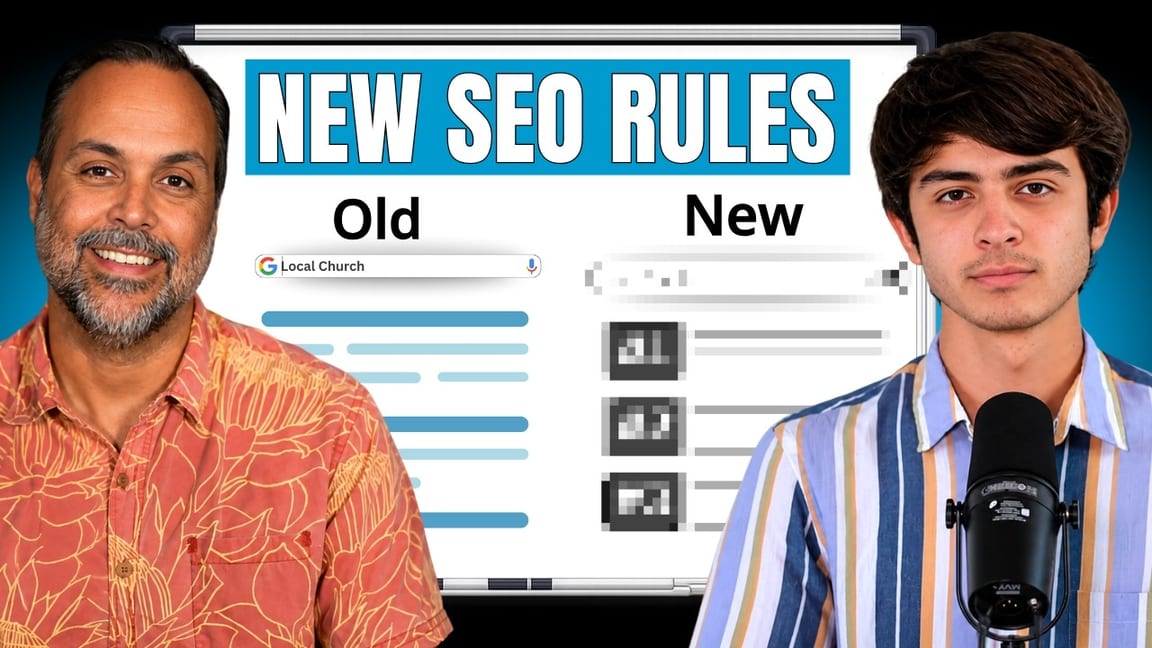
We’ve lived through a lot of iterations of this. There was a time when “SEO strategy” just meant typing “church in Honolulu” or “church in Austin” over and over on your website. Stuff the phrase in enough times and you’d rank number one. You could game the whole system with a couple of cheap tricks.
Google caught on fast, and those days are long gone. The systems are dramatically smarter now. You can’t trick your way to the top anymore — but there are still things that genuinely work, and that’s what this is about.
The bigger shift is that SEO isn’t even really a website thing anymore. It’s your Google Business Profile. It’s social media. It’s reviews. It’s AI search. All of it adds up to one question: can people find you online when they’re looking for a church? That’s a much broader discipline than it was even three years ago.
And when you actually watch how people search now, the reason everything changed becomes obvious. Ask yourself where you go to find a good restaurant for an anniversary dinner. For a lot of us the order is: word of mouth first, then Maps, then social media — pulling up Instagram or TikTok to watch someone’s actual review. Others of us have quietly shifted most of our searching to AI. When we travel, we’ll get back to the hotel around 5, open Claude, and ask it for dinner recommendations near us. It’s using the same sources Google would — we’re just letting AI do the sorting.
Notice what almost never happens in any of that: clicking through to an actual website. Even a plain Google search now hands you an ad, a map pack, and an AI overview before you ever reach a church’s homepage. That’s why “SEO” has to mean something bigger now. All of these are search. People are still looking for what a church does — the target has just moved.
Okay. Six rules. Let’s get into them.
Rule 1: Your Google Business Profile is your most important real estate
If you take one thing from this episode, take this. Your Google Business Profile (GBP) is the single most valuable piece of digital real estate your church owns right now.
Quick context if the name is new to you: GBP is what used to be called Google My Business, and before that it was the old Google+ era. It’s the listing that powers the map pack — those top few results with the little map when someone searches “churches near me.” Showing up there is enormous for a church.
But here’s what most churches don’t realize: that same profile is the raw material AI is trained on. Your GBP info, your reviews, your photos — that’s what ChatGPT, Gemini, Grok, and Claude pull from to decide which organization has authority and which one to recommend. Your Business Profile is the foundational pillar of every other rule on this list.
A few things to actually do:
- Claim it. You almost certainly already have a profile — Google auto-generates them — but it does nothing for you until you claim it. If you haven’t, that’s step one, today.
- Give Google everything it asks for. Every field, every question, your service times, your hours, your ministries. A fully completed profile gets recommended to the right people; a half-empty one gets skipped.
- Fix your hours — this one’s sneaky. We’ve done testing on this, and Google often won’t show your church at all if it’s not “open” at the moment someone searches. One of the most common mistakes is listing hours as “Sundays, 9:00–10:30 AM.” Technically true, but now you vanish from every search at 6 PM on a Friday. If you can in any way justify it, list your church as open 24/7 so you keep showing up whenever people are actually looking.
- Load it with photos. Get 10–15 up: the exterior of the building (people need to recognize it so they don’t drive past), and shots during a service with seats full and something clearly happening. Don’t only post empty, spotless rooms — full rooms look alive and inviting, and AI engines increasingly pull those images when they recommend churches.
- Keep feeding it. Adding fresh photos consistently is itself a signal. Treat GBP like another social network — use the posts feature for events and what’s coming up, and make a rhythm of adding a couple of new photos every month.
Rule 2: Your homepage has to answer who, what, where, and when
We’re not going to spend much time on the website — but it still matters, mostly because AI overviews now pull directly from your homepage.
When someone lands on your site, it has to be instantly clear: When do you meet? Where do you go? What is a service like? Who’s welcome? If you’ve got kids’ ministry or an unusual meeting time — say a Saturday night service — that has to be obvious. And it’s not just for the human visitor anymore. When someone Googles “churches near me” and the AI overview lists your church with a little description, that description is built from the details on your homepage. The clearer you are, the better it represents you.
This is where we keep coming back to one idea: make it as easy as humanly possible for someone to come to your church. Don’t make it confusing. Don’t use insider language. The goal is to get people through the door and be a blessing to your community — so tell them where to park, what to wear, when to show up.
The single most effective tactic here right now is FAQs — but written a specific way. For years we’ve all written cutesy FAQ questions aimed at the human reader (“What do I wear?” “Will you accept someone like me?”). Nothing wrong with keeping a few of those. But what’s valuable now is writing FAQs the way someone would actually type them into ChatGPT, and answering each in two to three sentences.
So instead of “What time are services?” you’d write: “What time do services start at New Hope Hawaii Kai?” And instead of just answering “9:00,” you’d write: “Services at New Hope Hawaii Kai begin at 9:00 AM. They usually last about 90 minutes and end around 10:30.” Do the same on your homepage, your about page, and each ministry page:
- “What do people typically wear at New Hope Hawaii Kai?”
- “Is Life Church part of a denomination?”
- “What does Life Church believe about the Bible?”
- “What is youth ministry like at New Hope Hawaii Kai?”
Ask the question the way a real person would search it, then answer it in two or three sentences. That framework gets you cited far more often.
We’re not guessing on this one. We ran it at our own church, and in 45 days we saw a roughly 5x increase in the number of times we were cited by ChatGPT and Claude. Some of that is the rising tide of AI search generally — but 5x in six weeks is astronomical. This works.
One more mindset shift while we’re here: most church websites are built for the existing member, not the visitor. The giant “Give” button is front and center because that’s what members come for. But a member will happily take ten extra seconds to hunt down the tithe button — they’re committed. A first-time visitor won’t. You have seconds to grab their attention, be clear, and feel welcoming.
The old-school test still works: find someone who doesn’t go to your church, hand them your site on their phone (most searches are mobile), and watch. Can they tell in five seconds what this church is about and what to do next? Or do they squint and go, “I don’t really know what this is”? That feedback is gold.
Rule 3: AI search is the new frontier — and early adopters win
This is the big one. AI search is completely changing how people find churches. ChatGPT is the giant, but there’s also Google’s AI overviews, Gemini, and Claude.
We saw a chart recently on how usage has shifted. Two years ago ChatGPT was something like 80% of the market — totally dominant. Now it’s down to roughly 40–45%. Still the biggest by far, a clear plurality, just not a majority anymore. Gemini is number two. Claude, despite being what some of us basically live in all day, sits around 7% as people’s daily driver. And we’re in a wild moment for these tools — new flagship models launching, getting pulled, relaunching, rivals leapfrogging each other week to week.
The point isn’t which one wins. It’s this: whether you like it or not, when someone searches for a church, AI is going to be one of the first things they see. Some people are intentionally searching in ChatGPT and Claude. Ranking there is a completely different game — and it’s wide open right now.
Here’s what we know from years of doing church marketing: early adopters get most of the rewards. The churches that jumped on Facebook when it first hit built huge audiences. The ones that jumped on Reels and TikTok five years ago built followings that are much harder to build today. AI search is that same opportunity, right now, before everyone wises up. This is already settled — AI search is going to be a thing. Being early on it is the whole edge.
And to be clear, we’re not saying you have to use ChatGPT yourself. We’re saying you want to make sure the people who are on it find your church. Think about what a Google search looks like today: it used to show the top church websites and people would browse the top five. Now there’s an AI overview block sitting above all of that — “Here are the top three churches in Austin,” with a name and a short description for each — and most people never scroll past it. That block is built mostly from your Google Business Profile, your website, and your reviews.
Which is a great segue, because we actually built a free tool for this: a Church Near Me Test. It shows where your church ranks on the Google map pack and across AI searches, as if someone were searching from one mile from your front door. You get a report on screen and emailed to you. It’s free — the link is in the episode description below. Run it to get your baseline before you change anything, then run it again after.
Rule 4: Social search is now a real thing
This one’s new, and if you’re on the older end it might sound strange — but it’s absolutely happening, especially with Gen Z and younger millennials.
“Social search” means using the search bar inside Instagram or TikTok the way you’d use Google. Instead of Googling “best places to eat near me,” a lot of younger people type it into TikTok and scroll through videos — real people, influencers, actual reviews — to decide. When my wife and I plan a Disneyland trip, she doesn’t Google the best rides or snacks. She searches TikTok, watches people’s review videos, and that’s how we decide what we’re doing. It sounds odd if you didn’t grow up with it. It’s completely normal now.
There’s a reason behind it. Younger generations have largely rejected classic, polished advertising — a glossy, expensive commercial reads as “ad,” and we tune it out. That’s why ad companies now make their ads look like a regular TikTok or YouTube video, or hire influencers to make them in their normal style. What Gen Z trusts is the authentic-looking thing: real people, real experiences, real reviews. So when we’re deciding anything, we go where the real reviews live — which increasingly is the video platforms.
Here’s the good news for churches: we did some rough testing, and social search is the wild wild west right now. We searched “churches near me” and “churches in Hawaii Kai” on Instagram Reels and TikTok. Sadly our own church — one of the most prominent in the area — didn’t show up at all. But plenty of other churches did. So we dug into why, and the answer is simple: titles, descriptions, and hashtags matter, exactly like they do on YouTube. The churches showing up for “churches near me” had put #churchnearme right in their tags.
That’s another huge, get-in-early opportunity. One caveat: these platforms have heavy recency bias. A baptism highlight video you tagged nine months ago isn’t going to keep showing up — these videos have a much shorter lifespan than an evergreen YouTube video.
And here’s an idea worth testing: have your social media person film a “come with me to church” style video — the same casual, first-person format as those “here’s everything I ate at Disneyland” videos. Here’s a morning at New Hope, some worship B-roll, into the service, what the pastor talked about, all in that authentic, unpolished tone. We see that format constantly for restaurants and theme parks and almost never for churches. If your church is trying to reach young people, this could be a really effective, wide-open space. (If you try it, tell us in the comments how it goes — you’ll probably need a few attempts in a few styles to really know.)
Rule 5: Reviews are one of the strongest signals you have
We talk about reviews constantly, so we’ll keep this tight — but they matter enormously, and AI loves them because they’re the hardest signal to fake.
- Ask for them. They don’t happen by accident, especially at churches. Build a rhythm of asking. We host an “Aloha lunch” for new people to meet the pastors, and we’ll simply say, “If this has been a good experience so far, would you leave us a review? It means a lot.” People in that moment usually will.
- Encourage the city and church name in the review. “I love this church” is great — we’ll take any review. But “We spent years looking for a church in Austin and were so thankful to find New Hope Church in Austin” is a much stronger signal, because it ties your name and location together.
- Consistency beats bursts. They call it velocity. One big push that gets you 15 reviews and then nine months of silence is a worse signal than a steady trickle. The threshold where we see churches start to perform better is 15 total reviews, then about 2 new ones per month. Get past 15 and keep two coming in monthly, and you’ll see real results.
Rule 6: Make your information consistent everywhere
The last rule is about consistency — and it’s bigger than people think.
Your name, address, service times, and hours need to match across every place you appear: your Google Business Profile, your website, your social channels, old Facebook groups, everything. Google and AI engines are actively looking for consistency, because conflicting information makes them look bad — nobody wants to send a person to the wrong service time. When everything lines up, the algorithm concludes, “This is clearly a real place and this info is almost certainly correct,” and prioritizes you. When your times and address conflict across platforms, you get deprioritized — and you’re far more likely to get an AI hallucination pulling from some outdated listing.
In our industry this is called your NAP — name, address, and phone number. And it’s the very first thing we fix when a church hires us for local SEO. We manually verify their info across roughly 75 different listing sites — not just Google and social, but all the smaller directories most people forget exist. Here’s the honest reality: on an average church, something is wrong on about 60 of those 75. Usually small stuff — a wrong service time on the Better Business Bureau listing that nobody at the church ever knew to update. But small errors add up.
It’s genuine grunt work, which is why churches pay us to do it. But the payoff is real: a church sitting at, say, #10 in local rankings can often jump to around #5 just from getting these 75 signals to agree. That’s 75 different sources all quietly telling Google, “This church is real, and this is the correct information.”
The bottom line: give the internet what it wants
We want to be clear about something. This SEO stuff — big scary word aside — is not technical. You don’t have to dig into your website’s code or fiddle with metadata. These are obvious, accessible things almost anyone at your church can do, and most of them don’t take much time. They’re genuinely actionable, starting today.
If we had to sum all of it up in one line, it’s the old saying: give the people what they want. In 2026, that means give the internet what it wants. Google, ChatGPT, and all the rest have told us exactly what they’re looking for. Give it to them — clearly, consistently, and in the format they want — and they’re smart enough to do the rest.
Try it yourself. Open ChatGPT and search the way a real person would: “My wife and I are looking for a church with a thriving young adult community, in this denomination, and we’ve got two young kids.” That’s how people actually search now. See if your church comes up. Then make these changes and run it again.
The two biggest gold mines here are AI search and social search. You can still be early on both — and early is where the biggest rewards live.
Your Next Step
Not sure where your church actually ranks — on Google, on AI search, or on social? We offer a free church marketing and website review. Our team will look at how findable, fast, and clear your church is online, and send back honest, specific recommendations you can actually use. No sales pitch. Real feedback.
Turnaround is about 48 hours. It’s free for any church that asks.