
Gen Z churchgoers now attend church more often than churchgoers in any other generation. The gap between church closures and church plants shrank from 1,500 in 2019 to 200 in 2024. And the long decline of American Christianity may have finally leveled off. These are not predictions. They are data points from Pew, Barna, and Lifeway Research that every church leader needs to understand heading into 2026.
Here are the numbers behind the biggest shifts in the church landscape.
The Short Answer
The most important church statistics for 2026: 62% of U.S. adults identify as Christian, and that share has held steady since 2019 (Pew). Gen Z churchgoers attend church 1.9 weekends a month, more often than churchgoers in any other generation (Barna). 31% of Americans attend weekly or nearly weekly (Gallup). Among Southern Baptist churches, those started since 2000 grew membership 12% over five years while older congregations shrank (Lifeway).
Key numbers, verified September 2026
| Statistic | Number | Source |
|---|---|---|
| U.S. adults who identify as Christian | 62%, steady since 2019 | Pew Research, 2025 |
| Americans who attend weekly or nearly weekly | 31% (57% seldom or never) | Gallup, 2025 |
| Gen Z churchgoer attendance | 1.9 weekends a month, highest of any generation of churchgoers | Barna, 2025 |
| Protestant churches closed vs. started, 2024 | 4,000 closed, 3,800 started | Lifeway Research, 2026 |
| Membership change, SBC churches founded since 2000 | +12% over five years | Lifeway Research, 2026 |
| Americans raised Christian who no longer identify | 22% of all U.S. adults, out of 80% raised Christian | Pew Research, 2025 |
| Senior pastors who seriously considered quitting in the past year | 24%, down from 42% in 2022 | Barna, 2026 |
| Americans who typically attend church at Christmas | 47% | Lifeway Research, 2024 |
If you want to know how your church shows up when people in your area search for one, run the free Churches Near Me test. It takes about two minutes.
Church Statistics at a Glance
| Statistic | Data Point | Source |
|---|---|---|
| Weekly or nearly weekly attendance | 31% of Americans | Gallup, 2025 |
| Gen Z churchgoer attendance rate | 1.9 weekends/month | Barna |
| Millennial churchgoer attendance rate | 1.8 weekends/month | Barna |
| U.S. Christian population | 62% of adults | Pew Research |
| Church closures vs. openings | 4,000 closed, 3,800 opened (2024) | Lifeway Research |
| Churches at pre-pandemic levels | Median attendance rose to 70 in 2025, first gain in 25 years (much of it reshuffling, not broad growth) | Hartford Institute, 2025 |
| Churchgoers who tithe at 10% | Only 27% | Vanco, 2025 |
| Average church budget | ~$100,000 | National Congregations Study |
| Parents who attend weekly | 26% | Pew Research |
| Raised Christian, no longer identify | 22% of all U.S. adults | Pew Research |
40+ Church Statistics for 2026

Below is a wide range of our findings from sources such as Gallup, Barna, and Pew Research Center. You’ll find everything from church attendance statistics to the annual donation amount.
1. Decline of U.S. Christians has Leveled
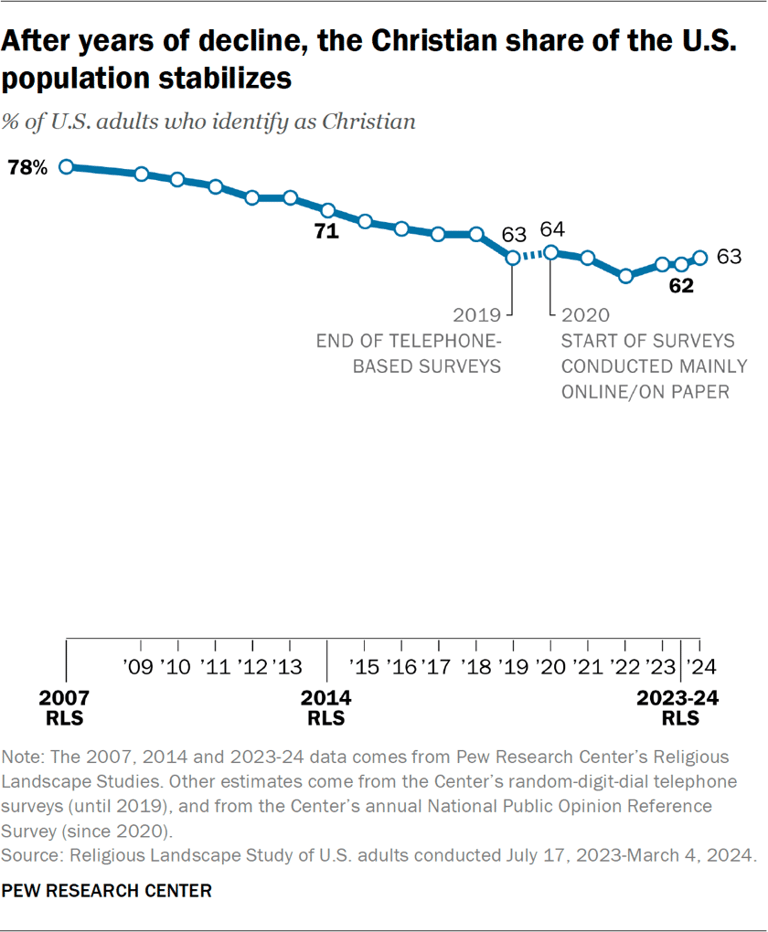
According to Pew Research, the number of Christians in the U.S. may finally stop declining. After years of consistent decline, the percentage of Americans who identify as Christian appears to be stabilizing, at least for now. A large new Pew Research Center survey of 36,908 adults found that just over six in ten Americans still identify as Christian, suggesting the trend may be slowing rather than continuing downward.
2. What Percentage of Americans are Members of a Church?
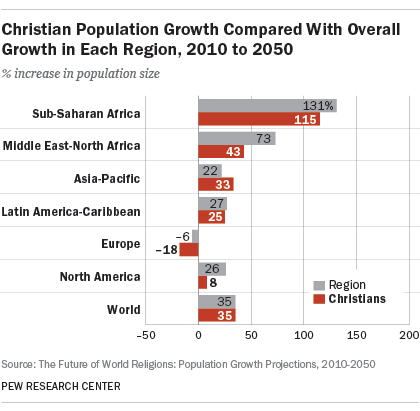
This may be a surprise, but Christianity is growing around the world and is growing faster than the rate of population. The world’s population is climbing at a 0.86% annual rate and will pass 8.3 billion by the end of 2026.
Christianity is growing at 0.95% a year, according to the Gordon-Conwell data Lifeway Research published in April 2026. The Christian population is projected to top 3 billion before 2050, even as church membership patterns in the U.S. keep shifting.
3. Engagement Is the New Church Attendance
Some church leaders are shifting away from using attendance as the primary metric for growth and looking to engagement instead.
Key Statistics:
- Median in-person worship attendance rose to 70 in 2025, surpassing pre-pandemic levels and marking the first positive gain in 25 years of tracking (Hartford Institute for Religion Research, 2025 data)
- Much of the recovery is driven by internal reshuffling rather than broad growth: mainline Protestant congregations continue to see steep declines, and small congregations continue to struggle, even as the overall median rose (Hartford Institute for Religion Research)
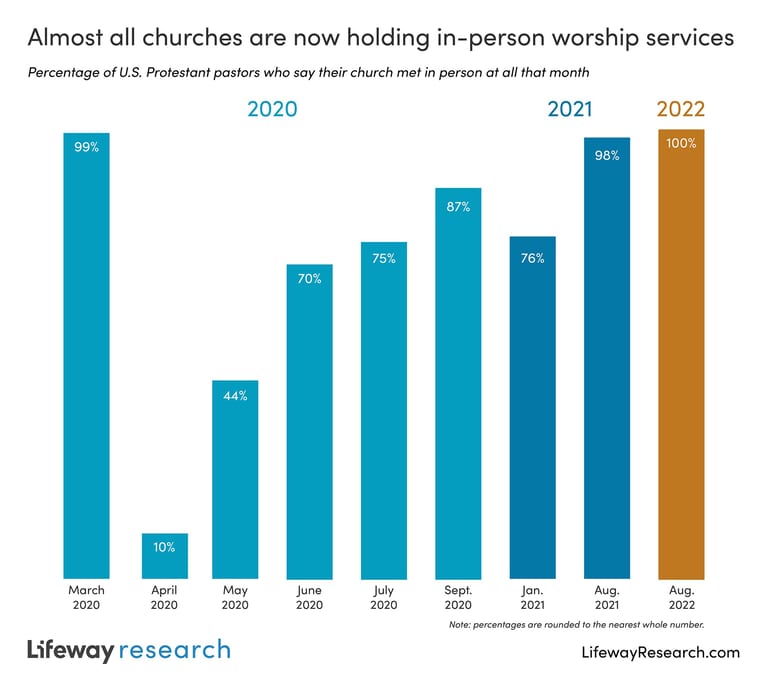
- 68% of U.S. Protestant churches have fewer than 100 people, including 31% under 50 (Lifeway Research, 2022)
- As of 2022, smaller churches were more likely to report being at or near their previous attendance rates (Lifeway Research)
4. 2025 Church Attendance Stats
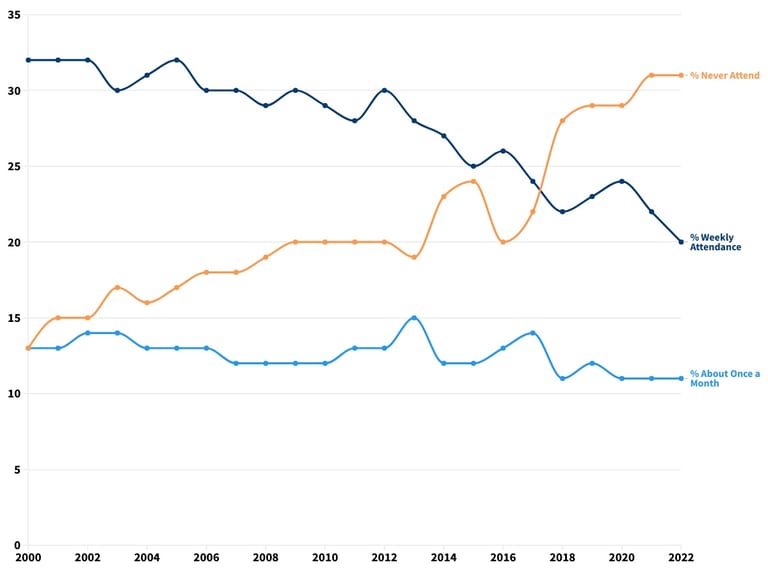
What counts as regular church attendance depends on how you define it. In Gallup’s 2025 data, 31% of Americans said they attend church weekly or nearly weekly, another 10% attend about once a month, and 57% attend seldom or never. Majorities have said they rarely or never attend every year since 2018.
Key statistics include:
• 31% of Americans attend weekly or nearly weekly
• 10% attend about once a month
• 57% attend seldom or never
• Overall church attendance has steadily declined since the early 2000s
When someone searches for a church near them and yours doesn’t show up in local results, they won’t find you. Local SEO is one of the most practical ways to fix that. Here’s a complete guide to local SEO for churches so your church shows up when people in your community are searching.
5. Gen Z Churchgoers Attend More Than Any Other Generation

Gen Z churchgoers are attending more often than they used to, and more often than churchgoers in any other generation. See the Church Attendance and Growth Trends section below for the exact figures and how they’ve changed since 2020.
6. What Does Gen Z Look For in Church?
According to Missional Marketing’s study of non-churchgoing young adults ages 18 to 30, Gen Z is primarily looking for faith that feels relevant to everyday life and makes a real impact in the world. They want a church and community that offers direction while also addressing real needs around them.
What draws Gen Z to church goes beyond basic theology. They are more interested in topics that intersect with their lived experience, including mental health, doubt, identity, purpose, social justice, and environmental concerns.
These non-churchgoing Gen Z adults want churches that help the poor, address mental health, and create real opportunities to help others, not just talk about it. We could not independently confirm the study’s specific percentage breakdowns, so we’re not printing numbers we can’t verify.
7. Church Attendance Has Doubled For Young Adults Since Pandemic

For years, Boomers and older adults were the most consistent churchgoers. That pattern has changed. Today, Gen Z and Millennial churchgoers, often assumed to be disengaged from faith, attend more often than churchgoers in older generations.
Data shows steady growth among these younger generations. In 2020, they averaged about one weekend per month in attendance. Today, that number has nearly doubled, adding almost an extra weekend per month in just five years. Earlier spikes in Gen Z attendance reflect when only the oldest Gen Z adults were included in surveys, whose habits closely mirrored those of their parents.
8. Millennial Churchgoers Are Also Attending More
Millennial churchgoers are showing up more than they used to, just behind Gen Z. See the Church Attendance and Growth Trends section below for the exact numbers.
9. Church Attendance Declines for Most Denominations
For many years, mainline Protestant denominations saw steep membership losses while evangelical churches largely held steady or grew. Between 2000 and 2015, groups like the Presbyterian Church USA, the Episcopal Church, and the United Church of Christ reportedly lost around 40% of their members, while evangelical churches saw modest growth in the early 2000s.
That trend has since reversed. As of a 2023 analysis, church attendance was declining across nearly all denominations, including conservative evangelical churches, reaching historic lows at the time.
10. Non-Denominational Churches See Attendance Growth
Nondenominational churches stand out as one of the few areas of growth in recent years. According to the U.S. Religion Census, adherents in independent, nondenominational churches grew by nearly 9 million between 2010 and 2020, while the Southern Baptist Convention and the United Methodist Church each lost about 2 million. While some individual congregations are growing, overall church participation in the U.S. continues to decline.
11. Spiritual Beliefs Are Widespread
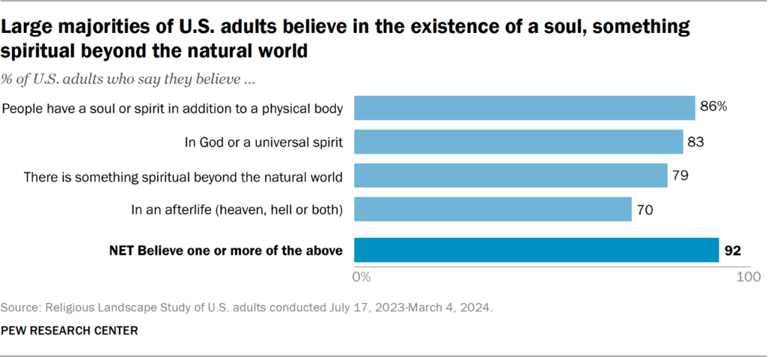
The Pew Research survey also reveals that most Americans continue to hold spiritual or supernatural beliefs. A strong majority believes that people have a soul or spirit beyond the physical body. Many also say they believe in God or a universal spirit and agree that there is more to reality than what can be seen. A significant number still believe in an afterlife, including heaven, hell, or both.
12. Young Americans Are Less Religious Than Older Generations
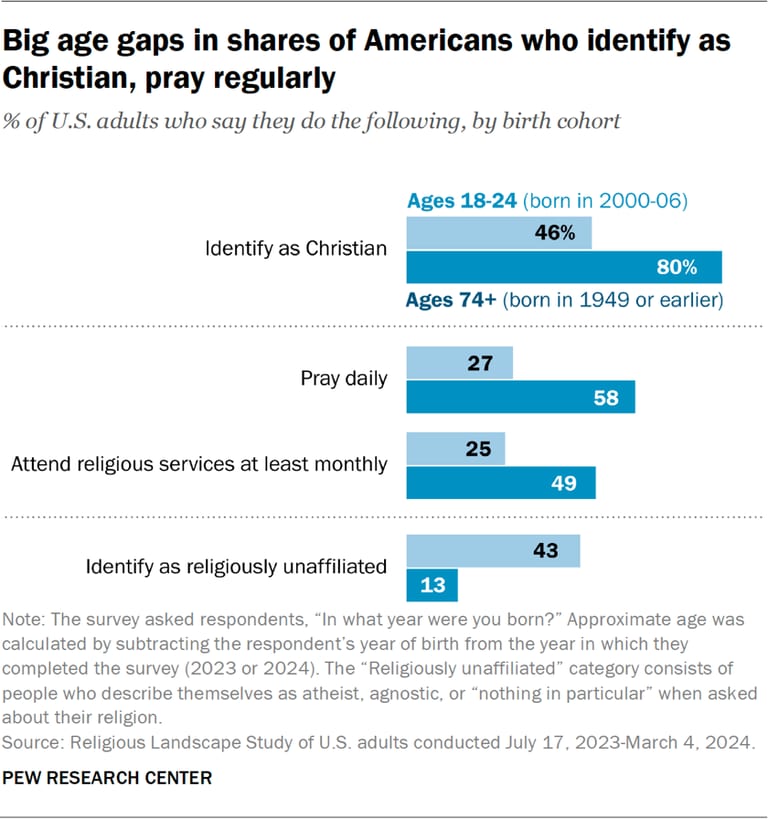
The data also highlights a clear generational gap. Younger Americans are far less religious than older adults across nearly every measure. Adults ages 18 to 24 are much less likely than those 74 and older to identify as Christian, pray daily, or attend religious services on a regular basis. At the same time, younger adults are significantly more likely to say they are religiously unaffiliated.
The survey also shows that fewer young Americans were raised in religious households compared to older generations. And even among those who did grow up in religious homes, a smaller share have continued practicing their faith into adulthood. This points to a long-term shift in how faith is passed down and maintained across generations.
13. The Spirituality Gap Between Generations is Smaller
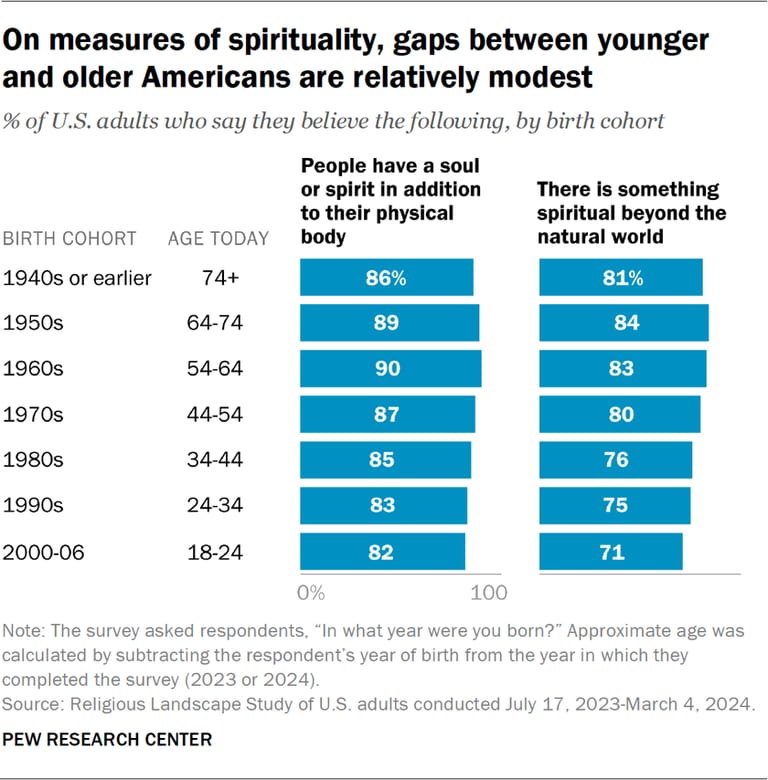
According to the source, when it comes to questions about spirituality, the differences between age groups are much less pronounced. Across every age range, at least eight in ten adults say they believe people have a soul or spirit beyond the physical body.
Belief in a spiritual reality beyond the natural world also remains strong among younger adults. Around seven in ten adults ages 18 to 24, and roughly three quarters of those ages 25 to 34, say there is something spiritual beyond what we can see. That is only slightly lower than the share of adults 74 and older who hold the same belief.
14. The Gender Gap is Narrowing
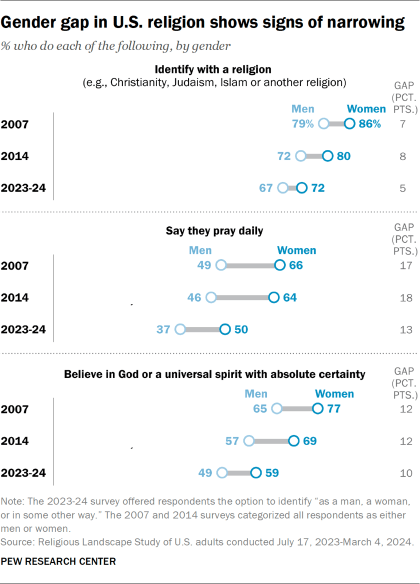
Some recent reports suggest young men may be more religious than young women, which would be a major shift from the past. Historically, women in the U.S. have consistently been more religious than men. The new survey does not show a full reversal, but it does suggest the gap is narrowing among younger adults.
Women still report higher levels of religious belief and practice overall, including prayer. However, the difference is much smaller among younger adults than among older generations. For example, daily prayer rates among adults ages 18 to 24 are nearly the same for men and women, while the gap is much wider among older adults. Even so, in every age group, women remain at least as religious as men.
15. Americans Raised Religious More Likely to Remain Religious
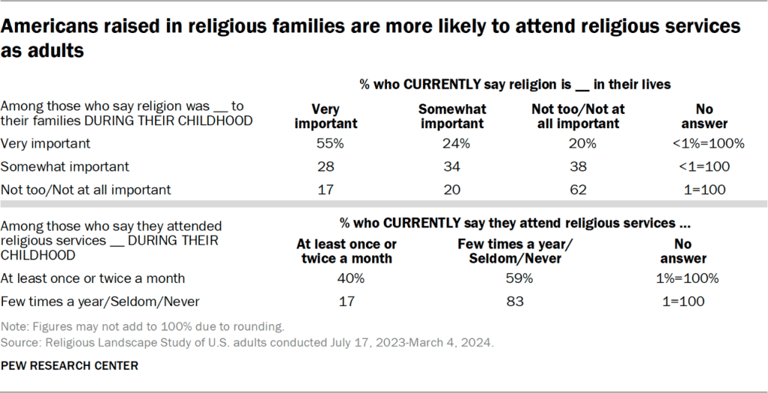
The survey shows a strong link between religious upbringing and adult faith. People raised in religious homes are far more likely to remain religious later in life. Over half of those who grew up in families where religion was very important still say it is very important to them today, compared to just 17% of those raised in less religious households.
The same pattern appears with church attendance. Adults who attended services regularly as children are more than twice as likely to attend regularly now. Those raised in highly religious homes were also much more likely to keep their childhood faith, while people raised with little religious involvement were far more likely to leave religion altogether or switch beliefs as adults.
16. Americans Raised Christian No Longer Identify as Religious
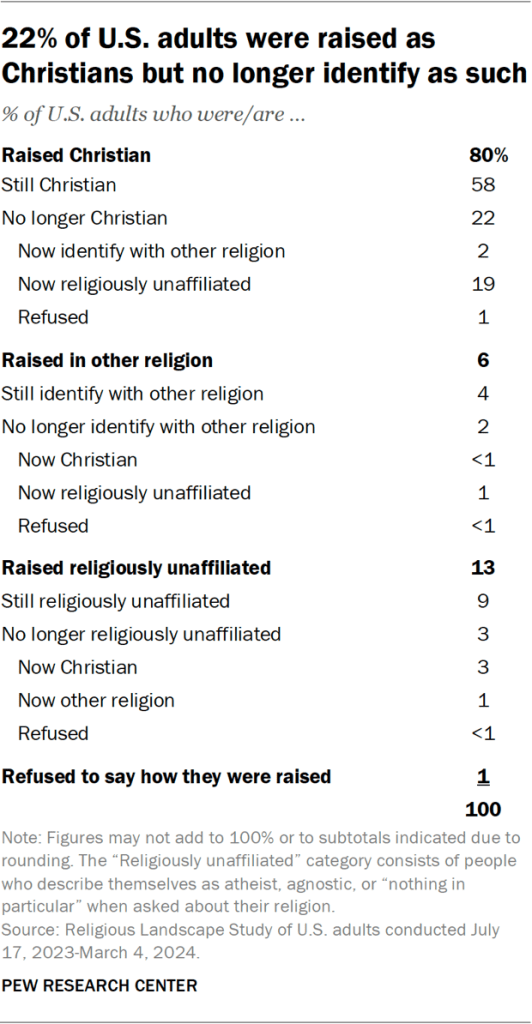
According to Pew Research, about 35% of U.S. adults say their current religious identity is different from how they were raised. This includes people who switched between Christian traditions, moved between non-Christian religions, or shifted in or out of religious affiliation altogether. That share is similar to what Pew found in 2014. When simplified into three groups, Christianity, other religions, and no religion, the trend is clear: Christianity loses far more people than it gains. While 80% of Americans were raised Christian, 22% of all U.S. adults no longer identify as Christian today. See the Church Attendance and Growth Trends section below for how that switching breaks down between converts and departures.
17. American Spirituality Soars as They Age
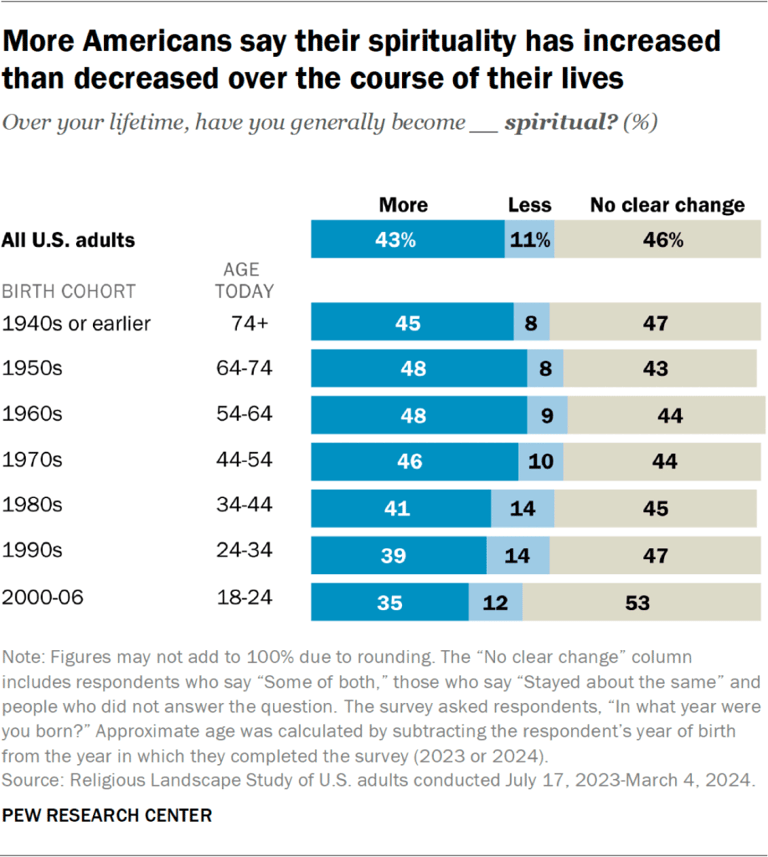
According to the source, more Americans say they have become more spiritual over time than less spiritual, by a wide margin of 43% to 11%. This pattern holds across all age groups. Most Americans also believe people have a soul, that there is a spiritual reality beyond the natural world, and that an afterlife exists. While younger adults are less religious by traditional measures, the differences are much smaller when it comes to basic spiritual beliefs.
18. Many Leave the Church Every Day
People leaving churches is the quiet side of the attendance story. Pew’s 2025 Religious Landscape Study found that 80% of U.S. adults were raised Christian, and 22% of all U.S. adults no longer identify that way. Most churches plan for some annual attrition, and the pandemic accelerated it.
Median in-person attendance has risen to 70, surpassing pre-pandemic levels and marking the first positive gain in 25 years of tracking, but the Hartford Institute for Religion Research attributes much of that shift to reshuffling among existing congregations rather than new participation. Mainline Protestant churches are still declining and small congregations are still struggling, so ongoing attrition remains hard to measure at the level of a single congregation.
19. Average Age of Senior Pastors
The demographic profile of senior pastors in the U.S. skews older. Lifeway Research’s annual phone surveys of 1,000 U.S. Protestant pastors put the average age at 53.84 (median 55) in 2022, essentially unchanged from 2013 (Lifeway Research). With the majority still male, this raises questions about diversity and generational leadership within church communities, a gap you can see reflected in the US pastor rankings.
20. A Quarter of Parents Bring Kids to Church
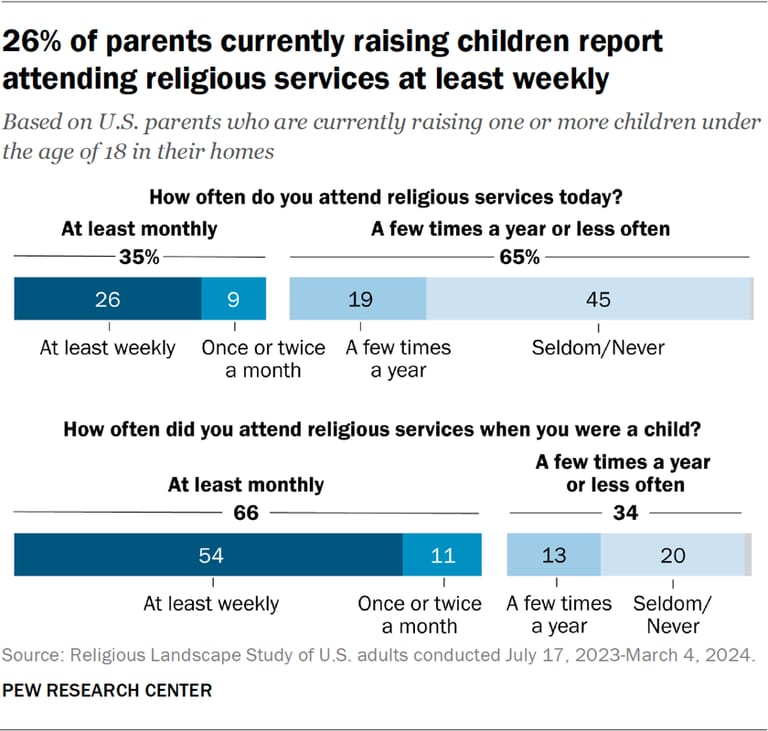
Overall, 26% of parents say they attend religious services weekly, with another 9% attending once or twice a month. While the survey did not ask whether children attend with their parents, even if all of these families did, it would still fall well below the roughly two-thirds of parents who say they attended religious services at least monthly during their own childhood.
21. Nearly Half of Americans Still Go to Church at Christmas
Despite shifts in church attendance patterns over the years, the significance of church during Christmas remains strong in the American psyche. Major holidays, especially Christmas, continue to draw people into churches. A 2024 Lifeway Research study found 47% of U.S. adults typically attend church at Christmastime, 48% do not, and 5% aren’t sure. For nearly half the country, Christmas is still a church holiday, which makes it the easiest Sunday of the year to invite someone.
22. The Gap Between Church Closures and Plants Is Shrinking
Church closures still outpace new church plants, though the gap is narrowing fast. See the Church Attendance and Growth Trends section below for the full 2024-vs-2019 numbers. One detail worth knowing on its own: the roughly 4,000 Protestant church closures in 2024 equal about 1.4% of the estimated 293,000 Protestant congregations in the U.S., according to Lifeway Research.
23. Digital Follow-Up Is Now Part of Church Health
Live streaming, online giving, and digital communication went from emergency measures in 2020 to standard practice. The more useful question now is not whether a church is online. It is whether its digital tools help a first-time guest take a second step: an online connection card, a follow-up text that week, a clear next step on the website.
We don’t have a trustworthy national number that isolates how much digital tools lift engagement, so we won’t print one. The practical move is simple: follow up with every first-time guest within a week, every week, and track how many come back.
24. Online Giving Continues to Rise
Digital giving keeps taking a bigger share of total church giving. See the Church Giving Statistics section below for the payment-method and giving-frequency data. If your church still relies primarily on the offering plate, you’re leaving giving on the table.
25. Church Volunteering Is Rebounding
Weekly church volunteering is climbing, led by younger generations. See the Church Attendance and Growth Trends section below for the full generational breakdown. Rebuilding your volunteer culture is one of the most important post-pandemic priorities for turning new volunteers into long-term ones.
26. The Average Church Budget Is $100,000
According to the National Congregations Study (2018-19 wave, its most recent completed data), the median U.S. congregation has about 70 regular participants and an annual budget of roughly $100,000. That’s a different survey and a different measure than the Hartford Institute’s “median rose to 70” attendance finding elsewhere on this page; the two happen to share a number, not a source. This is a reminder that the “typical” American church is far smaller and leaner than what you see on social media or at conferences.
Most church leaders are not managing multi-million-dollar operations. They are working with tight budgets, small teams, and limited resources. Strategy and stewardship matter more than ever for these churches.
27. Only 27% of Churchgoers Tithe at 10%
Only 27% of regular churchgoers give at or above the traditional 10% tithe mark, according to the Vanco Churchgoer Giving Study. See the Church Giving Statistics section below for what churchgoers actually give and why that gap persists.
28. Catholic Conversions Surging in 2026
A National Catholic Register survey found 66 of 71 U.S. dioceses expected more people to enter the Catholic Church at Easter 2026, some at record highs. This suggests a counter-trend to the overall narrative of Christian decline.
While Protestant churches are largely experiencing flat or declining membership, the Catholic Church is seeing a notable influx of converts. This is a trend worth watching, especially for leaders who assume all of American Christianity is moving in one direction.
29. Small Churches Dominate the Landscape
Small churches are the norm, not the exception. 68% of U.S. Protestant churches have fewer than 100 people, including 31% under 50, according to Lifeway Research (2022).
This creates a perception gap: most church leaders serve small congregations, but most church content and conferences cater to larger ones.
30. Fewer Pastors Are Thinking About Quitting
In Barna’s latest data, 24% of U.S. senior Protestant pastors seriously considered leaving full-time ministry in the past year. That is down from a peak of 42% in 2022, but it still means about one pastor in four. Among pastors who did leave, Lifeway Research found the top reasons were a change in calling (37%), church conflict (23%), and burnout (22%).
Burnout is not just a personal issue. When pastors burn out, churches lose momentum, staff turnover increases, and congregations suffer. Investing in pastoral health, sabbaticals, and peer support networks is essential for the long-term health of any church.
31. Multisite Churches Continue to Expand
Multisite churches have continued to grow as a model, with an estimated 5,000+ multisite congregations in the U.S. according to Leadership Network research. The model allows established churches to reach new communities without starting from scratch.
However, the model is not without challenges. Some multisite churches have consolidated locations post-pandemic, and smaller campuses that relied heavily on video teaching have struggled with engagement. The most successful multisite churches tend to invest in strong local campus pastors and genuine community at each location.
32. New Church Plants Are Healthier Than Legacy Churches
Lifeway Research’s analysis of Southern Baptist Convention churches found those founded since 2000 grew membership 12% over five years, the only group that grew. SBC churches founded 1950-99 (-11%), 1900-49 (-13%), and before 1900 (-11%) declined. Church planting continues to be one of the most effective strategies for reaching unchurched communities.
New churches tend to reach younger, more diverse populations. They also tend to adopt digital tools, contemporary worship styles, and community-focused outreach strategies from day one, rather than trying to retrofit them later.
Church Attendance and Growth Trends
Median congregation attendance rose in 2025 for the first time in 25 years of tracking, even as longer-run generational and religious-identity shifts keep reshaping who’s in the room. Here’s what the newest research says about who’s showing up, how often, and why it matters for a church running 200 or more.
Median attendance rose after a 25-year decline
Median in-person worship attendance rose to 70 in 2025, surpassing pre-pandemic levels and marking the first positive gain in 25 years of tracking, according to the Hartford Institute for Religion Research (Faith Communities Today, 2025 data, published April 2026). The finding comes from a survey of 7,453 congregations across 79 denominations and traditions, fielded September through December 2025.
The Institute is direct about what’s driving that number: much of the growth reflects internal reshuffling rather than an expansion of religious participation overall. Mainline Protestant churches continue to see steep attendance declines, and small congregations continue to struggle. For a 200-plus church, this reads as a reshuffling story: some congregations are pulling ahead while others, especially mainline and smaller congregations, keep losing ground.
Compare your own attendance trend to your own pre-2020 baseline before drawing a conclusion either way. Congregation size and denomination affect the picture too much for the national median to tell you where your specific church stands.
| Years | Adults attending weekly or nearly weekly | Source |
|---|---|---|
| 2000-2003 | 42% | Gallup |
| 2011-2013 | 38% | Gallup |
| 2021-2023 | 30% | Gallup |
| 2025 | 31% | Gallup, 2025 |
The population-level number and the congregation-level number are measuring different things, and both can be true at once. Gallup tracks how often U.S. adults say they attend anywhere. The Hartford Institute figure tracks attendance that congregations themselves reported.
The age gap is still real, but Christian identity has leveled off
Younger adults remain far less likely to attend regularly: 25% of 18-to-29-year-olds attend weekly or nearly weekly, compared to 37% of adults 65 and older (Gallup, 2025). Christian identification shows a similar age split: 46% of adults 18 to 24 identify as Christian, versus 80% of adults 74 and older (Pew Research, 2023-24 data, published February 2025).
The 62% of U.S. adults who identify as Christian breaks down to 40% Protestant, 19% Catholic, and 3% other Christian traditions (each a share of all U.S. adults) (Pew Research, 2023-24 data). Overall, 35% of U.S. adults say their religious identity today differs from how they were raised, and roughly six former Christians leave the faith for every one convert (Pew Research, 2023-24 data). That ratio is worth sitting with: on net, more people are leaving Christianity than joining it.
Younger generations are showing up more than the headlines suggest
Gen Z churchgoers now attend about 1.9 weekends a month and Millennial churchgoers about 1.8, both up from roughly one weekend a month in 2020, the highest levels Barna has recorded for young adults (Barna, 2025). Across all ages combined, churchgoers average 1.6 visits a month, so younger generations are pulling that overall number up rather than down.
Weekly volunteering is climbing alongside attendance: an estimated 24% volunteered weekly at church in 2025, up from 15% in 2024 (preliminary data), led by Gen Z at 21% and Millennials at 19%, against 11% of Gen X, 9% of Boomers, and 12% of the oldest generation (Barna and Gloo, State of the Church, 2025). The source doesn’t state the base for the 24% overall figure, and it’s higher than any single generation’s figure, so treat it as directional rather than precise. Younger volunteers showing up in bigger numbers comes with a job attached: they’re new to serving, so onboarding and retention now matter as much as recruiting.
Net church formation is still catching up to closures, though the gap is closing fast: 4,000 Protestant churches closed against 3,800 started in 2024, a 200-church gap that’s narrowed sharply from the 1,500-church gap in 2019 (Lifeway Research, 2026).
Church Giving Statistics
Religious giving is still the single largest category of American charitable giving, but the habits behind it are shifting: fewer people give on a strict weekly rhythm, more give by card, and most donors give less often than they say they intend to. Here’s what the newest giving research means for a 200-plus church’s budget and stewardship strategy.
The big number: Giving USA’s $152 billion
Americans gave about $152 billion to religion in 2025, about 23% of all U.S. charitable giving and still the largest single category tracked by Giving USA, as analyzed by the Lake Institute on Faith & Giving (2025 data, published July 2026). Religious giving grew 2.4% in nominal dollars year over year, but after inflation it actually declined 0.2%. For a single congregation, that means holding steady in nominal dollars isn’t the same as holding steady in real terms. Budget conversations should account for that gap directly instead of assuming last year’s dollar total buys what it used to.
Church-specific data tells a slightly better story than the sector-wide number. ECFA’s 2025 State of Giving report, released December 2025, found cash giving to member churches rose 2.6%, against 1.2% for member nonprofits, the second straight year churches have outpaced them (ECFA State of Giving via MinistryWatch). Individual cash gifts still make up roughly 75% of total revenue for ECFA member organizations. Government grants are a small slice by comparison; individual generosity is what actually funds these organizations.
What churchgoers actually give
Average weekly giving per person, measured across combined in-person and online attendance, is $29.63 (in-person alone averages $39.08), according to Christian Standard’s 2025 survey of 241 churches (2024 fiscal-year data, a sample of larger churches averaging $1.8 million in annual giving each), a figure also cited on Vanco’s page. Only 27% of churchgoers tithe at or above the traditional 10% mark, per the Vanco Churchgoer Giving Study.
Payment method is shifting too: about half of all church donations now come via card or online methods rather than cash or check, per Enterprise Apps Today data cited on Vanco’s page (2024). At the same time, the habit of giving weekly has faded:
| Giving frequency | Share of churchgoers | Source |
|---|---|---|
| Gave weekly, 2015 | 49% | Vanco |
| Gave weekly, 2025 | 39% | Vanco |
Fewer people giving on a strict weekly rhythm makes recurring and scheduled online giving more valuable. It keeps cash flow predictable when fewer people are dropping a check in the plate every Sunday.
The intention-to-action gap
Christian donors want to give more consistently than they do. In a 2026 survey of nearly 2,000 Christian donors, 95% said they aspire to give monthly or more often, but only 30% actually do (Givelify Philanthropic Research, 2026 Giving in Faith report, via Lake Institute). Church leaders overestimate how well that intention translates into action: nearly 900 surveyed church leaders estimated that about half of their own congregants give monthly or more, a gap of about 20 points above what donors actually report (same source).
Most of your givers already want to give consistently. The practical lever is removing friction: recurring giving, text-to-give, a giving page that works on a phone, so intent turns into a habit.
Looking Ahead to 2026

The data tells a clear story. Gen Z churchgoers are showing up at rates nobody predicted, and that is a massive opportunity for churches willing to meet them where they are. At the same time, church closures outpacing new openings is a warning sign that the status quo is not sustainable for aging congregations that resist change.
Online giving, active social media, and a church website that works all give people an easier way in.
The decline of Christianity in America may be leveling off, but that does not mean leaders can coast. The churches that will thrive in the next decade are the ones adapting now: planting new communities, investing in young leaders, and treating their online presence as seriously as their Sunday morning experience.