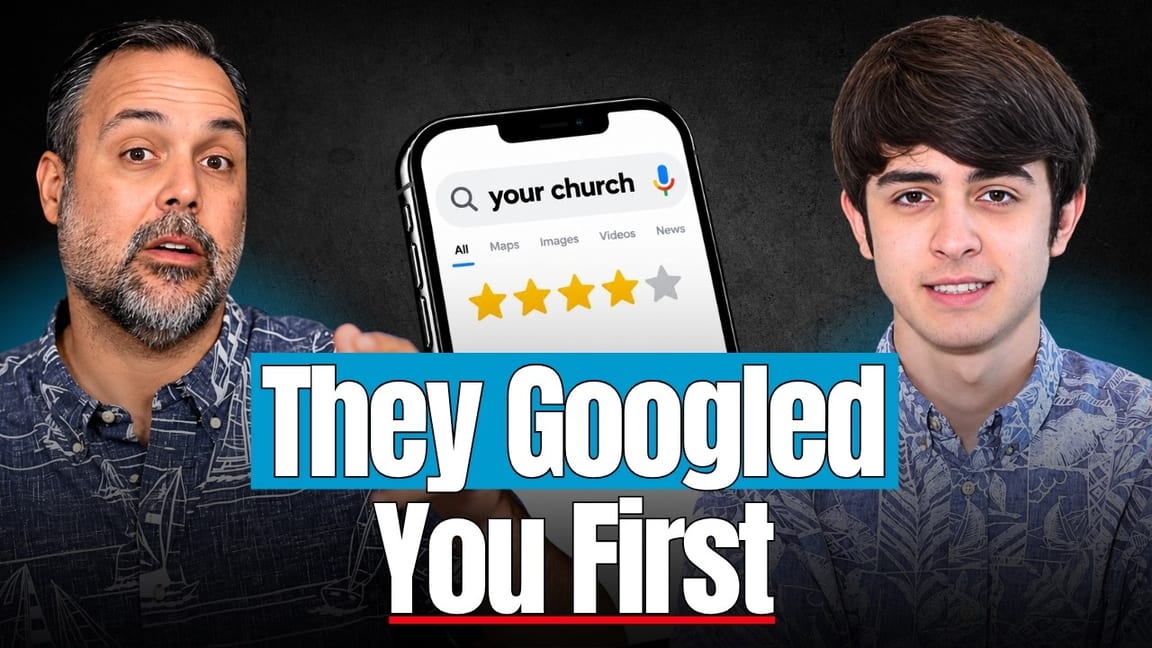
The person visiting your church in 2026 is not the person who visited 20 years ago. They’ve done more research. They have more questions. And they’re looking for something very different.
I’ve been in ministry since 2004. (One of us was two years old at the time.) The world has changed a lot since then, and I suspect many of us still picture a church visitor who doesn’t really exist anymore.
Meet Saddleback Sam
Back in the early 2000s, at the height of the Purpose Driven Life movement and the 40 Days of Purpose campaigns, a lot of us were studying Rick Warren. He was hugely influential on me as a young pastor, and I still love Rick. In The Purpose Driven Church, he described “Saddleback Sam,” the typical person Saddleback was trying to reach.
Sam is a perfect time capsule of the year 2000. As I remember him, he has a flip phone clipped to his belt and wears business casual that’s far too formal by today’s standards. (Look him up.) He’s married with kids, financially stretched, short on time, and living in Orange County. He was basically a young Boomer or early Gen Xer with a family.
A lot of pastors still picture some version of Sam when they think of a visitor: a young family. I know I do. For those of us whose parents were Gen X, we were the kids in those young families. My dad was on staff at a large church in North Carolina back then, and the people who filled it on Sundays look nothing like who’s walking in today.
So maybe it’s time for a new avatar. We’ll call him REACHRIGHT Reggie. Here’s who he is.
Who the New Visitor Is
They’re likely Gen Z, and the most consistent attender in the room
Gen Z churchgoers attend an average of 1.9 weekends a month, more consistently than any other generation.
This stat gets misread a lot. It does not mean more Gen Zers go to church than Boomers, Gen X, or millennials. The typical Gen Zer is still less likely to attend. But the ones who do attend show up more often than anyone else. They’re the people most likely to be doing life with your church, volunteering, and showing up to events. That’s worth knowing.
It matches what we see. Gen Z in our church, and in the churches we talk with, is hungrier and more engaged in their faith than generations for whom church was just what they’d always done.
They’re increasingly likely to be a man
Men now outpace women in weekly attendance, 43% to 36%, the widest gender gap in 25 years.
When I started in ministry 22 years ago, the opposite was true. We had an obvious shortage of men, and we prayed like crazy that God would help us reach them. There were stats going around, and some people now call them “stat crimes,” claiming that reaching the father brought the whole family to church at rates in the 90s, compared to the 20s if you reached the mother. I always found that a little demeaning to women. But reaching men was top of mind for every church I knew.
To be honest, I don’t think anything we tried worked. We did silly things, like driving motorcycles onstage, hoping guys would finally show up. It didn’t move the needle. Some churches made genuinely good efforts to reach young men, and those probably helped. But this sweeping change is bigger than churches getting better at ministering to men. Something shifted culturally, and as believers, we’d say God is doing a new thing in people’s hearts, largely apart from our best efforts.
They’re more likely to be a new believer
Bible sales are up 87% in recent years. Much of that comes from new Christians, especially among younger generations.
Cultural Christianity Is Fading, and Faith Is Getting Stickier
Twenty years ago, Christianity in America was much more cultural. Even families that weren’t really Christian went to church because that’s what everyone in the neighborhood did. For a lot of Gen Z, that default is basically gone.
We come from opposite sides of that story. I grew up in church with a dad in ministry. Of the friends I grew up with in that church community, not many are still pursuing the Lord as young adults. Of my Christian friends now, I’d guess about half grew up in church and half had no grid for any of it until they got radically saved as teenagers.
I didn’t grow up in church at all. My mom raised me as an atheist. At five years old I asked her what happens when you die, and she told me you just don’t exist anymore. My parents didn’t come to faith until late in my childhood.
There are still traces of cultural Christianity. Christian music seems to be having its best moment ever, with Christians and non-Christians alike using it as background tracks on TikTok. But the default is fading. And faith is showing up in surprising places. Billy Corgan, lead singer of the Smashing Pumpkins, recently said on a podcast that Jesus Christ is Lord. Meanwhile, some of the Christian artists I grew up listening to on Christian radio have since deconstructed. If you’d told my 16-year-old self that the guy whose CDs I was burning would end up being the Christian, I wouldn’t have believed you.
People who come to faith through adversity, outside a Christian culture and drawn by the Holy Spirit through their own discovery, tend to have a stickier faith. It’s battle-tested. We’re not against raising kids in church. We’re 100% for it. But a faith formed only by being surrounded by Christian culture can lack that testing. Many of the people walking into your church today have already been through some of that before they ever arrive. That probably explains part of why the Gen Z believers who do show up are so consistent.
They’ve Researched You Before They Arrive
The digital transformation of the last 20 years has changed how people find churches. We don’t try things in person first the way we used to. We watch reviews, read other people’s opinions, and look at everything from arm’s length before we commit, whether it’s a restaurant, a purchase, or a church. There’s a running joke in YouTube comments under a trusted reviewer’s video: “Thanks, my opinion just dropped.”
Before, it was: someone invited me to church, so I’ll go Sunday and see if I like it. Now it’s: someone invited me to church. What was it called again? Let me pull up their Instagram and their website. That’s true for Christians and non-Christians alike.
We saw this firsthand recently. A visitor told me before service, “I just want you to know, we totally love this church.” She’d just told me it was her first time, so I asked how she could know that. She’d been watching our services online and had read our reviews before ever walking in. (Have you noticed that visitors are usually the first ones there, 5 to 10 minutes early, while your members trickle in 5 to 10 minutes late?)
Visitors are far more educated about your church than they used to be. Many pastors still push back on asking for reviews, but reviews are just testimonies.
Here’s why it matters. You probably love your church and think it’s the best one in town. Maybe it is. But if that doesn’t come across online, the person who would love it will never show up to find out. Twenty years ago, people had to show up to see what you were like. Now your online presence is part of evangelism. It is the first visit.
Pull the weeds
When I started in ministry at 23, I was an associate pastor at a church of about 300, which mostly meant doing whatever the lead pastor didn’t want to do. He was very particular about the walk from the parking lot to the front door. Every Sunday he’d walk it with me until I got it: a weed growing out of a crack, a gum wrapper on the ground. I was blind to that kind of thing, but he understood how much the first impression mattered.
That first impression now happens online, and it deserves the same care. Treat your Instagram and your website as your new greeting team. We put a lot into making sure people feel warmly welcomed on Sunday morning, but that welcome starts online. Scroll through your Instagram and website the way he walked that path. What are the weeds? What needs to be removed, changed, or updated?
Their Theology Is All Over the Place
People are now being discipled by social media. We had a teenager start coming to our church whose family isn’t Christian at all. He came to faith through preachers’ clips on TikTok and Instagram, and ours was likely the first church he’d ever attended. He had deep theological knowledge of certain niche topics, with surprising blind spots in what we’d consider pretty basic parts of the gospel. I’d never seen anything like it.
Saddleback Sam probably went to Sunday school. He knew Noah’s ark, David and Goliath, and that Jesus died on the cross. Many new visitors don’t know some of those basics, but they’re hungry and eager to go deeper.
Twenty years ago, visitors were usually either culturally Christian, with a general grasp of the gospel, or theological blank slates. Deep theology was hard to access. You had to go to a bookstore, or to school. There weren’t YouTubers covering every possible angle of the faith.
Today, visitors arrive much more settled in their worldview, and they’re often looking for a church that matches the one they’ve already formed. The church can’t just accommodate whatever worldview people bring. If someone has been listening to healthy biblical teaching, like that young man, their theology may be uneven but at least it’s accurate. Others have been listening to teachers who are not biblically accurate, and they’ll be more sensitive to anything in your sermon they disagree with. Almost no one arrives with zero spiritual thoughts, especially where theology meets politics.
People also fact-check you on the fly. While you preach, they look up what a passage says or what their favorite Bible teacher thinks. On secondary issues, like women in ministry, there are great teachers on both sides, so whatever your church holds, they’ll find a voice that disagrees. You’re competing with other voices. They hear you on Sunday, but the other six days they may be listening to all kinds of pastors.
That’s not necessarily bad or scary, but be mindful of the algorithm. TikTok is built to push the most engaging, clickbait content. A young person can get pulled into a political pipeline, and the same thing can happen with Christian teaching. Someone with no Sunday school background has nothing to compare it to.
So take a fresh look at your discipleship pathway, from the first visit to the third to getting connected. At our church, that means a monthly Aloha Lunch followed by Growth Track. Make sure the path can meet people who arrive from very different starting points.
They’re Desperate for Community
Ten or twenty years ago, many churches pushed toward the friendliest, most vanilla services possible to draw the biggest crowds. That movement has largely died. Young visitors aren’t looking for a show. They’re looking for community. Many realize: I’m lonely. I live online instead of in real life. I need good friends. And the church has always been one of the strongest local communities anyone can walk into.
The church has known about loneliness for a long time, but despite our best efforts, we haven’t made it better. When I was 23, I started a young adults group called Tribe. Our tagline was “a family for the familyless generation.” That felt true then, and it’s far worse now. By comparison, people back then had tons of friends.
I saw a study recently, and I’m working from memory here, so take the exact numbers loosely. In the ’90s, just over 50% of Americans had a non-family member in their home in a given month. Today it’s about 12%. COVID did a number on us. We all know we need more relationships. We’re just not having people over.
And it’s about to get worse. I recently saw a demo, which could have been faked, of an AI agent on a Zoom call that was so convincing that only 3% of testers could tell it wasn’t a real person. We were already lonely. It’s about to become a full-blown epidemic.
That’s good news for the church, if we execute well. The church is the best place on earth to heal this. We used to build services around producing the best content. Content is now free and abundant. There are better preachers, better worship music, and better everything online than anything you can produce on a Sunday. But nobody out there can offer what your church can: a real place of community. That’s our superpower. It should be all hands on deck.
That has two practical implications:
- Put community front and center online. When people research your church, the community you’ve built should be the first thing they see, because it’s what they’re looking for.
- Offer more than Sunday. People used to see each other all week, at the park, at school drop-off, at the grocery store, so Sunday was enough. That doesn’t happen anymore. Invite people into small groups and other gatherings more than ever before.
Your number one assignment with a visitor isn’t to impress them with your message or your worship. It’s to make sure they make a real human connection. That’s the secret to stickiness now. Whatever that system looks like at your church, lean into it.
Your Next Step
Want to know what a new visitor sees when they research your church before Sunday? We offer a free church marketing and website review. Our team will look at your website, social media, and online presence the way a first-time guest would, and send back honest, specific recommendations you can actually use. No sales pitch. Real feedback.
Turnaround is about 48 hours. It’s free for any church that asks.
More Resources
- Church First Time Guests Aren’t the Same Anymore
- What the Fastest-Growing Churches Know That Most Don’t
- Ranking the Most Powerful Ways to Reach Gen Z in 2026
- 7 Secrets to Effective Church Community Building in a Digital World
- How to Build the Perfect Church Plan-Your-Visit Page
- How to Get More Google Reviews for Your Church