Every few years, something changes the rules of church marketing. Smartphones did it. Social media did it. Now AI is doing it again, and this time the change is moving faster than most churches can keep up with.
The conversation we’re having with pastors has shifted. A year or two ago the question was should we use AI. That’s still a fair question, and there are real places it shouldn’t go. But most pastors have moved past it. The question now is how: how do we actually put this to work in the day-to-day life of a church, especially in marketing? Most leaders know there are better workflows out there. Few know how to get from here to there.
That’s what this episode is about. What changed, and what you can do about it.
Why the Advice Keeps Changing
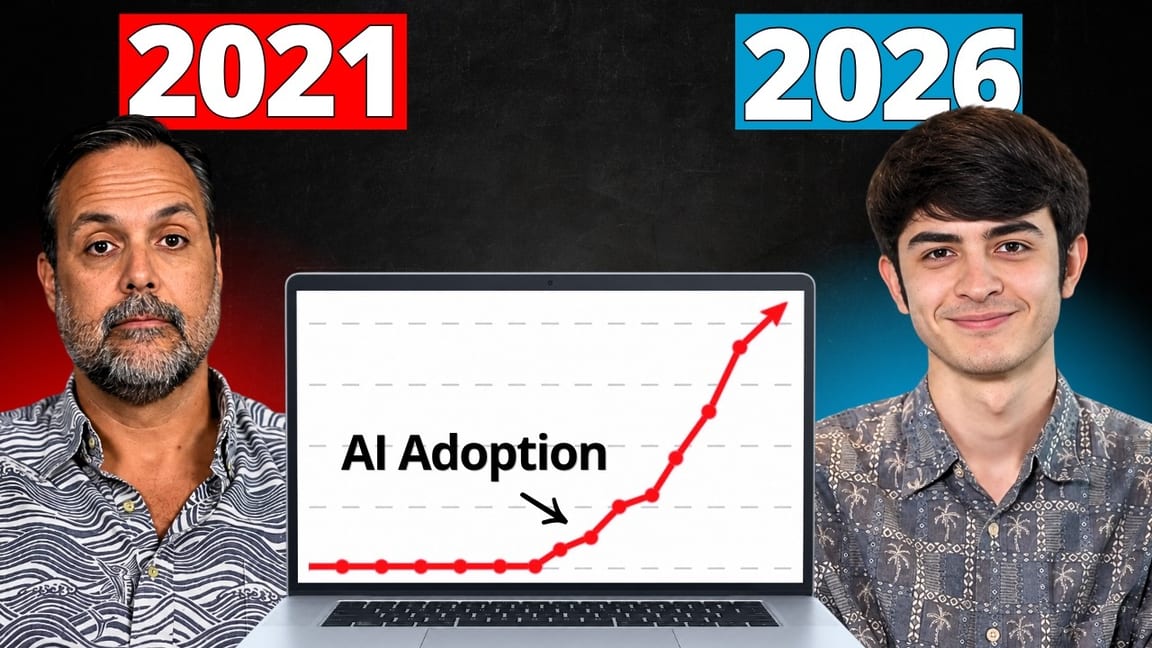
The church marketing advice we’d have given on this podcast five years ago is different from what we’d say now, and AI is the reason. Back in 2021, blog writing was our main content channel. We did really well with it. Then AI made written content so cheap and so common that it stopped moving the needle, so we pivoted hard into video and podcasting, and it’s been great.
Nobody likes changing systems. But AI is different from most system changes: once you get over the first hump, everything on the back end gets easier.
Here’s a way to measure it. We tried to estimate how much longer it would take our team to do a normal week’s work if we took away Claude and every other AI tool tomorrow. For our content team, the honest answer is roughly 50% more hours for the same output. Even that undersells it, because the output itself has grown because of these tools. We never would have reached this level without them. Personally, I’d say AI has at least doubled what I can get done.
For churches, the lesson is this: once you bring AI into your 2021-era marketing systems, you could do the same work in less time. But the better move for most churches is to keep the hours and grow the output, and be better stewards of the assignment to reach new people.
One stat from Barna frames the gap well:
- 95% of church leaders say technology opens new opportunities for ministry.
- 33% say they’re using AI meaningfully.
Nearly every pastor agrees these tools could free up time for the parts of ministry only they can do. Only a third think they’re actually using them that way. We want to close that gap. (We’re not getting into the ethical boundaries here. We covered those a few weeks ago in AI in Churches: Where Does It Cross the Line?) Here are the four new rules.
Rule 1: Content Creation Is No Longer the Bottleneck
Churches have an advantage in content that most organizations don’t. Your average plumber isn’t producing weekly plumbing content. But the church has produced content on a basically weekly basis for 2,000 years. People gather, a sermon gets preached, and people receive it.
About ten years ago, churches figured out that since they were already recording, they might as well put the content on Vimeo or YouTube. AI is just the next logical step with the tools of our day.
One clear line first: don’t ask AI to make content from the Bible for you. “Find me something from Romans to post this week” is not what we’re talking about. The goal is to take the content you already created, in your voice as a pastor, and help it travel further.
The sermon transcript playbook
The key that unlocks all of it is your sermon transcript. After we upload Sunday’s message to YouTube, we pull the transcript, which YouTube generates at roughly 99% accuracy. From that one transcript you can produce:
- Small group discussion guides. A no-brainer.
- Carousels. Swipeable still graphics, ideally with photos that reinforce one of the week’s themes rather than generic images.
- Text-on-screen videos. B-roll of whoever spoke Sunday, a provocative line on screen, and a “check the caption for more” that pulls people into the full idea.
- Sermon clips. Tools like Sermon Shots and Opus Clip use AI to cut short clips out of your message every week.
- Email copy and newsletters. Same message, different format.
We put together a free PDF of 77 AI prompts for pastors, and the prompts for everything above are in it.
Do all of that by hand (three sermon clips, carousels, discussion guides, the rest) and it’s close to a full-time job. With AI, it’s about two hours a week. That’s the lowest-hanging fruit in this whole conversation.
Why it matters
Instagram and YouTube are where people find content now. Not street corners or the big public gathering places of the past. That’s where people get their news, their entertainment, their information. If that’s where people are showing up to listen, that’s where we need to show up with the gospel. Keep the in-person services, obviously.
I just got back from a trip to Korea and the Philippines. In Korea, street preaching is alive and well. We got stopped about a dozen times by people sharing the gospel, and I encouraged and blessed every one of them. I’m not against one-to-one evangelism at all. There’s absolutely a place for it.
But consider this. I recently did a YouTube Live with Pastor Mike Signorelli. He only started taking his channels seriously around COVID, five or six years ago: YouTube, TikTok, Facebook, Instagram. When we published our data-backed research on the most influential pastors in the world, he came in at number four. For context, Joel Osteen was number three and Steven Furtick was around eight or nine. A pastor who got serious about online ministry half a decade ago now has reach comparable to theirs.
This is the best time in history to take the gospel to the ends of the earth, and most churches are underusing it.
Think about it from the pulpit side, too. You put real work into your sermon because you believe the message matters. (If you don’t feel that way about your sermon, work on a new one.) The people in the room Sunday were blessed by it. We want more people blessed by it. What kept most churches from clipping and posting it everywhere was the time and effort. That barrier is mostly gone.
Rule 2: Personalization at Scale Is Now Possible for Small Churches
If your communications team is one person juggling everything, AI can carry a lot of the data work that used to live in that one person’s head.
We’ll be honest: this one makes us cautious. We hate fake personalization. People are craving real human interaction, especially from the church, and we never want to trick anyone into thinking a bot or a mail merge is a real person on our team.
So here’s where we draw the line. If I’ve genuinely committed to praying for our new visitors every week, a casual “I’m praying for you this week” might be fine. But I’d never let AI write something specific like “I’m praying for you and the situation you’re facing” when I’m not actually doing that. In business data, AI personalization drives big jumps in open rates and click-throughs. Some companies use what they know about you to fabricate a personal touch and get the click. The church isn’t a business. We don’t do whatever is most efficient. The church has to be authentic, 100%.
Where AI personalization is a great fit is the unglamorous back-end work, like segmenting your email list. Instead of all-church blasts to everybody:
- Parents of elementary-age kids get the content that’s relevant to them.
- Senior adults get what they’re actually looking for.
- Volunteers in a specific ministry get the “we need help with this” emails.
- Young parents hear about the events built for them.
Some content overlaps, but plenty doesn’t. Getting the right message to the right people saves everyone time and cuts the confusion. We’re experimenting with this ourselves, and it makes us more efficient and more personal without faking anything.
Rule 3: AI Changed How People Find Churches
Ten years ago, someone typed “church near me” into Google. Now they type the way they’d talk to a person: “My family and I are looking for a church in this area with something for our elementary school kids.” AI Overviews come up first, Google’s AI Mode works a lot like ChatGPT, and the search engine understands that context.
Most churches are sleeping on this, and it’s one of the biggest opportunities out there right now.
Not all clicks are equal
When someone reaches your website from ChatGPT, their visit carries a little tag that says where it came from. (Claude doesn’t pass it the same way, but ChatGPT does.) So you can identify those visitors on the back end.
In our business and at our church, people arriving from ChatGPT are much further along in their decision than someone who wandered onto the site. They’ve already built up context in conversation with their AI, and they trust what it tells them about as much as a recommendation from someone they know. We’re seeing signs they might trust it even more, because their AI often knows them better than a coworker or neighbor does, and it’s done more research on the alternatives.
For a church, that means someone coming from AI is far more likely to actually show up on a Sunday than someone clicking a Meta ad or a generic “churches near me” result. AI referrals are the Cadillac of website traffic.
I wish our church and our business had jumped on YouTube five years earlier than we did. I wish I’d jumped on TikTok in 2019, when traction was easy. AI search is that window right now.
Three things that help AI recommend your church
Google has published guidance as search has changed, and the recipe hasn’t changed much since we first covered how to show up in ChatGPT church recommendations. Quickly:
- Add FAQs that answer specific questions. That’s how people search now, and AI pulls answers from that content. Ages, kids’ programs, youth group, service times, denominational details. If it’s on your site, AI can recommend you. If it isn’t, it won’t, even if you’re the perfect church for that family. And don’t stop at one FAQ on your About or Plan Your Visit page. Build FAQs into every page where they make sense: kids, youth, men’s and women’s ministry, life groups. People have questions about all of them. (More in FAQ Pages and AI Search.)
- Keep your information up to date and consistent on your Google Business Profile, Yelp, and everywhere else: service times, location, current photos. Google trusts that data heavily and checks that it matches across platforms.
- Get reviews, and keep them fresh. Not just good reviews, recent ones. It feels a little strange for a church to ask members for Google reviews, but it moves the needle. Google sees it as a business profile, and recent reviews tell it this place is alive and people are showing up.
This isn’t lip service. My wife recently started painting murals and other commissions, and we built her a new website. I asked someone she’d painted a piece for to leave her a quick Google review. Since then, she’s gotten inquiries from people referred by AI, mostly ChatGPT, since that’s the easiest source to track. These steps work for churches, businesses, artists, anyone who wants to be found online.
Want to know where your church stands? Our church near me test checks whether your church gets recommended in both local search and AI search.
Rule 4: The Authenticity Bar Has Been Raised
The flood of AI content in every channel has put people on guard more than ever. Every post gets the same question: Is that real? Is that AI? So the parts of your church that are authentic and real (your community, your people, your story) matter more than ever. Put them first.
There’s a real risk here. A church has built trust with its people. Take the wrong shortcut with AI and break that trust, and it’s very hard to win back. Trust is hard to earn and easy to lose.
So use AI as a thought partner, never the thought leader. When you multiply your sermon into carousels and clips, you still have to review it and humanize it. We use AI heavily for brainstorming here, including on our YouTube scripts, but in the end a person writes it, edits it, and makes it human. AI doesn’t let you hand off your responsibility to obey the Holy Spirit, or your responsibility to be authentic with the people you’re called to pastor.
A simple practical test: before any copy, video, or promo image goes out, ask whether it’s pure AI. If it is, it won’t land. People are developing an eye for AI images and AI writing, and they tune it out. The photos from your baptism Sunday are powerful. Mixed in with AI-generated images, they lose their power.
The authenticity tsunami
There’s an AI tsunami coming, but there’s an authenticity tsunami right behind it. Gary Vee is investing in a restaurant where you lock your phone away at the host stand and get seated at communal tables with strangers. People are so hungry for something real that it’s become an investment opportunity. My daughter is one of many people buying old digital cameras because those photos feel rawer and more real than overprocessed smartphone shots.
This is the church’s secret sauce. Everything about the church is built on real people, real community, and the realest thing there is: the love of Jesus. It’s transformed our lives, and if you’re a pastor reading this, it’s transformed yours. As the world gets more automated and more artificial, I believe people will flock to the church as the one place where things are still deeply human and completely authentic. That could draw millions of people toward the gospel, and we need to be ready for it.
Your Next Step
Not sure where your church stands on any of this: your AI search visibility, your sermon content workflow, your digital front door? We offer a free church marketing and website review. Our team will look at how findable your church is online, from local search to AI recommendations, and send back honest, specific recommendations you can actually use. No sales pitch. Real feedback.
Turnaround is about 48 hours. It’s free for any church that asks.
More Resources
- AI in Churches: Where Does It Cross the Line?
- Your Church Trusts ChatGPT More Than You. Here’s Why.
- How Smart Churches Are Using AI Prompts to Save HOURS
- How to Create Sermon Clips for Social Media
- How to Get More Google Reviews for Your Church
- The Biggest Mistake Churches Are Making on Social Media Right Now