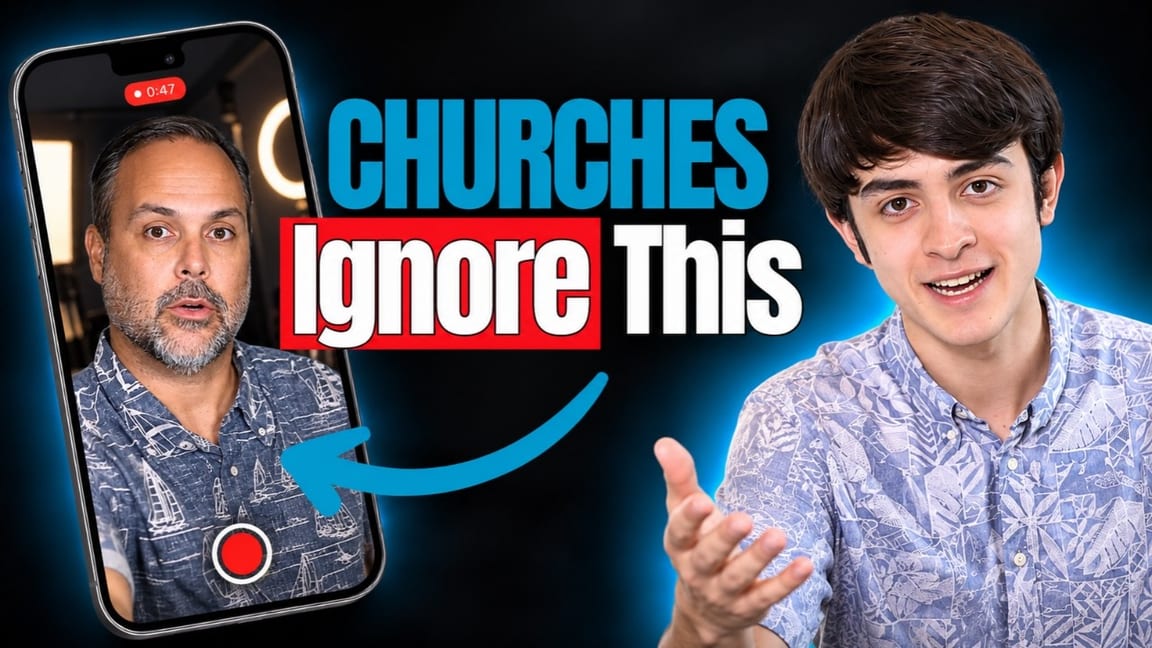
One video format is outperforming everything else on social media right now. It isn’t cinematic or produced. You can shoot it in your office in five minutes, and most churches have never tried it.
It’s a person looking straight into a phone camera and talking.
Why We Stop Scrolling for a Face
Think about what makes you stop scrolling. For me, it’s usually easier to say what I skip: anything heavily produced. A clip from a sitcom I don’t know, I scroll right past. But when someone is just looking at the camera and talking, it almost catches me off guard. Everything else is so polished that the lack of production makes me think there must be something interesting about it.
For me, it feels like a FaceTime call. Doom scrolling is passive. You’re lying there half-watching. Then someone looks you in the eye and starts talking to you, and suddenly it feels like you’re in a conversation. You obviously aren’t, but your brain responds as if you are.
The Format
- A pastor, staff member, or even a church member sharing a testimony
- Holding a phone and looking directly into the camera
- Talking for 30 to 90 seconds
- Captions on screen
That’s it.
Captions matter more than you’d think. Videos with text overlay retain 25% more viewers than audio-only formats, because they work whether the sound is on or off. Many people really do scroll with the sound off. On Instagram, I usually do until I turn it on. I’ll watch an entire video on mute, just reading the captions. That’s normal now, even if it sounds strange.
What Churches Post Now, and Why It’s Getting Harder
I work on church social media every day at REACHRIGHT, and most church content falls into a few categories:
- Sermon clips, usually cut from a live stream: a wide shot of someone on a stage
- B-roll of people arriving or the room in worship
None of that is bad or wrong, and you should keep making it. But it all reads as produced. Very few churches are posting talk-to-camera videos, and the ones who are tend to be the most successful pastors on social media right now.
We’re deep into the short-form vertical video era. TikTok took off around 2018 and 2019, and early adopters reaped big rewards. It peaked during COVID. Back then, almost any short vertical video got reach, so the goal was simply to post something. Now the platforms are saturated. A lightly edited sermon clip still has value, and we still help churches make them, but it’s harder to get reach with them than it’s ever been. The low-hanging fruit is gone. An AI-clipped sermon is better than nothing, but it won’t get the viral results it might have a few years ago.
Why Raw Beats Polished
Phone footage looks good now
Raw doesn’t mean low-quality. Phone cameras and mics are so good now that this footage looks and sounds perfectly fine. We’ve just come to read phone footage as normal, and normal is what we trust.
Polished content reads as an ad
Every platform has ads, and our brains have gotten very good at spotting them. The moment your brain says “that’s an ad,” you scroll. Many of those ads look like TV commercials, the expensive kind you see during a football game. Our brains have learned to treat that look as artificial.
So when your church posts real content that looks like a commercial, it triggers the same reflex. I pay for YouTube Premium, so I don’t see many ads, but I can spot an integrated ad read from a mile away and make it my life’s mission to skip it.
Brands have figured this out. I’ve started seeing ads from huge companies that look like a regular TikTok, and I don’t recognize them as ads at first. Picture a protein powder startup: a guy on a walk, holding up his phone, talking about his workouts, who eventually mentions the powder he uses. Then the “shop now” link pops up. It’s cheaper to make, and it works better.
So imagine your pastor on a walk, expanding on a point from Sunday’s message, sharing a prayer, or answering a question from the comments. That’s the kind of content we see performing.
”Unscripted” Doesn’t Mean Unplanned
My first worry is the workload. Sermon clips can be completely hands-off for a pastor once the sermon is preached. This format needs the pastor’s time every week. I want to try it at our church, and I expect pushback from leaders about the extra work.
It’s not hard in theory. But two pastors can post 60-second videos in the same format on the same passage, and one takes off while the other goes nowhere. Some of that is how engaging the speaker is and how the channel is already doing. But a lot of it is something you can plan: the first five seconds.
The hook makes the difference
Compare two openings for the same video:
- “Hey guys, Pastor Thomas here. Last Sunday we were talking about Jesus going after the lost sheep, and I just think what’s really powerful…” Five to eight seconds gone, and nothing has happened yet.
- “You can never go too far from Jesus. He will always seek you out.” Then into the passage.
Even if the rest of each video is identical, the second one will get more traction.
A system that doesn’t require a script
Make it a habit, not an experiment. A single “let’s try it and see” video tells you nothing. Decide that once a week you’ll shoot these videos. Spend 15 to 30 minutes deciding what you want to say and finding an interesting angle.
If a social media person or someone else on staff manages your accounts, they can hand the pastor two things: what the video is about, and the first sentence. Pastors can talk on a topic. You don’t need to script the whole thing. Give them the topic and the hook.
Use AI to find the angle, not to write the video
This is a good use case for AI, if you use it correctly.
Bad prompt: “I want to shoot a raw talk-to-camera video for my church. Write me a script.”
Better approach: “Last week I preached on Matthew 16:1–12. Here’s the transcript from YouTube. Help me find a section that would make a great short-form vertical video, write a strong hook, and give me a general outline that doesn’t stray from what I actually said in the sermon.”
Then don’t read it. Memorize the hook, glance at the outline, and ad-lib the rest so it stays natural. The worst version of this format is someone reading a script off their phone, looking just below the camera instead of into it. People spot that instantly. An AI-written script delivered word for word is the opposite of what makes this format work.
AI is genuinely useful here for two things: researching hooks and pulling out your core point. Many pastors find it harder to say something in one minute than in 30, because they’re used to preaching full sermons. Having AI, or another person, ask you questions until you land on the one thing you’re trying to say is very effective.
One hook pattern that has worked for us: open with “This guy…” or “This girl…” It’s a little clickbaity, but people immediately know a story is coming. “I couldn’t believe what this girl said to me…”
One take, no edits
Pastors already know how to deliver a message. This is just a very short one. Unlike Sunday, you can take as many tries as you need. If it takes five attempts while you build the skill, that’s fine. But once you have a take you like, leave the imperfections in: the ums, the brief pauses to think. If a pause runs past a second or two, or the take is genuinely bad, redo it. Otherwise, one take and no edits. That’s what keeps it organic.
Do It Dirty
Preaching to a room and talking into a lens are different skills. Plenty of confident preachers get thrown off looking straight into a camera. Look back at our early podcast episodes and you’ll see how different I was on camera. (One of us came in with on-camera acting experience. The other was used to being filmed preaching, which isn’t the same thing.) Fifty videos in, you’ll look back at your first ones and cringe. We still do with our early episodes. We leave them up for nostalgia.
So, do it dirty. Your first one probably won’t be great, and that’s fine. Everyone is bad at this when they start.
And if a video is bad, nobody will see it anyway. The algorithm doesn’t show it to anyone. A young woman in our church felt so embarrassed that a reel didn’t get the likes she expected that she deleted it. But if only 20 or 40 people saw it, there’s nothing to be embarrassed about.
You also can’t predict what will hit. One of our best-performing long-form videos this year was about the order to hire church staff, a topic we assumed was too niche to interest anyone. Try things, watch what works, and do more of that.
It’s the same muscle as preaching. Your first sermons probably weren’t great either, and they likely weren’t preached to 200 people. The worst case here is that you spend five minutes and the video doesn’t reach many people. The best case is that it takes off.
Our video team recently committed to getting 1% better on every video. Make one improvement each time, and by the end of the year you’ll be remarkably better. Pastors can do the same with this format.
Does This Actually Get People to Church?
A fair pushback: Our goal on social media is to get people in our community to show up on Sunday. Worship clips and sermon clips show them that experience. How does a talk-to-camera video do that?
Keep posting worship and sermon content. But this format helps it reach more people, in two ways.
It grows the account. When a format performs well, your views, likes, and followers grow, and that helps everything else you post reach more people.
It builds familiarity with the person they’ll hear on Sunday. Picture someone who doesn’t attend your church scrolling TikTok. Your pastor’s talk-to-camera video comes up, and they watch the whole thing. A few minutes later, another one appears, and they watch that too. Now the algorithm shows them a sermon clip from the same account. They already feel like they know the speaker, so they watch that one through too. Now they’re seeing what your church is like on a Sunday, and they tap the profile to see where it is.
These platforms also favor local content. Reels, TikTok, and YouTube Shorts all tend to show posts from your area to people in your area. Anyone in the world can see your video, but the algorithm leans toward your neighbors. That’s why we see so much Hawaii content, and not much fall foliage from Maine.
Pastor’s Brand or Church’s Brand?
This is the part we wrestle with. Should these videos go on the church’s account or the pastor’s personal account?
I’m sensitive about this. I don’t want to be the face of the church. The church should be bigger than me or our lead pastor. John the Baptist said, “He must increase, but I must decrease,” and we need to check our hearts on this.
But research shows that one of the main reasons people choose a church is a connection with the lead pastor, or whoever does most of the speaking. People often watch sermons before they visit, and they’re more likely to come if they feel connected. Through your stories, people feel they know you, even if you don’t know them.
The bigger reality is that people connect with people more than brands. Look at your YouTube subscriptions: almost all of them are people, not brand accounts. When we built the Church Influence 100 and the Pastor Influence 100, the most influential pastors had about 4x the followers of the most influential churches. Most of those pastors have far more followers on their personal accounts than on their church’s accounts.
That’s how social media started. Facebook, MySpace, and early Instagram were about people connecting with people: your friend’s account, the person you knew in high school. Businesses followed because that’s where people were spending their time. But a person is still more compelling to follow than a brand or a building. The church isn’t a business, though, so a business best practice isn’t automatically right for you.
We don’t have a perfect answer. It will be different for different churches. Some will be comfortable with it and some won’t. Pray about it. We’d planned this format with a church account in mind, but there’s a real case for the pastor’s personal account too.
It Costs Nothing
You don’t need any new equipment. Your phone is enough.
- Audio: The phone’s built-in mic is very good. If you’re outside and it’s windy, play it back. If it sounds bad, move or get a cheap mic. A $5 to $10 one will do. Some creators hold a small lavalier mic in frame, which is fine, but we haven’t seen evidence that it helps. If cost matters, skip it.
- Movement: You don’t need action to hold attention. On-screen captions do that work. The words appearing as you speak give the eye enough to follow.
We’d love to see what you make. YouTube links usually work in comments even when other links don’t, so drop one if you try this at your church, and we’ll give you feedback. And hold us accountable, because we’re doing it too.
Your Next Step
Want a second set of eyes on your church’s social media and video strategy? We offer a free church marketing and website review. Our team will look at your website, social media, and digital presence, and send back honest, specific recommendations you can actually use. No sales pitch. Real feedback.
Turnaround is about 48 hours. It’s free for any church that asks.
More Resources
- How to Write Hooks for Sermon Clips That Stop the Scroll
- How to Create Sermon Clips for Social Media
- Mike Signorelli Reveals the Hidden Reason Most Churches Stop Growing
- The Biggest Mistake Churches Are Making on Social Media Right Now
- Developing a Pastoral Brand: 7 Strategies for Building Your Ministry Identity
- 5 Quick Church YouTube Shorts Strategies