“I hate social media. I hate the internet. I wish it didn’t exist.”
That’s not what you’d expect to hear from the pastor who ranked number four on our list of the most influential pastors in the world. Our team analyzed roughly 650 of the best-known pastors to understand what pastoral influence looks like in this era, ranked on real data, much of it social reach. Mike Signorelli, lead pastor of V1 Church in New York City, came in fourth. We’d never met him before the list came out.
So we sat down with Mike to find out what’s behind his rapid rise, what nearly broke him along the way, and the thing he says stops more churches from growing than anything else.
Lead Like a Biblical Pastor, Not an American One
We asked Mike for his secret sauce. His answer started with the apostle Paul.
Paul wrote about a thorn in his flesh, “a messenger of Satan.” Mike says Paul would make the worst megachurch pastor ever, because that level of transparency would look like he was undermining his own authority. “We kind of come from this new school idea that we have to project perfection,” Mike says.
He also points to “follow me as I follow Christ.” Mike points out that the Greek word Paul uses there is the same one used for an actor playing a part. “Paul’s saying, ‘I’m doing the best Jesus impression I can do,’” Mike explains. Think of Michael Jackson impersonators: none of them nails every detail, but each one shows you something real about him. Mike hopes people see elements of Christ in him because of his years following Jesus, not because he’s perfect.
So Mike leads with his brokenness and his struggles, and that becomes an invitation for people to walk the same road with him. “You don’t have to be 10 steps ahead of the people,” he says. “Just two steps.”
When he teaches on evangelism, he first goes out on the streets of New York and evangelizes himself. He gets rejected, cussed out, and ignored, with no band playing emotional music behind him. Then he tells his church what it actually feels like and asks if they’re willing to do the same.
“I just flipped it on its head and basically was like, what would it look like to be a biblical pastor instead of an American one?”
Every time we do one of these interviews, the megachurch-pastor stereotype goes out the window. And authenticity keeps coming up. It’s what people are hungry for, especially Gen Z.
How a Social-Media Hater Went Viral
Why he resisted
Mike is a child of the ’80s, and he remembers what people were like before algorithms. Back then, millions of people watched the same shows. Now everyone gets a feed of exactly what they want to see, and that shapes how they come to church.
“The unintended consequence of that is we go to church and now we want our preferences, and we want to hear what we want to hear,” Mike says. He wonders whether the “itching ears” Paul warned about look a lot like the algorithm. “We’re losing this healthy collectivism. We’re migrating towards hyper-individualism.”
So he took pride in staying off it. “I’m a real pastor. I’m a real preacher. I’m not going to be on social media.”
What changed
Then COVID hit New York. V1 didn’t own any of its buildings, so there was nowhere to meet. People were getting ticketed just for walking down the street. “I had refrigerated trucks being loaded with bodies on my block,” Mike says.
He was making about a hundred phone calls a day, checking on every congregant and trying to shepherd them one by one. His wife was afraid he’d burn out. Her suggestion: What if you go live, and instead of talking to 100 people individually, 100 people watch you together?
He told her it was a bad idea. As the pandemic dragged on, he realized he’d been “checkmated.” He went live.
And he went viral. Early on, his live streams were reaching 6,000 to 10,000+ people a day, with some passing a quarter of a million views. That eventually grew into more than two million YouTube subscribers. “I’m sort of the unintentional influencer,” he says. “God had to sovereignly force me into it.”
His wife had told him, “Mike, I know you’re a real minister. That’s why it’s going to work.” She was right.
Social Media Is Gasoline, Not the Fire
Mike didn’t become a viral pastor out of nowhere. Before the pandemic, he already thought of himself as a builder and a church planter. He traveled to many countries with John Maxwell studying leadership and served as an executive pastor before becoming a lead pastor.
- V1 started with 18 people in New York City.
- Before COVID, he launched three campuses in three years with almost no social media presence.
- The church was already running 1,000 to 1,500 people and hit the fastest-growing church in America category before he was known online. (“People were like, who is this dude?”)
- After the internet took off, V1 grew to seven campuses nationally. The online campus is now the largest.
“Social media put gasoline on a fire I already knew how to start and maintain,” Mike says. He knows people with large online ministries and very small physical ones, and he’s not assigning value to either. But his story is a reminder that online reach multiplies ministry that already exists. It doesn’t replace it.
The Hard Lesson: Go Slow to Go Fast
When we asked about the challenges of growing that fast, Mike said his mind flashed to Frodo climbing Mount Doom and Anakin in the lava. “It was brutal, man.”
His biggest lesson: he put people in positions before they were ready. They had the gifting and the potential, but they hadn’t been through the process, and some didn’t have the character to sustain the role. When the assignment wasn’t connected to the right process, it caused a great deal of heartache. Some he had to remove, and some removed themselves.
Now he lives by a new phrase: “We go slow to go fast.” Don’t skip steps or rush people through phases of development, no matter how ambitious you are.
What His Media Team Looks Like
We wanted to see how the cheese gets made. (Mike, an Italian American with a deep love of Parmigiano-Reggiano, appreciated the metaphor.)
First, a warning: no team will replace you. Many pastors hope they can preach and let a team handle the rest. In every ministry Mike has seen succeed online, the pastor deeply cares about it.
“I could say I don’t like social media, but then it’s like me saying I don’t like church,” he says. “I had bad pastors that hurt me… but I didn’t just complain about it. I built seven churches.” His approach to social media is the same: go in and make it what he thinks it should be.
For building a team, he tells pastors to “pray for the eyes of Samuel to see the Davids.” There are people in your church who want to help. Look for them.
Today, V1’s media team includes:
- Two full-time editors and one part-time editor
- Two social media managers
- A person dedicated entirely to thumbnails and titles (Mike stays deeply involved here)
- A copywriter
Some of them aren’t local. One editor is in the Netherlands, another in Chicago. Mike is in the team’s group chats directly, because social media isn’t a 9-to-5.
Learn to surf
That one landed for us in Hawaii. “You don’t get to choose the wave, but you choose how you surf it,” Mike says. Socially, politically, and culturally, there are two kinds of people in the water right now: those getting pummeled and wishing it would end, and those who’ve climbed onto the surfboard of social media. Everybody falls off sometimes, but one group is having fun and the other is miserable.
“Pastors listening, it’s not going away. And if you don’t answer the questions that your congregants are asking, somebody else will, and it might not be the same answer you give them.”
One Thing Smaller Churches Can Start Now: A Non-Sunday Live Stream
We asked what a pastor of a 150-person church could start doing tomorrow. Mike’s answer: go live, but not on Sunday.
People who faithfully attend your church love you and want to receive from you, whether you have 100 people or 10,000. A live stream gives them more access. Mike has seen pastors do well with a midweek touchpoint, like a Wednesday morning live before work. People put it on, ask questions, and talk through Sunday’s sermon. Think of it as FaceTiming with your church family.
That’s exactly how Mike started: live streaming, answering his congregants’ questions, and interacting with them. “It just provided so much value.”
We love this, because most pastors hear “live stream” and think “Sunday service.” Even when you acknowledge the people watching online, a Sunday sermon is mainly for the people in the room. A direct-to-camera live built for the people on the other side of the screen is a different thing.
The Hidden Reason Churches Stop Growing: Offense
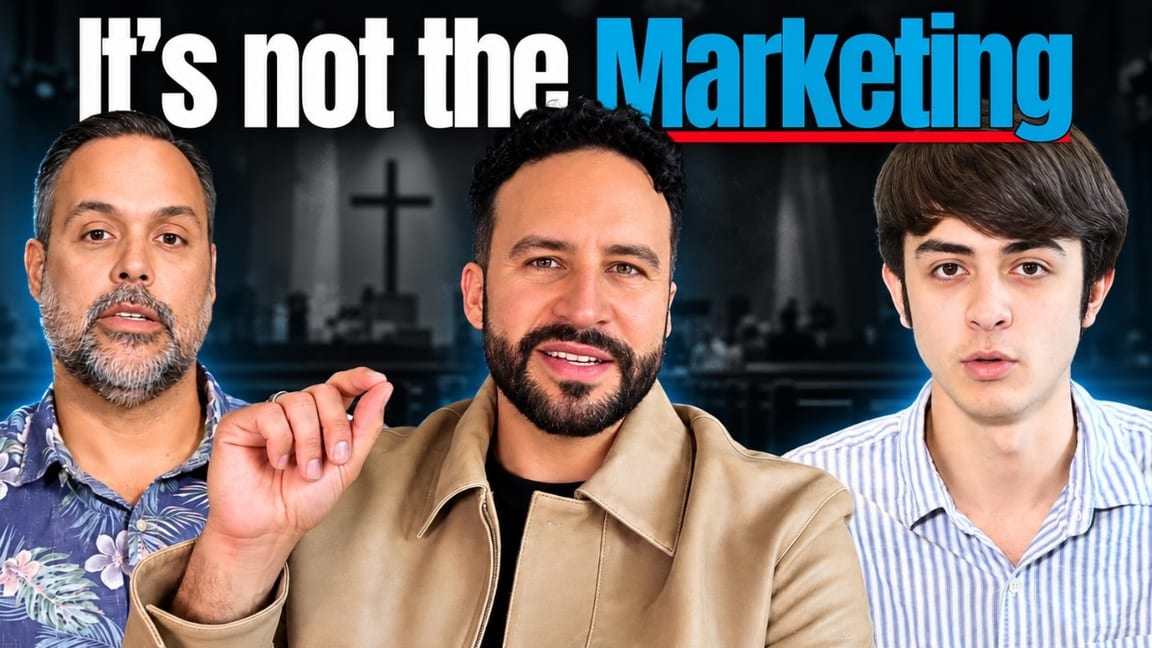
Mike’s new book, The Unoffendable Heart, has a foreword by John Bevere. “Churches don’t really lack gifting or anointing,” Mike says, “but I’ve seen many churches destroyed by offense.”
John and Lisa Bevere had been praying about who would write this generation’s book on offense. When Mike sent John the manuscript, John told him, “This is it.”
From his experience launching seven campuses, Mike puts it bluntly: offense has been the biggest barrier to growth. Offense on the worship team. Offense on the serving team. Offense in the small groups. “Offense, that is the barrier.”
He points to Peter and Judas. Jesus rebuked both. Peter went on from disciple to apostle. Judas let Satan into his heart and lost his calling and his life. The difference was how each one handled offense.
Mike preached The Unoffendable Heart as a sermon series at his church years ago. Other pastors built small group curriculum from that series alone, and he says it changed their churches. A pastor of a 150-person church in California has already bought 150 copies of the book for the whole congregation to go through together. Mike expects many churches to see growth as an unintended consequence of people getting free from offense.
Why your church might hear it from someone else
Mike compares it to parenting: sometimes your kids respond to their teacher or coach better than to you. He’s had guest speakers preach something he taught a year earlier, and his staff called it “fire.” That’s why we need the whole body of Christ. Sometimes an outside voice can say what your church needs to hear in a way yours can’t.
”Get high on your own supply”
Mike’s advice for how pastors should use the book, borrowed from the streets of New York, is to let it work on you first. (We’ll note the street rule is supposed to be the opposite. Mike’s version is better.)
It’s the same principle as his evangelism. “I don’t bring my church 15-year-old stories. I bring them five-day-old stories, because that’s where authority comes from.” Let it work in your own heart and marriage, get free from offense yourself, and then lead your church through it. Pastors aren’t exempt.
Love God, Love Your Wife, Preach Average, Never Give Up
When Mike planted his church, his pastor gave him advice that he thought at the time was “the dumbest” platitude. Every year since, it has haunted him in the best way:
Here’s what Mike has learned about each one:
- Many people start out in love with God but fall out of love with God.
- Some stay in love with God but fall out of love with their spouse.
- Preach average. How do people drift into heresy? By always reaching for something extravagant. “If it’s new to the body of Christ, it’s probably heresy.” Preaching average settles your soul. You don’t have to go viral or stretch a passage out of context for a big illustration. You’re there to feed the sheep.
- And plenty of people who do the first three still give up.
That’s how Mike keeps going in some of the hardest cities in America: New York, New Jersey, Miami, and Chicago. “If you can do that, which apparently is the hardest combination of things in the entire body of Christ, you will obtain the prize.”
Your Next Step
Want your church’s online presence to multiply the ministry you’re already doing? We offer a free church marketing and website review. Our team will look at your website, social media, and digital presence, and send back honest, specific recommendations you can actually use. No sales pitch. Real feedback.
Turnaround is about 48 hours. It’s free for any church that asks.
More Resources
- The Most Influential Pastors in the World
- The Biggest Mistake Churches Are Making on Social Media Right Now
- Your Church Needs a Social Media Manager (And the Intern Doesn’t Count)
- AI Just Changed the Rules for Church Marketing (Again)
- What the Fastest-Growing Churches Know That Most Don’t
- There’s a New Type of Church Visitor (And Most Churches Aren’t Ready)