Most churches are on social media. Very few of them are using it in a way that reaches anybody new.
Scroll through a typical church Instagram account and you’ll find the same things over and over: event announcements, program updates, and insider language that only makes sense if you already attend. That content doesn’t get many likes or comments, and it doesn’t reach many people. There’s a simple reason why.
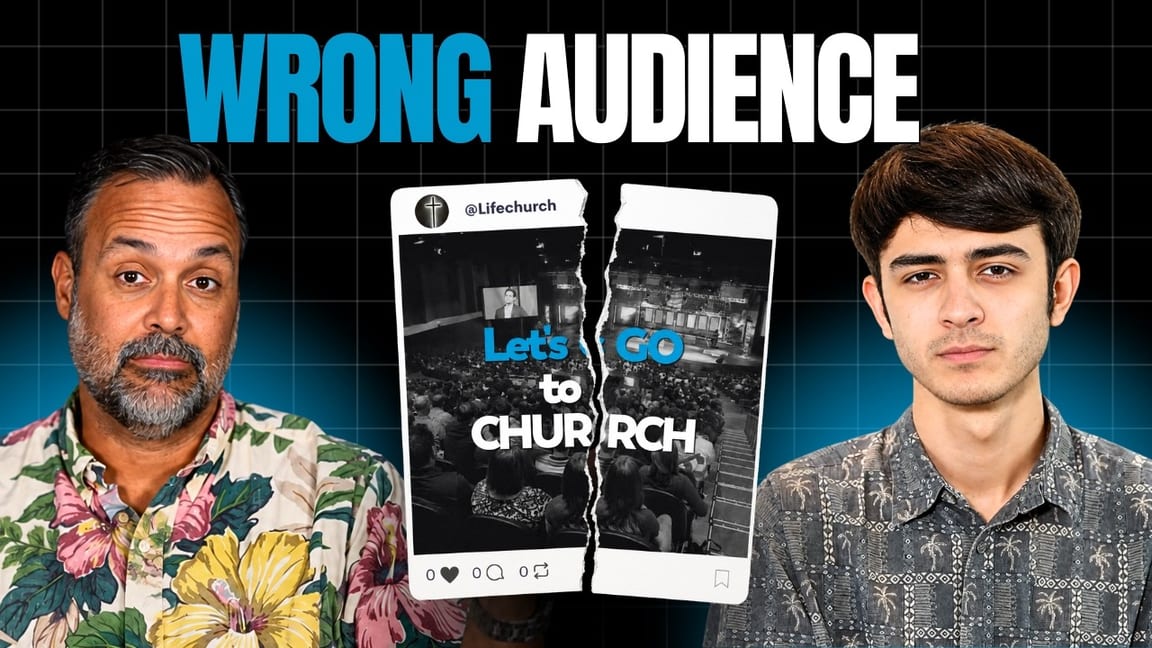
The biggest mistake we see churches make on social media is posting for members instead of strangers.
It’s a strategy left over from an older version of the internet. Call it the 2016 algorithm. It worked back then. It doesn’t work now, and most churches are still posting as if it does.
Your Followers Aren’t Seeing Your Posts
Social media used to work like this: you post something, and the people who follow you see it. Almost everyone who followed you would see almost everything you put out.
That world has been gone for six or seven years. Today, whether someone follows you barely matters. On a platform like Instagram, a very good post from a church reaches about 4% of its followers. That’s a good result, not a bad one. The platforms figured out quickly that if you want reach to your own audience, you should have to pay for it. If you’re not paying, 4% is about the best you can expect.
What decides who sees your content now is interaction history. That means whether someone has engaged with your content before, or with content like it. The algorithm makes connections you’d never think about:
- Someone watched another video with the same sound (for those of us who still say “backing track”), so they get yours.
- Your on-screen text includes a Bible verse they engaged with in someone else’s video, so they get yours.
- They watched an entire 58-second sermon clip from you last week, so they’re almost certainly getting your next reel too.
Flip that around and you get the stat that should change how you plan every post: about 95% of the people who see your church’s content don’t attend your church.
So you can’t assume your members will see your content. Most of the people who do see it will be strangers the algorithm thought might be interested.
Outreach, Not Inreach
That’s the big shift. Social media is outreach content, not inreach content.
Before you post, ask: if this were the first time someone had ever encountered our church, would they understand it? Is it interesting? Would they stop, comment, or tap through to our page?
“Hey, small groups are cancelled this week because of Labor Day” fails every one of those questions. You still have to communicate that to your people. Put it in an email blast, not on your feed.
”Real ministry” vs. “fake ministry”
Underneath the announcement problem is a belief a lot of church leaders hold without saying it out loud. It goes like this: real ministry happens in our building. Social media is fake ministry, and its job is to push people toward the real thing.
We’ll be clear about where we stand. People are better discipled in person than on social media. We’re not arguing the two are equal.
But when you have someone’s attention for a split second, that moment doesn’t always have to be an announcement pulling them into church life. Sometimes the job is planting seeds and building familiarity. Then, when that person is finally ready to find a church, they think: I’ve seen that pastor. His stuff pops up in my feed all the time, and I really like his messages. If we’re going to try a church on Christmas Eve, maybe we should check out that one in our neighborhood.
That’s the real play on social media.
You can be more direct. You can put a call to action in a video and invite everyone to your big fall harvest party. The post itself might be fine. The problem is that it gets almost no reach, and a post nobody sees isn’t effective no matter how good the call to action is.
It’s also a real privilege. A lot of the people who start seeing your content aren’t believers yet. They’ve just begun interacting with church content online, and you get to be a voice in that space. Give them a sermon clip, or something encouraging, or something inviting. Not a schedule change.
Is There Any Room for Member-Facing Content?
Yes, but it has to be slipped in.
Think about how you give a dog medicine: you cover the pill in peanut butter. Content that’s valuable to your members can still work on social media, as long as it’s packaged in a form the rest of the world will actually watch.
One example we use with churches in our social media management service is a Saturday “Sunday hype” reel. A recent one was a grid of nine B-roll clips of people caught in the act of living out the church’s values: hugging in the foyer, coming up out of the baptism waters, hands raised in worship. A small branded line of text in the middle said something like it’s almost Sunday.
It serves two purposes. For members, it’s a reminder that tomorrow is Sunday. For someone who isn’t part of the church yet, it’s a behind-the-scenes preview of what happens there, full of people who look like them.
The same idea works for your announcements. Say you want people to join a life group. A graphic that says “Looking for a life group? Link in bio” won’t go far. A sermon clip from the application section where you talk about community, or a testimony from someone whose life was changed by a life group, will go much further.
Six More Mistakes Costing You Reach
Posting for members is the big one, but it isn’t the only one. Here are the others we see all the time.
1. Broadcasting instead of engaging
People comment “great message, pastor” or DM the church with a question, and nobody responds. The account works like a radio station, broadcasting out and never engaging with the social part of social media.
Our rule: every comment gets a response. Unless you’re one of the largest churches in the country (we get it, Joel Osteen can’t personally answer everything), this should be your policy. Most of us don’t get that many comments, so it doesn’t take much work.
Two tips make this more valuable:
- Reply in a way that invites another reply. Don’t just answer. Ask what they think. Start a conversation.
- Make content that asks for a response. End your reels with a question on screen, like what are you praying for this week?, and ask people to answer in the comments.
This pays off twice. People who know the church, or even the pastor, will reply are much more likely to comment again. And comments are a strong signal to the algorithm that your content is worth showing to more people.
2. No consistent voice
The tone and quality shift from week to week and post to post. Even the comment replies sound like different people wrote them. The result looks haphazard and confused.
We think every church needs two documents:
- Brand guidelines. Your logo, your colors, your fonts. This is your central source of truth. When your posts stay consistent, people start recognizing you instantly: oh, that’s New Hope.
- A brand voice document. How we talk. Words we use and words we don’t. How scholarly our language should be. A church built around verse-by-verse expository teaching, like John Piper’s, will sound different from Steven Furtick’s church, and both should. Different leaders and churches communicate differently. Document yours.
When we start with a new church, the first step is a two-hour discovery conversation, and we come out of it with a clear brand voice document. We use one ourselves, too. Different people on our team write social posts, reply to comments, and send emails, and we all need to sound like the same organization.
AI can help here. Don’t ask it to invent your brand voice. Instead, feed it a lot of writing you’ve already done and ask it to help you name the patterns: how you talk, what your general rules are, and what makes your voice yours.
This matters more than it might seem. I’ll say it as a younger person: before I visit a church, I’m checking their Instagram first. If the page looks consistent, clean, crisp, and inviting, that moves the needle for me. If it’s all over the place, it comes across as messy. That might sound shallow, but it’s how people decide.
3. Treating every platform the same
Cross-posting is fine, and sometimes it’s the smart move. If you spend an hour clipping, editing, adjusting the sound, and color-correcting a sermon reel, put it on Instagram, Facebook, TikTok, and YouTube Shorts.
What you should change is the title, description, and caption for each platform. Your Facebook audience and your TikTok audience are very different people, and your YouTube audience is different from both.
Here’s one thing we’ve learned about YouTube: it has a much longer shelf life. A TikTok post lasts a couple of days at most. A YouTube Short can keep getting found for years, especially if it’s titled “How to ___.” Something like “How to Give More Generously” will do better on YouTube than on TikTok, because people keep typing that question into search.
4. Ghosting between Sundays
Everything goes up on Sunday, and then the account is silent all week.
We understand why. Sunday is when the content happens: the sermon, the lobby moments, the testimonies. But think about when people actually look at church pages. It’s almost never Sunday, because on Sunday most of those people are at church. It’s Tuesday or Thursday, when someone thinks, wait, I heard about that church. Should we check it out this weekend?
Spread your sermon shorts, behind-the-scenes clips, and photos across the week. You’ll reach more people, the platforms reward steady posting, and you show that the church is active beyond Sunday morning.
Posting only on Sunday also tells us something. If you actually have a plan, Sunday is the hardest day to post, because you have a hundred other things going on. A Sunday-only feed usually means oh no, we forgot to post this week.
Our floor is three posts a week. That’s also our rule for adding a new platform. If you’re only on Instagram and thinking about TikTok, don’t add it until you can commit to three posts a week there. Until then, put all your focus on one channel.
5. Avoiding video
Some kinds of content are easy and some are hard. A Canva graphic with a Bible verse is the easiest. A great photo from the service is harder. Video is the hardest: shaky phones, choppy audio, all of it.
But today, video is basically required. A single static image won’t perform nearly as well.
There are ways to make it easier:
- Replace the original audio with a trending sound or a worship song.
- Keep it simple: a sermon clip, candid footage of people arriving in the lobby, or your pastor giving a 30-second mini message to the phone.
- Instagram carousels are technically photos, but they have movement, because people swipe through them. They count for something. We’re also doing a lot of video carousels now, though six videos in one post is the ultimate hard mode.
Much of the difficulty with video is simply that people are nervous on camera.
I understand that. If you want to see something funny, go to our YouTube channel and sort the videos from oldest to newest. It was COVID. You couldn’t get a haircut in Hawaii, so I had a huge beard and long hair, and I was filming in my bedroom with a strange intro song. Our motto was: we’re just going to do it dirty. We knew video mattered, so we made it anyway. My advice is to get over yourself and do it.
The other piece of advice is to start from a template. Look at what other churches are doing. Look at the videos you enjoy. The point isn’t to chase trends. It’s to notice how something was shot, which sound it used, and how the caption worked, and then make your own version. It’s much easier than starting from “we need to do video. Do I need a DSLR? Where do I even start?” Having a model takes a lot of the pressure off.
6. Chasing followers instead of reach
Followers are a vanity metric. We still track them, and they’re on our monthly scorecard, but they barely matter. Many of your followers attend your church anyway, so likes from them don’t tell you much.
The numbers that matter are reach and, wherever a platform shows it, watch time.
We use the same approach on our own podcast. YouTube shows reach first, but we look at watch time. We’d rather have fewer people watch a whole 40-minute episode than a lot of people watch two minutes. The same is true for your reels and sermon clips. Someone who watches the first four seconds counts as reach, but you haven’t made an impact if they scroll right past.
Watch time matters to the algorithm because it’s how the platforms decide what’s valuable. If people keep watching, the video is giving them something, whether that’s entertainment, information, or encouragement. The platform then shows it to more people. Better retention leads to more reach.
So look at the number, and then ask why. Why did this video hold people and that one didn’t? What’s different? That’s a large part of what our content work comes down to. Sometimes we honestly can’t figure it out. We just keep doing more of what works.
One boundary: we don’t compromise the gospel for the algorithm. If saying the name of Jesus costs us views or watch time, so be it. All else being equal, we want to give the algorithm what it rewards, but only so the gospel travels further.
Should Churches Pay for Social Media?
Our answer is yes and no. It depends on what you’re paying for.
Invest in people. Churches should invest in social media, either by hiring someone on staff to run it (we made the case for that hire recently) or by outsourcing it.
Real ad campaigns can work. Some companies run plan-your-visit ad sequences for churches that cost thousands of dollars a month. If you have that budget, it’s not the worst way to spend it, but it takes a lot of money at that scale to make it work. A better fit for most churches is promoting events and one-off posts with a strategic, well-built campaign. We’re not against Meta ads. As a company, we spend thousands of dollars every month on ads ourselves.
Boosted posts usually don’t work. You know the pattern: reach is low, so you give Meta $10 to push a post in front of more people. The problem is that the platform can’t control how long anyone watches. It can only put the post in front of more eyes. You’re paying for views, not watch time.
We’ve tested this on multiple platforms, most heavily on YouTube, and the results are the same everywhere. Say we give YouTube $100 to promote an episode like this one. YouTube first shows it organically to everyone who would have seen it anyway: people who’ve watched our content before, some of our subscribers, and people interested in church social media. Those views were earned. Then it uses your budget to reach the people who weren’t quite the right fit.
So you get more views and more reach, but almost all of that paid reach comes from people who aren’t interested and won’t engage. If they were interested, the algorithm would have shown them the post for free.
Our advice: skip the boost budget. Let your posts earn their views and watch time on their own merit, and put your energy into making content that can.
The Bottom Line
The version of social media that most church feeds are built for no longer exists. Your followers mostly aren’t seeing your posts. Strangers are.
That’s good news. It means every sermon clip, every Saturday hype reel, and every honest answer in the comments is outreach to people who may not have set foot in a church in years. Treat it that way.
Your Next Step
Want outside eyes on how your church looks to someone who’s never been there? Start with a free church marketing and website review. Our team will look at your social media, your website, and your overall church presence, then send back honest, specific recommendations you can actually use. No sales pitch. Real feedback.
Turnaround is about 48 hours. It’s free for any church that asks.
More Resources
- Your Church Needs a Social Media Manager (And the Intern Doesn’t Count)
- Which Social Media Platforms Are Actually Worth a Church’s Time?
- Why Your Church Instagram Isn’t Growing (And How to Change That)
- 8 Social Media Missteps Churches Make That Kill Engagement
- How to Create Sermon Clips for Social Media: The Complete 2026 Guide for Churches
- 5 Social Media Mistakes That Are Hurting Your Church