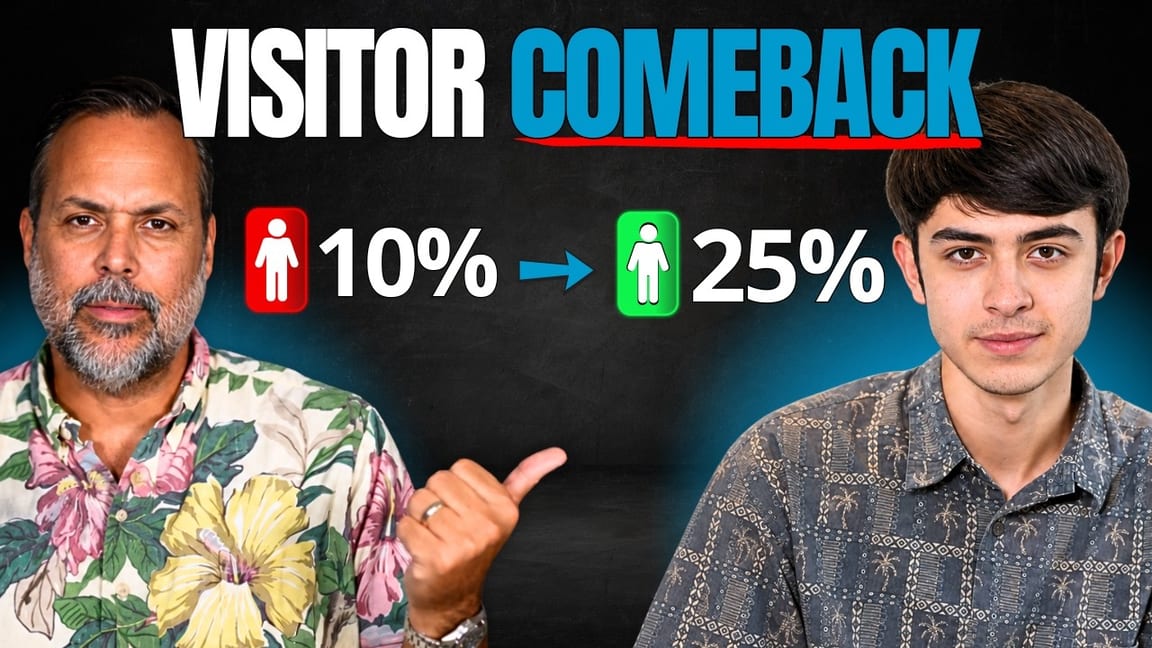
About 1 in 10 people who visit your church for the first time will come back for a second visit.
Not one in three. Not half. Roughly ten percent. And most of us have quietly convinced ourselves the number is much closer to 100% — that if we can just get somebody through the front door once, the building does the rest.
It doesn’t. There’s a leak in the bucket, and almost nobody is talking about it.
We spend an enormous amount of energy in this industry — us included — on getting new people to walk through the doors. Social media, web design, outreach events, a better Sunday experience. None of that is wrong. We do it for a living and we stand by it. But after decades of working with churches on growth, the weak point is almost never the front door. It’s what happens in the seven days after someone walks in.
The Actual Numbers
Our friends over at Text In Church put the range at 10–20% of first-time visitors returning for a second visit. That lines up with what we see in the field, with one adjustment: 10–11% is the realistic baseline for a typical church. The very best churches — the ones who treat this as a real discipline — get it into the mid-20s. A few push higher.
So the spread looks like this:
- Average church: 1 in every 10 visitors comes back.
- Church that actually works at this: 1 in every 4.
Out of 100 first-time visitors, that’s 10 second visits versus 25. Same building, same preaching, same worship team — 15 more people. And note what that number is not: those aren’t new members. That’s just the people willing to show up a second time.
If your gut reaction is “there’s no way we’re only at 10%,” measure it. Most churches that actually sit down and count come out lower than they expected.
This Is a Math Problem (Sorry)
We’re in the business of ministry, so nobody loves hearing this framed as arithmetic. But Jesus told a lot of math parables, and the math here is genuinely clarifying.
Start with attrition. The average church loses roughly 10% of its members in a given year to nothing dramatic at all — people move, people pass away, life happens. We do an annual Planning Center cleanup at our church every year: a five-hour saga of going through every single name. Last time we removed a few hundred people from a list of almost 3,000. That’s not decline, that’s just the normal life of a church.
Now take a 100-member church.
Do nothing. No visitors at all, and you’re a 90-member church next year. Compound that and in about fifteen years the church doesn’t exist.
At a 10% return rate. To replace those 10 people, you need roughly 100 first-time visitors a year — about two new people through your doors every single week — just to stay exactly the same size.
At a 25% return rate. You need about 40 visitors a year. Less than one new person a week. To stay flat.
And the math compounds into your budget. Say you’re a church of 100 spending $10,000 a year — around $800 a month — on social media, website work, and outreach. Doubling your return rate doesn’t just add people. It cuts the number of visitors you need to buy in half. Retention is the cheapest outreach dollar you will ever spend, because it makes every other dollar go two and a half times further.
We don’t think church is a business. But there’s a principle the business world has known forever that translates cleanly: it is dramatically cheaper to keep a customer than to acquire a new one. Nobody stops advertising because of that. They just stop pretending acquisition is the whole job.
Most “Growth” Is Redistribution
Here’s a piece of context that makes retention matter even more. Church Track’s data suggests a large share of current church growth isn’t new conversions — it’s redistribution. People moving between churches.
New conversions are happening, praise God, and that’s the goal. But a big percentage of the people visiting your church this Sunday were at a different church last year. And that’s not automatically a bad thing — families move to a new town, seasons change, and Christians looking for a church home are exactly who you want to welcome well.
It does change the stakes, though. If the pool is partly people who have already decided to leave somewhere, then the quality of your welcome and follow-up isn’t a nice-to-have. It’s the whole ballgame.
Small Churches Have the Advantage Here
On raw numbers, big churches see far more visitors. On percentage of visitors retained, smaller churches usually win — and it’s because of relational depth. If you pastor a church of 60, you know every face in the room. A visitor sticks out, and they’re not getting out the door without meeting you. You personally are the hospitality team.
That’s a real advantage, and if you’re a small or mid-sized church, lean into it hard.
It’s also the trap. Because at 60 people you can get away with having no system at all — and then you grow. Our church runs about 300 on a Sunday with roughly 280 regulars, and even at that size you can’t track it by memory. People come and go. Some attend twice a year. At 600 it’s a different animal entirely. The churches that struggle most at scale are usually the ones who never built a process because they never needed one.
There’s a second reason big churches lose more people out the side door, and it’s worth saying plainly: it is very hard to leave a church where your friends are. If your whole life is woven into that community, things have to get genuinely bad before you walk. That’s also the source of a lot of church hurt — when someone does have to leave, they lose their entire social world at once. Relationship is the real retention mechanism. Everything else is scaffolding to get people into relationship faster.
Is This a Systems Problem or a Culture Problem?
Both — but you get the culture by building the system, not the other way around.
In our heads, our churches are so warm that a visitor walks in, gets greeted by six people, hears an incredible worship set and a great message, and leaves already plugged into a life group. That’s the version we imagine, largely because it’s our own experience as leaders. We love our people and we assume they’re excellent at this.
Then you talk to somebody who visited once and never came back, and what you hear is: nobody said hi to me, and I never heard from anyone again.
Ideally, a culture of hospitality solves this on its own. In reality, you build systems and the culture catches up to the system. So let’s talk about the systems.
When Do People Actually Decide?
Earlier than you’d like. A lot of studies point to the parking lot — before the service even starts. You can absolutely wreck a good first impression with a bad message, but by and large the comfort level gets set in the first few minutes.
Honest confession: a couple of years ago, newly married, we visited several churches over several Sundays to figure out where we’d land. Looking back, some of those decisions happened embarrassingly fast, on pretty surface-level impressions. One church just felt performative within minutes of walking in — before worship, before the sermon. Not Holy Spirit discernment. Just a vibe. Others took longer, and came down to the preaching. That’s not entirely fair of us. It’s also just how humans work.
It’s also different depending on who’s visiting. Someone with no church background is running almost entirely on vibes, because they have no framework for what church is supposed to be — and if they do encounter the gospel and respond, they genuinely don’t know what their next step is unless you tell them. Someone who’s been serving in churches for years has a much more savvy eye and is evaluating specifics: the style of the preaching, the substance of the message, the feel of the room.
Either way, the decision lands early — but not so early that you’ve lost control. Which brings us to the single highest-leverage thing on this entire list.
The 24–48 Hour Window
Churches that follow up within 24 to 48 hours see roughly three times the return rate.
Run that through the same hypothetical. 100 first-time visitors, no follow-up, 10 come back. Same 100 visitors with fast follow-up: closer to 30. We’re oversimplifying to make the shape visible, but the shape is real. If you don’t have a follow-up strategy, or yours is vague, that is the single biggest lever available to you right now.
The text message rule
Here’s the specific version we run, and the one piece of advice to take if you take nothing else.
Whoever preached that morning personally texts every first-time visitor by 5:00 PM on Sunday. Not 48 hours. Six hours. If it was a guest speaker, the lead pastor sends it.
We’ve done this at our current church, at the church before it, and at churches we consult with. It works every time. Any church under 500 can do this directly — and honestly, there’s no real cap. A church of 5,000 seeing 100 visitors a week should still get a text out; you just need help sending them.
The content matters far less than people think. Something like:
Hey Joe — it was so great to meet you and Rebecca at church today. I hope you’ll come back again next week. I’m going to be praying for you this week — is there anything specific I can pray for?
That’s it. That text gets replied to about 70% of the time. Which means you’re not sending a message, you’re starting a conversation. A little back and forth, and now this person has an actual connection with the pastor of the church — and the number one reason people choose a church is that they feel they can relate to the lead pastor.
Think about what’s happening from their side. They just sat in a room where a whole congregation listened to you speak for forty minutes. And then you texted them, by name, that afternoon. Our rough estimate is this single practice moves a church from about 10% to about 15% on its own.
Two non-negotiables:
- It has to come from a real phone number. Not a shortcode, not a broadcast.
- It cannot be generic. “Thanks for visiting New Hope! Here’s a link to our life groups” gets ignored instantly. People can smell a template from across the room.
Yes, Sunday afternoons are sacred. This takes about five minutes.
Map the First 30 Days
By the third visit, most people have decided whether this is their church. It’s rare for someone to visit four or five times and still be genuinely undecided. So the window you’re designing for is roughly 30 days.
Get out of ministry-leader headspace for a minute and walk through it as the new person:
- Visit 1 — Text from the preacher within six hours. Email 24 hours later.
- Visit 2 — They came back, so they’re interested. Text again. Invite them to the next new members lunch.
- Visit 3 — Now ask around: who’s been talking to this family? Is there a small group that fits? Make the introduction.
Those are just examples — build your own. The point is to be purposeful about the touch points instead of hoping they happen. Plenty of people will never respond to any of it, and that’s fine. You’re designing for the 10–25% who will.
And don’t over-engineer it into something robotic. What makes people want to be part of a church isn’t sensing that you have a slick strategy. It’s sensing that you have intention — that this church actually wants them there, is thinking about them, and is inviting them in.
Automate Less Than You Think
We’re subscribers to Text In Church at our own church, and they’re genuinely good people building a good product. (No partnership, no sponsorship — just an honest recommendation.) Tools like that are great for sending texts and running email drips at sensible intervals.
But the further into this we get, the less enthusiastic we are about automation as the answer. People spot authentic versus automated from a mile away, and this particular moment is too valuable to hand to a robot.
What you need instead is a real human who owns visitor follow-up. Call them your 30-days champion. Two jobs:
1. Enforce the process. This matters more than it sounds. One of our first ministry jobs, back in 2004, was calling every first-time visitor on the phone — because that’s how you did it then, and people still answered their phones. It was miserable. Cold-calling strangers, getting hung up on, getting “don’t call me again.” And what we found ourselves doing was inventing reasons not to call. Line busy? Great, won’t try again. Anything mildly uncomfortable and socially exposed will get quietly dropped, by well-meaning people, every single time. Somebody has to own it and insist it happens.
2. Run the handoff. You cannot be the permanent point of contact for all 100 people who visit this year. But you can hand each of them to someone else. Within that first month, figure out one real thing about this person — life stage, a class they’d want, a new baby showing up in your children’s check-in records — and connect them to a life group leader or a ministry leader who fits. A group text introduction on a Sunday is enough. The goal is to get them into relationship with someone who isn’t you, because relationship is what makes people stay.
Track What You Can
Most churches count Sunday attendance and maybe first-time visitors. Far fewer track second visits, third visits, or how many people joined a small group this quarter versus left one.
That’s the data that tells you where the leak is. It’s great to know the bucket leaks. You can’t patch it until you find the hole. Getting a ton of first and second visits but almost no thirds is a completely different problem from getting lots of new members who never join a group.
Rick Warren’s rule of thumb is the one we keep coming back to: if you can’t measure it, you can’t manage it.
Realistically, some of this is hard. Even first visits are tricky — with good incentives you might get 70% of first-timers to fill out a connect card. Second and third visits are harder still, because the old “everyone fills out an attendance card each week” model doesn’t fly anymore; people are much more guarded about their data now.
Here’s our actual trick: children’s check-in is the most reliable attendance data you have. It’s the one place people willingly log in, every week, by name. Families with kids are easy to track. A single adult on their third visit, or a couple in their fifties with no kids at home, is genuinely hard — and we don’t have that fully solved.
Life groups and membership classes, on the other hand, are very trackable. We use Planning Center, we know who’s in which group, and we ask group leaders to take attendance (with varying degrees of success). We mark people off when they complete our new members class. Track what you can, don’t lose sleep over the rest.
The Sticker Budget
One last tactic that costs almost nothing and punches way above its weight.
When families check kids in, our children’s director sends each kid a handwritten card with stickers in it. That’s the whole thing. A card that says thanks for coming, with stickers they can put on stuff.
It works for a dumb, beautiful reason: kids don’t get mail. Ever. Not even on their birthday, half the time. A hand-addressed envelope with a gift inside makes a kid love your church — and when a kid loves your church, the whole family gets significantly stickier.
Cost is a stamp, a card, and stickers you can buy by the thousand for nearly nothing.
The Bottom Line
Nobody is making videos about visitor retention. There’s no conference track for it. It isn’t in the standard stack of church growth advice — we literally just did an episode ranking that advice, and this wasn’t on the list.
And it may be the single biggest lever most churches have. Moving your return rate from 10% to 25% has roughly the same effect as more than doubling your outreach budget — except it’s mostly free, and the people it brings in are already predisposed to stay.
Stop only counting who walks in. Start counting who comes back.
Your Next Step
If you want outside eyes on your church’s digital front door — and on what happens to a visitor after they find you — start with a free church marketing and website review. Our team will look at your website, your communications, and your overall church presence, and send back honest, specific recommendations you can actually use. No sales pitch. Real feedback.
Turnaround is about 48 hours. It’s free for any church that asks.
More Resources
- Your Church’s Follow-Up Strategy Is Broken
- How To Build The Perfect Church Visitor Follow-Up Process
- These Follow-Up Mistakes Are Why Your Church Visitors Never Return
- Church First Time Guests Aren’t the Same Anymore
- We Ranked the Most Common Church Growth Advice
- 13 Tips For Creating An Effective Church Contact Follow-Up Process
- How To Welcome New Attendees To Keep Them Coming Back