HubSpot for Nonprofits gives eligible nonprofits 40% off HubSpot’s Professional and Enterprise products. The question a pastor or church admin asks is shorter: will HubSpot give that discount to a church?
Probably, yes. HubSpot’s eligibility page does not name churches or religious organizations as ineligible (HubSpot nonprofit eligibility criteria, checked November 5, 2026). It does carry a nondiscrimination clause that mentions religion, and HubSpot’s sales team makes the call, so your church’s answer is “conditional” until a rep says yes.
The bigger question is whether your church should buy HubSpot at all. My answer for most churches is no, even at 40% off. The free version is a different story.
No IRS determination letter in your files? Most churches don’t have one, because the IRS never required churches to apply. Read how to prove your church is a nonprofit before you talk to HubSpot. It covers your three paths: your own letter, a denominational group exemption, or filing Form 1023.
Does HubSpot offer a nonprofit discount?
HubSpot offers a “40% discount on Professional and Enterprise Tier HubSpot Products” to eligible nonprofits, taken off “the then-current list price” with a “Minimum contract term” of one year (HubSpot eligibility criteria, November 5, 2026). The landing page at hubspot.com/nonprofits sums it up as “Save 40%.”
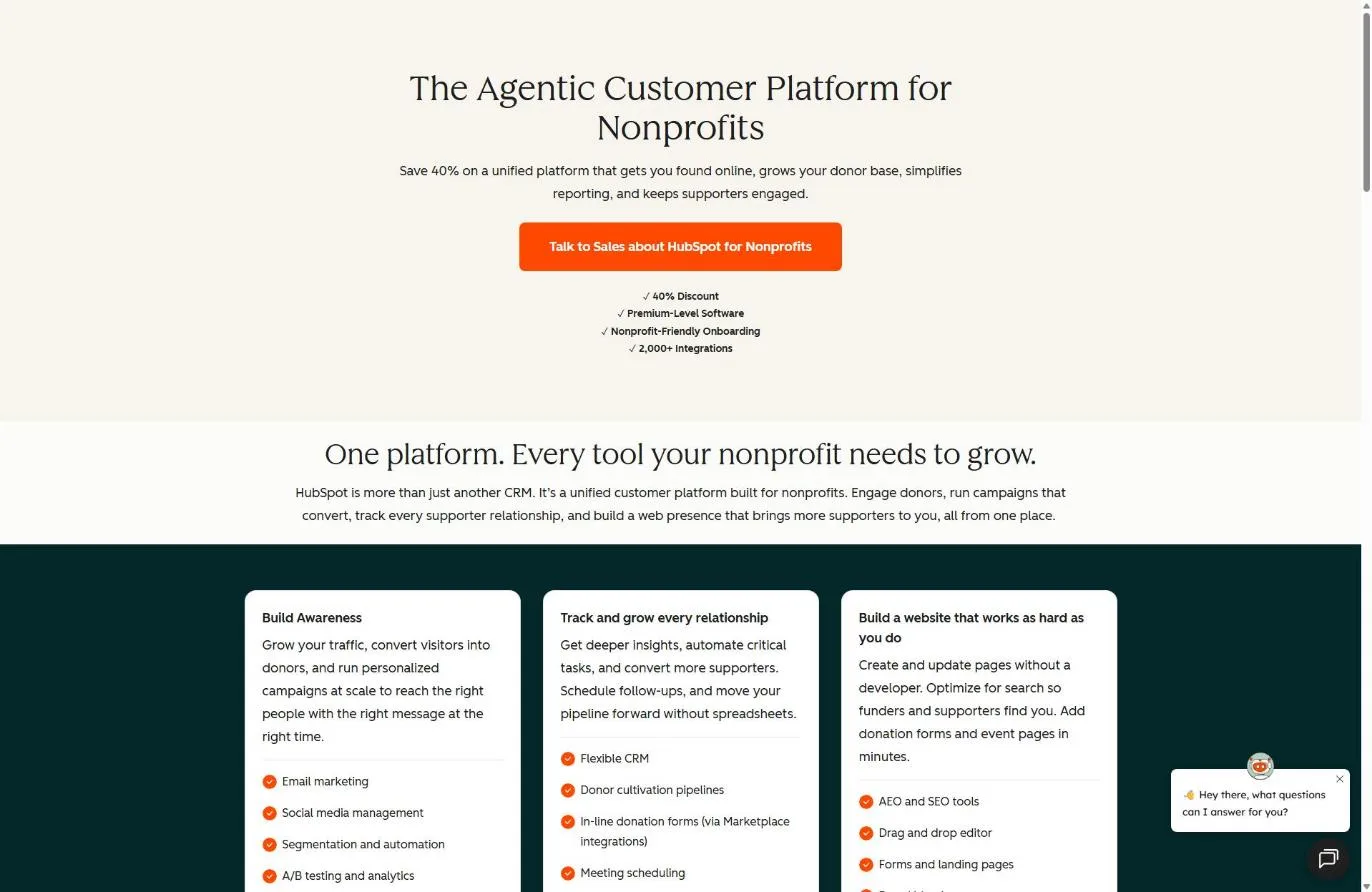
Four limits matter before you get excited. The discount does not apply to “Starter Tier products, Add-Ons, capacity and limit Increases.” It cannot be added later: “Customers may not apply the nonprofit program pricing to existing products or subscriptions.” The apply section says to “Be a new HubSpot customer,” and HubSpot doesn’t say whether a free account counts against that. And it lasts, in HubSpot’s words, “for the duration you remain to be eligible as a nonprofit organization with HubSpot.”
The no-retroactive rule is the one that bites churches. If your communications director buys Professional at full price this month and asks about the nonprofit rate next month, the existing subscription stays at list price. Ask first.
Can churches get the HubSpot nonprofit discount?
Churches can likely get the HubSpot nonprofit discount, because HubSpot’s criteria never exclude churches. Criterion 1 requires “a registered charity, nonprofit or non-governmental organization with recognized legal status,” with 501(c)(3) as the US equivalent. Criterion 2 requires “a mission to benefit the community.” The program is only open in “Australia, New Zealand, the USA and Canada” (HubSpot, November 5, 2026).
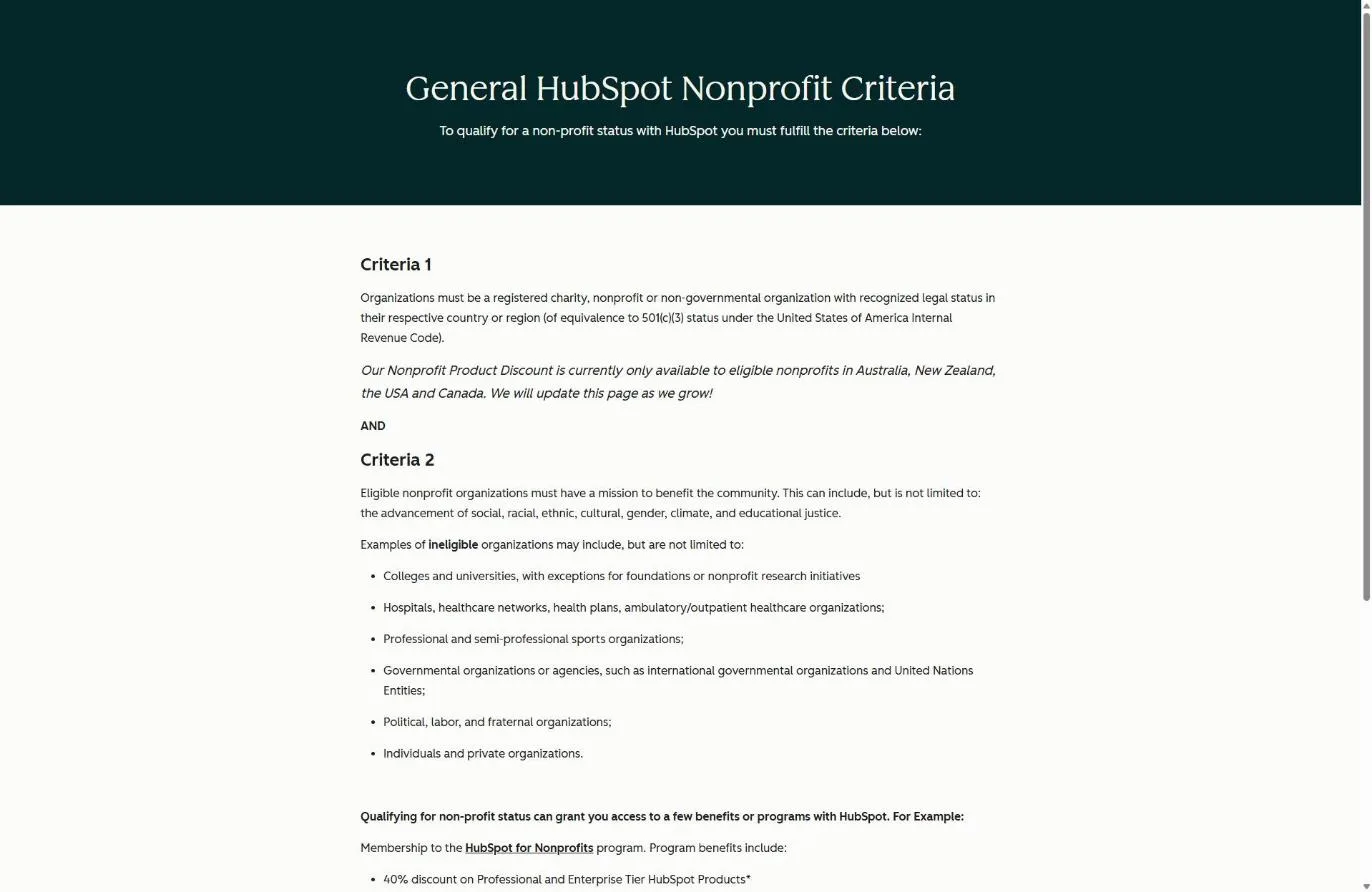
The ineligible list names colleges and universities, hospitals and health plans, professional sports teams, government bodies, “Political, labor, and fraternal organizations,” and individuals. Churches, religious organizations and places of worship are not on it.
Then comes the clause every church should read before the sales call. HubSpot says it will not discount “any organization whose mission or activities promote opposition toward protected groups including on the basis of religion,” alongside race, disability, age, nationality, veteran status, sexual orientation, gender and gender identity (HubSpot eligibility criteria, November 2026).
Here is what that sentence does and doesn’t say. It does not exclude religious organizations. Religion appears as a protected category, the same way it does in most corporate nondiscrimination policies. The clause targets organizations whose mission promotes “opposition toward” a protected group. HubSpot does not define “opposition,” and the page says nothing about faith-based hiring, statements of faith or membership standards. HubSpot reviews each organization through its sales team, so the practical move is to ask the rep directly before you sign a one-year contract.
Two church-adjacent groups have their own problems. A Bible college or seminary falls under “Colleges and universities.” A church-run health clinic may fall under the healthcare exclusion. Apply as the church itself.
What if our church doesn’t have a 501(c)(3) letter?
A church without its own 501(c)(3) letter has a gray-area answer at HubSpot, because HubSpot’s criteria page lists no required documents at all (checked November 5, 2026). It asks for “recognized legal status” equivalent to 501(c)(3), and HubSpot names no validator such as Goodstack or TechSoup. Sales will decide what proof it wants.
Walk into that call with the strongest paper you have:
- Your own IRS determination letter, if your church ever filed Form 1023. Your church should also appear in the IRS Tax Exempt Organization Search.
- Your denomination’s group exemption letter, plus a letter on denominational letterhead naming your church and your church’s own EIN. New Hope Hawaii Kai, where I serve as Executive Pastor, is a Foursquare church under the denomination’s group exemption, and that’s the stack a church like ours would bring.
- Your EIN confirmation, which proves you exist but does not prove tax-exempt status on its own.
An independent church that never applied to the IRS has the weakest hand. HubSpot hasn’t published what it does with that case, so ask. The foundation guide explains each path, and our post on 501(c)(3) status for churches covers whether filing is worth it for you.
How much does HubSpot cost for nonprofits?
HubSpot for nonprofits costs 40% less than list on Professional and Enterprise, and full price on Starter. HubSpot’s Marketing Hub pricing page showed these starting prices on November 5, 2026, and the math below is mine, not a HubSpot quote.
| Marketing Hub tier | List price (starts at) | With 40% nonprofit discount | Required onboarding | Included |
|---|---|---|---|---|
| Free | $0 | $0 (no discount needed) | None | Up to 2 users |
| Starter | $7 per seat per month (HubSpot also shows $20) | Not eligible | None | 1,000 marketing contacts |
| Professional | $800 per month (also shown as $890) | About $480 per month | $3,000 one time | 3 core seats, 2,000 marketing contacts |
| Enterprise | $3,600 per month | About $2,160 per month | $7,000 one time | 5 core seats, 10,000 marketing contacts |
Source: hubspot.com/pricing/marketing and hubspot.com/nonprofit-eligibility-criteria, checked November 5, 2026. HubSpot shows two prices for Starter and Professional without labeling them; the lower one appears to be the annual-commitment rate. Discounted figures are my math. Prices in USD, before tax.
Run Professional out for a year. About $480 a month is about $5,760 for the year at the nonprofit rate. Add the $3,000 onboarding fee, and HubSpot’s pages don’t say whether the 40% touches onboarding, so budget for the full amount. That puts year one near $8,760 for three seats and 2,000 marketing contacts.
Extra seats and contacts push that up. HubSpot lists additional Professional core seats from $45 a month, and the nonprofit terms exclude “capacity and limit Increases” from the discount. A church with 3,000 people in its database will pay list price for the contacts above the included 2,000.
How to apply for HubSpot for Nonprofits (step by step)
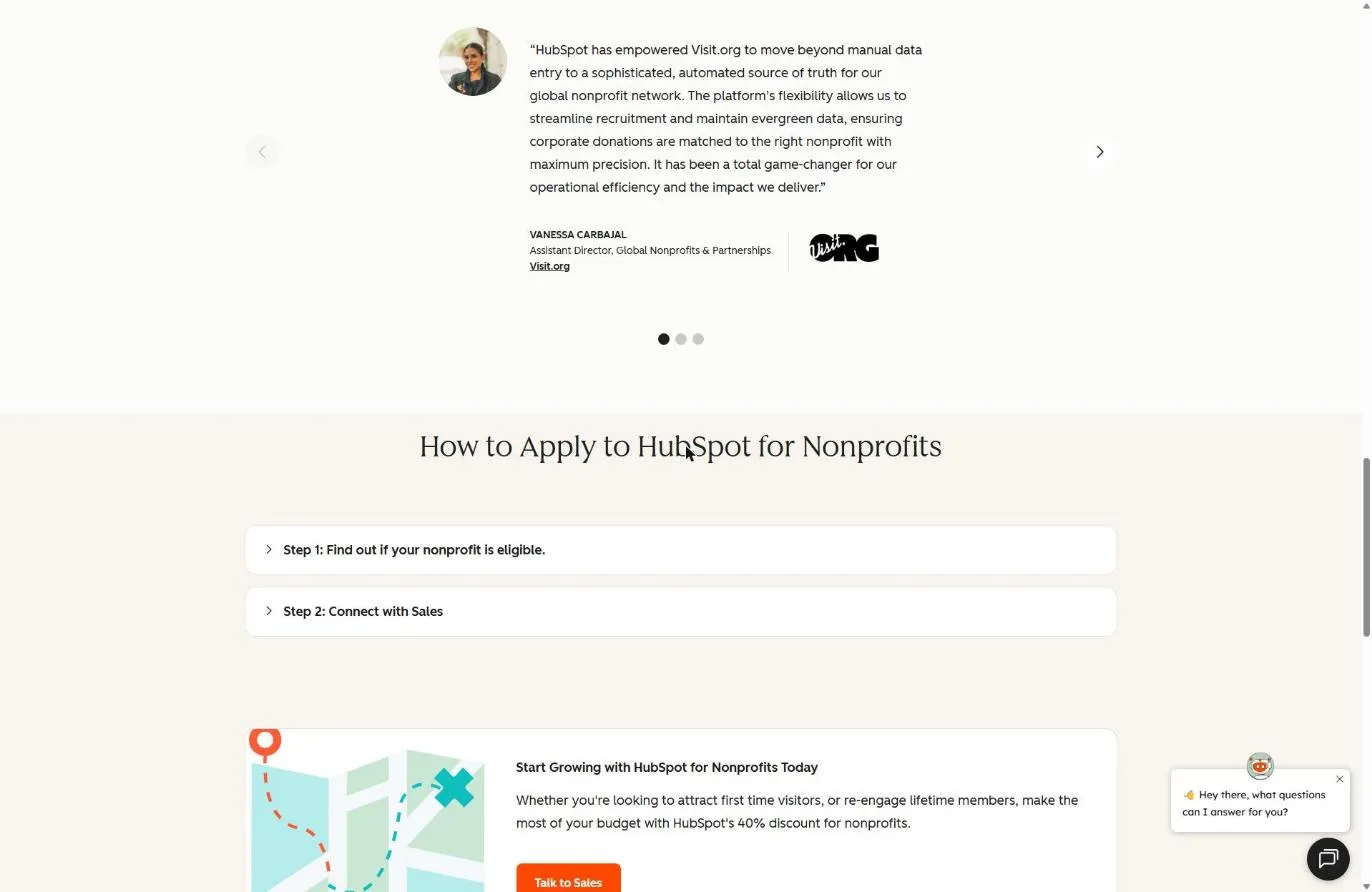
You apply for HubSpot for Nonprofits by talking to HubSpot’s sales team, not by filling out a self-serve form. HubSpot’s “How to Apply” section has two steps: check eligibility, then “Connect with Sales.” Here is how I’d run it for a church.
Step 1: Start on the free tools first
Sign up for HubSpot’s free tools with a church-owned email address, like office@ your church’s domain. The free Marketing Hub tier is $0 for up to two users with no credit card (HubSpot pricing, November 2026). Use it for a month. If you never hit a wall, you just saved yourself a sales cycle.
One caution: HubSpot’s apply section says to “Be a new HubSpot customer” and doesn’t define the term. If you already know you’ll want Professional, ask sales whether a free account affects eligibility before you sign up.
Snag: don’t let a staff member set it up under a personal Gmail. The account that owns the portal owns your contact data.
Step 2: Write down the job HubSpot has to do
Before the sales call, write one paragraph on what Professional will do that your current tools don’t. “Automated follow-up for first-time guests across email, with reporting on who came back” is a real job. “Better marketing” is not, and a good rep will sell you features against it anyway.
Step 3: Confirm eligibility on HubSpot’s criteria page
Read hubspot.com/nonprofit-eligibility-criteria start to finish, including the nondiscrimination clause. Confirm your church is in the US, Canada, Australia or New Zealand and that you’re applying as the church, not a school or clinic.
Step 4: Gather your proof
Put your IRS determination letter, or your group exemption documents plus your church’s own EIN, into one folder as PDFs. Write down the church’s exact legal name as it appears on those documents. HubSpot doesn’t publish a document list, so have both ready.
Step 5: Click Talk to Sales and ask five questions
From hubspot.com/nonprofits, select Talk to Sales. HubSpot does not publish what happens after that click or how long approval takes, so get answers on the call. HubSpot also asks you to note the “HubSpot for Nonprofits Program” in the form so the right team picks it up.
- Does our church qualify, given the nondiscrimination clause and our statement of faith?
- What documents do you need from a church without its own determination letter?
- Does the 40% apply to the onboarding fee and to extra seats?
- What is the renewal price after year one?
- Does our free HubSpot account count against the “new customer” rule?
Get the answers in writing, in the quote.
Step 6: Sign only after the discount shows on the quote
The nonprofit price cannot be applied to “existing products or subscriptions,” so don’t buy any paid tier while you wait. Sign when the quote shows the 40% on the Professional or Enterprise line and the term is the one-year minimum you agreed to.
What if HubSpot rejects your church?
If HubSpot says no, find out which rule the rep applied, because each has a different fix. HubSpot publishes no appeal process, so these come from its eligibility page and terms (November 5, 2026).
| Why HubSpot said no | What it usually means for a church | The fix |
|---|---|---|
| Couldn't confirm legal status | No determination letter, or the legal name doesn't match your documents | Send group exemption documents with your own EIN, or file Form 1023; match the legal name exactly |
| Existing subscription | Someone already bought a paid tier at list price | The discount applies to new purchases only; ask sales how it handles the next renewal or a new product |
| Wrong tier | You asked for Starter | Starter is excluded; use Free, or buy Starter at list |
| Ineligible organization type | You applied as a Bible college, seminary or clinic | Apply as the church itself |
| Outside the four countries | Church based outside the US, Canada, Australia or New Zealand | No program path; use the free tools |
| Mission review under the nondiscrimination clause | HubSpot read your mission or activities as promoting opposition toward a protected group | Ask the rep which language triggered it; if HubSpot holds firm, use the free tools or another platform |
Source: HubSpot nonprofit eligibility criteria, checked November 5, 2026.
Is HubSpot worth it for a church?
HubSpot Professional is worth it for very few churches, even at 40% off. HubSpot is a marketing and sales platform built for organizations that run campaigns, score leads and track pipelines. A church’s core records (members, attendance, groups, giving statements) live in a church management system, and HubSpot doesn’t replace that.
The church that might justify Professional looks like this: several thousand people in its database, a full-time communications staff that will build and maintain automated email sequences, and someone who will read the reports every week. If that isn’t you, the onboarding fee alone buys a lot of ministry.
For everyone else, here is how I’d stack it:
- HubSpot’s free tools if you want a simple contact database and basic forms for up to two users at $0.
- A church management system for member records and giving. Our guide to church management software covers what to look for, and free church software lists tools that cost nothing.
- A dedicated email tool for newsletters. Mailchimp gives nonprofits 15% off; see the Mailchimp for Nonprofits guide and our post on email marketing for churches.
If you’re weighing big-platform CRMs, Salesforce is the other name you’ll hear. Its Power of Us program gives 10 free Nonprofit Cloud licenses, and the Salesforce for Nonprofits guide explains why free licenses are not a free system. The full list of nonprofit software discounts for churches shows which programs accept churches.
Frequently Asked Questions
Free Church Marketing Review for Your Church
A CRM can't fix a website nobody finds. Before you spend on marketing software, we'll look at your website, your local search presence, and how your church shows up when people nearby go looking. You get a straight assessment and clear next steps, whether or not you ever become a client.
Related Guides
- Nonprofit Software Discounts for Churches: every program, and whether it accepts churches.
- How to Prove Your Church Is a Nonprofit: the documents behind every application on this list.
- Salesforce for Nonprofits: 10 free licenses, and what they really cost to run.
- Mailchimp for Nonprofits: the 15% discount and how to request it before you buy.
- Nonprofit Discounts on Email and Social Media Tools: Mailchimp, Constant Contact, Hootsuite, Buffer and more.
- What Is Goodstack?: the verifier behind Google, Canva and other programs.
- TechSoup for Churches: the other big validator, with stricter church rules.